All dishes / South Asia
Rasgulla Period BOrigin theory BVerified
Some fields (dish name, region and gates) are shown from the Japanese-edition data.
Offered to a goddess at the Jagannath Temple since the twelfth century—so the story goes, yet rasgulla is missing from the temple's earliest roll of offerings. Its firm trail opens in nineteenth-century Bengal.
Verification highlight popular claim → verdict → evidence
Popular claim: rasgulla has been offered as bhog at Puri's Jagannath temple for centuries, predating any Bengali claim. Verdict: unsubstantiated -- historians Haripada Bhowmik and Animikh Roy note rasgulla is absent from the temple's earliest fifty-six-dish offering lists, and curdled milk (chena) was long considered spoiled and unfit as an offering. The now-standard spongy version is instead documented as the 1868 creation of Kolkata confectioner Nobin Chandra Das, with an even earlier 1866 sale by Braja Moira also recorded. Key sources: K.T. Achaya, Indian Food (1994); Pranab Ray, Banglar Khabar (1987).
The three gates
- Ingredient-supply gate
- Milk and sugar were both locally available; the limiting factor was the development of using acid-curdled milk (chena) as a confection.
- Cooking-technique gate
- Milk is curdled with acid, shaped into balls, and simmered in sugar syrup.
- Venue gate
- Rooted in the confectioner (moira) culture of Bengal, later spreading to urban sweet shops.
Overview
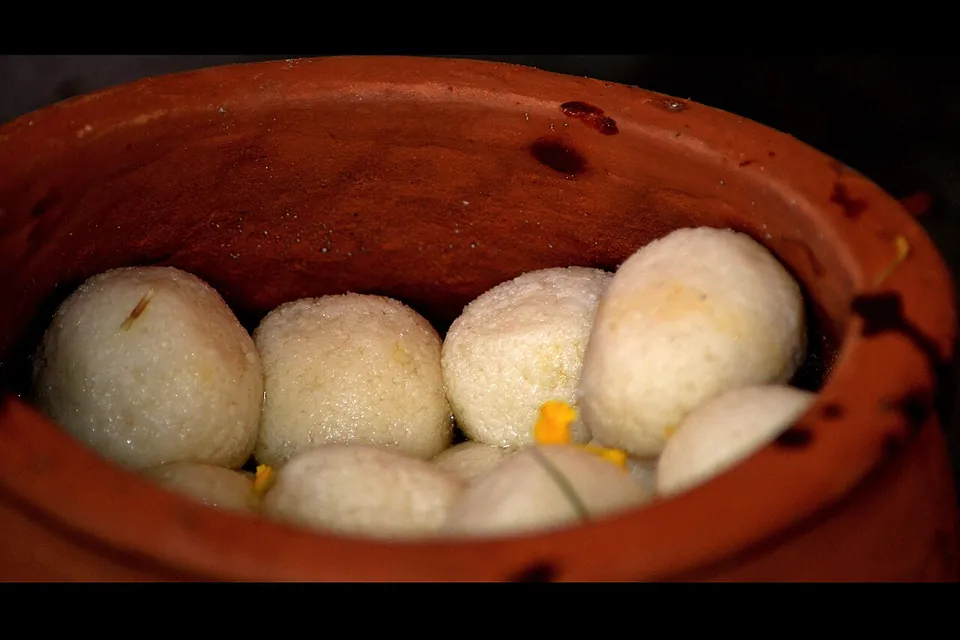
Rasgulla is a sweet of eastern India's Bengal region: chhena, milk curdled with acid, rolled into balls and simmered soft in sugar syrup. Known for its springy, spongy bite, it took shape in early modern to modern times, broadly the nineteenth century.
Milk and sugar were both long at hand in Indian kitchens, and so was the gesture of breaking milk with acid and lifting out the white curd, which was written down early. Rasgulla arrived at its present form when that curd was made the centerpiece of a confection—rolled into balls and floated in hot sugar syrup.
The sweet was raised by the Bengali confectioners known as moira. The steps are plain—curdle, roll, simmer in syrup—and in the artisans' hands they were refined, then carried to the counters of the sweet shops that opened in the growing cities. Craft and urban trade together lifted rasgulla from a regional specialty to a widely known sweet.
That the present springy form was worked out in Bengal is treated in food history as a broadly settled view. Which region deserves the credit, on the other hand, is still unsettled.
How we know
Rasgulla is claimed by two regions, each asserting itself as the birthplace. One is the West Bengal account. The Kolkata confectioner Nobin Chandra Das of Bagbazar is said to have devised the present spongy rasgulla in 1868, and in 2017 "Banglar Rosogolla" received a Geographical Indication tag for the traits of its variety. The other is the Odisha account, in which the sweet was born in Puri as khira mohana, developed into Pahala rasgulla, and was offered from early times to the goddess Lakshmi at the Jagannath Temple; here "Odisha Rasagola" received its GI tag in 2019.
What unsettles the claim of great age attached to the Odisha account—that the sweet was offered at the temple from the twelfth century—is the temple's own record. The historians Haripada Bhowmik and Animikh Roy point out that rasgulla is not among the temple's early list of offerings, the chhappan bhog, the fifty-six offerings. Chhena, broken with acid, was moreover taken for spoiled milk, and setting it before a deity would have been sacrilege. Even the fifteenth-century mention of rasagola in the Jagamohana Ramayana, held up as proof of age, is suspected of being a later interpolation in the manuscript; and a name surfacing in a text is a separate matter from whether a chhena sweet of the present kind existed at the time.
A second line of argument, drawn from the age of the ingredient, has often been pressed into this dispute: cheese and chhena were unknown in India before contact with the Portuguese in the seventeenth century, so no chhena sweet could have reached a twelfth-century temple. The food historian K. T. Achaya, usually cited for this, writes something narrower. He describes the twelfth-century Manasollasa as giving directions for boiling milk, adding a souring agent and separating out the precipitate—"what is today called chhena". What Achaya proposes is that the Portuguese, who routinely broke milk with acid to make cottage cheese, may have lifted the Aryan taboo on deliberately curdling milk, and so handed the confectioners of Bengal a new material. That is a suggestion about when chhena sweets spread, not a claim that acid curdling was unknown before. What casts doubt on the twelfth-century temple origin is not the age of the ingredient but the temple's own record of what was offered.
The Bengal account, for its part, is not of one piece either. The common claim that Das was the inventor of 1868 runs up against an earlier record. Pranab Ray's Banglar Khabar (1987) reports that Braja Moira was already selling rasgulla two years before Das, in 1866, at a shop near the Calcutta High Court. The food historian Michael Krondl too holds that, whatever its origin, rasgulla most likely predates Das. No contemporary document from the founding years of the 1860s has yet surfaced, and who the first maker was still wavers within Bengal itself.
What is firm is the line that rasgulla as the present chhena sweet took shape in nineteenth-century Bengal. Who established the present springy form, and as which region's specialty it took root, are questions carried into the present alongside the two GI tags.
The full set of origin theories and the detailed verification log — traceable all the way to their sources — are available on the Japanese edition.
See the full origin theories and verification log (Japanese) →