All dishes / Western Europe
Pastel de nata Period BOrigin theory BVerified
Some fields (dish name, region and gates) are shown from the Japanese-edition data.
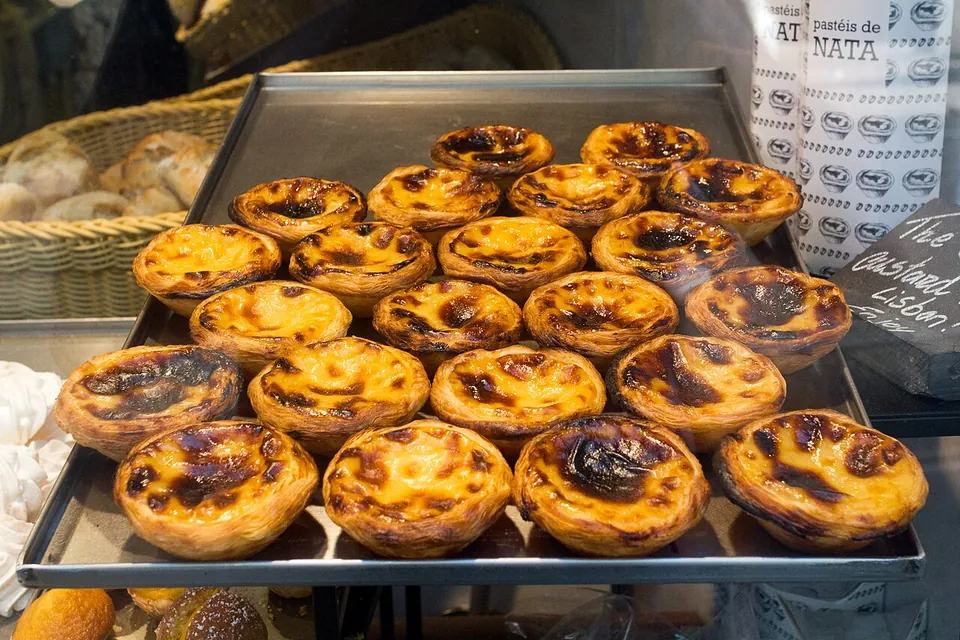
A Portuguese custard tart: egg-yolk filling, blistered on top, poured into layered pastry and baked at high heat. That it was born in a monastery has long been told, but the oldest record that has carried that lineage has recently been suspected of being a forgery, and what can be traced with certainty begins with its commercial sale in 1837.
Verification highlight popular claim → verdict → evidence
Legend traces the tart to monks at Lisbon's Jerónimos Monastery, who used surplus egg yolks (left over from starching habits and clarifying wine) in convent sweets. The monastery link fits a real tradition of Portuguese convent confectionery, but the specific attribution comes only from the founding story of the Belém pastry shop, not an independent period source. A 1729 manuscript once cited as the earliest written recipe has since been challenged as a possible forgery, since the abbess and copyist it names don't match the convent's own records. The one firmly documented date is the shop's 1837 opening, after the monasteries were dissolved in 1834.
The three gates
- Ingredient-supply gate
- Eggs and wheat were locally available; what mattered was affordable sugar reaching Lisbon through colonial trade.
- Cooking-technique gate
- An egg-yolk custard set inside layered puff pastry and baked hot enough to caramelize the top.
- Venue gate
- Said to originate in a monastery kitchen, later commercialized at a Belém pastry shop in 1837.
Overview
Pastel de nata is a small tart: a cup of thin, layered pastry filled with an egg-yolk-forward custard and baked hot enough to scorch the surface.
The ingredients were easy to come by in Portugal. Eggs and wheat were at hand, and the sugar that sweetened the custard was by then arriving cheaply from the colonies. What remained was the baking. Filling layered pastry with egg-yolk custard and baking it fast at a temperature high enough to char the top — only with this technique does the contrast of a toasted crust against a soft, molten center emerge.
The place it was born was not a town confectioner's shop but a monastery. Portuguese monasteries of the time used large quantities of egg white for starching cloth, clarifying wine, and the liturgy, and turned the leftover yolks into sweets — a tradition known as doçaria conventual, the monastery sweets. A pastry built on egg yolk sits naturally within that lineage.
It passed beyond the monastery walls in the nineteenth century. In the wake of the Liberal Revolution of 1820 the religious orders were dissolved, and in 1834 the monasteries were closed. A confectioner left without work moved to a nearby sugar refinery and sold the recipe, and the shop that opened in 1837, the Fábrica de Pastéis de Belém, became the starting point that can be traced clearly in the written record.
How we know
Across Portugal's convents and monasteries it was common to use egg whites for starching cloth, clarifying wine and the liturgy, and to turn the leftover yolks into sweets. But the evidence long cited to place pastel de nata within that lineage, a 1729 manuscript from the Convent of Santa Clara in Évora with a recipe for 'Pastelinhos de Natta', was questioned as a possible forgery by Isabel Drumond Braga in 2024: the prioress and copyist named in it do not match the convent's admission records. A 2023 doctoral thesis by João Pedro Gomes goes further, arguing that 'monastery sweets' as a lineage is itself a story recast in modern times. Neither the authenticity of the manuscript nor the standing of the lineage has been settled.
If the lineage itself is unsteady, a finer claim stands on even shakier ground: the named origin, 'devised at the Jerónimos Monastery in Belém.' No contemporary cookbook or monastery record supporting it has so far come to light. Trace the claim back and it leads to the founding story of the Fábrica de Pastéis de Belém, the shop that opened in 1837. The shop's own official history, too, can speak with certainty only as far as the closure of the monastery in 1834 and the commercial sale of 1837; before that, no independent source tells where in the monastery it was made, or by whom.
Even the dates of the turning point have been smoothed over in the retelling. The trigger was the Liberal Revolution of 1820, but the monasteries were actually closed in 1834. The recipe, left with nowhere to go, passed to a sugar refinery and, through the shop that opened in 1837, became a local specialty. That much is settled. Who first baked it, and where, before that point is still in the midst of historians' scrutiny of the sources.
The full set of origin theories and the detailed verification log — traceable all the way to their sources — are available on the Japanese edition.
See the full origin theories and verification log (Japanese) →