All dishes / North America
Crab cake Period BOrigin theory CVerified
Some fields (dish name, region and gates) are shown from the Japanese-edition data.
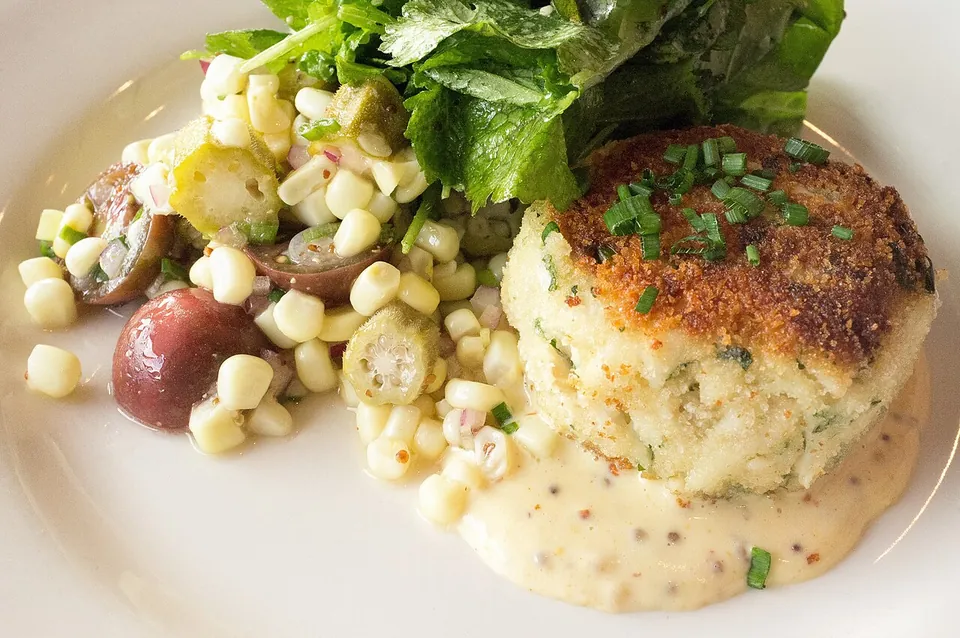
Maryland's crab cake is a regional dish of picked blue-crab meat from Chesapeake Bay, bound with breadcrumbs or crackers and shaped into a patty. The earliest printed recipe to carry the name 'crab cake' dates from 1891, nearly half a century ahead of the 1939 book long taken to be the first record.
Verification highlight popular claim → verdict → evidence
Myth: Crosby Gaige is often credited with inventing/naming the Baltimore/Maryland crab cake in his 1939 cookbook. Verdict: refuted -- Thomas J. Murrey's 1891 recipe in Cookery with a Chafing Dish predates Gaige by 48 years; Gaige's contribution was popularization, not invention. Main sources: Murrey, Cookery with a Chafing Dish (1891); Maryland's Way: The Hammond-Harwood House Cook Book (1963).
The three gates
- Ingredient-supply gate
- The blue crab at the heart of the dish is native to the Chesapeake Bay, and Indigenous peoples were eating it long before Europeans reached the coast. It came out of the bay itself, so the supply of the main ingredient sets no earliest date for the dish.
- Cooking-technique gate
- What defines the dish is the handwork: picking the meat out of the crab, then binding and shaping it with breadcrumbs or crackers. European settlers worked out that method, and it appears in print in the 19th century. Refrigerated rail in the 1930s carried crab cakes across the country, but the dish had already taken shape around the bay.
- Venue gate
- Home kitchens and local cooking in the coastal towns around the bay: everyday fare of ordinary households, eaten by anyone living there.
Overview
A crab cake is picked blue-crab meat, bound with breadcrumbs or crackers, shaped into small cakes and cooked on both sides in a pan. It is a regional dish handed down in home kitchens around Chesapeake Bay, above all in Maryland.
The blue crab has lived in Chesapeake Bay since long ago, and the Powhatan and other Native peoples were eating it well before Europeans arrived. It was an old food of the place, part of life along the bay from early on.
In time, European settlers on the bay began picking the meat carefully from the shell, binding it with breadcrumbs or crackers and gathering it into cakes. Over the nineteenth century this way of making it was written into cookbooks, and in 1891 a recipe appeared in print under the name 'crab cakes.' In the twentieth century, once the crab could be carried inland by refrigerated rail in the 1930s, this home dish of the bay spread across the United States.
How it settled into a regional dish over the nineteenth and twentieth centuries can be followed in print. Who first put it into this form, and when, is not known.
How we know
The crab cake carries a small mix-up about when it first appeared in print—not some grand tale invented after the fact, but a popular belief that misread the dates, corrected against the record.
In 1939, Crosby Gaige's New York World's Fair Cook Book printed a Baltimore-style crab cake, and for a long time this was said to be the first record of the name 'crab cake.'
Yet there is a record nearly half a century earlier. Thomas J. Murrey's Cookery with a Chafing Dish, published in 1891, gives under the heading 'Crab Cakes' a method of boiling hard-shell crab meat and binding it with egg yolk into little cakes: 'The meat from the hard shell crabs, after boiling, may be made into little cakes, held together with the yolk of an egg.' The cakes are cooked on both sides in a chafing dish, a pan heated at the table, and the passage can still be read in the full text on the Internet Archive. Gaige's book came forty-eight years later; it neither named nor invented the dish, but helped spread it.
Moving the date of the first record does not settle how the dish itself came about, and two views stand side by side. One sees a continuous line: Native peoples ate the bay's blue crab from long ago, and settlers went on to pick the meat, bind it and shape it into cakes. Maryland's Way (published 1963), compiled from eighteenth- and nineteenth-century Maryland manuscripts and old cookbooks, records five crab-cake recipes reaching back to the early nineteenth century, and this view draws on it. The other holds that the present form, as a dish bearing the name 'crab cake,' took shape in late-nineteenth-century Maryland and should be set apart from older crab-meat dishes; it rests on Murrey's record of 1891. The question has not been settled in favor of either.
A story also circulates that the words crab cakes appeared in the Harrisburg Telegraph in 1873. But the paper's run can be confirmed in library catalogues only from 1879 onward, and the 1873 page itself has not been found. Among printed records that carry the dish's name, Murrey in 1891 is, for now, the earliest.
The full set of origin theories and the detailed verification log — traceable all the way to their sources — are available on the Japanese edition.
See the full origin theories and verification log (Japanese) →