All dishes / North America
Macaroni and cheese Period BOrigin theory CVerified
Some fields (dish name, region and gates) are shown from the Japanese-edition data.
An American comfort-food icon. A well-worn story credits President Thomas Jefferson with inventing it, but the foundation that runs his estate at Monticello rejects that tale, and dishes that pair macaroni with cheese reach back to medieval European manuscripts.
Verification highlight popular claim → verdict → evidence
It is often said that Thomas Jefferson, or his enslaved cook James Hemings, invented macaroni and cheese or first brought it to America. The Jefferson foundation at Monticello says otherwise: baked pasta with cheese was already common in France before Jefferson arrived there in 1784, and Hemings learned it during his training in Paris. Dishes pairing pasta with cheese go back to the fourteenth-century Neapolitan Liber de coquina and to the makerouns of the English Forme of Cury (1390). The macaroni recipe Elizabeth Raffald published in 1769 simmers boiled macaroni in cream with butter rolled in flour, then covers it with Parmesan and browns it; it is neither a béchamel dish nor one baked in the oven. The 1802 record cited by the Monticello encyclopedia is Manasseh Cutler's diary note of "a pie called macaroni" at a dinner in the presidential residence. To Cutler it looked like "a rich crust" filled with onion or shallot, but a man named Lewis at the same table told him there was no onion in it, and the diary says nothing of cheese, so whether the pie was the cheese dish known today cannot be established. The first recipe published in the United States is in Mary Randolph's The Virginia House-Wife (1824); in the 1830 edition, macaroni, cheese and butter are layered and baked in a hot oven. Jefferson's handwritten macaroni recipe, which bears no date, survives at the Library of Congress; it was most likely taken down from one of the cooks he enslaved, and the Monticello foundation names Hemings and Edith Hern Fossett as examples. What Hemings did was cook the dish, serve it and spread it, not invent it. The Kraft box came in 1937, long after.
The three gates
- Ingredient-supply gate
- Macaroni of hard wheat and cheese are both Old World foods, carried to America in the eighteenth century; a steady supply within the country is what sets the earliest possible date.
- Cooking-technique gate
- Boiling dried pasta, then layering it with cheese and butter and baking it in the oven (the form of Mary Randolph's recipe).
- Venue gate
- Home cooking and comfort food, settled into American kitchens as a dish out of the South. The Kraft box of 1937 belongs to how the dish spread rather than to how it came about.
Overview
From medieval Europe to the American table
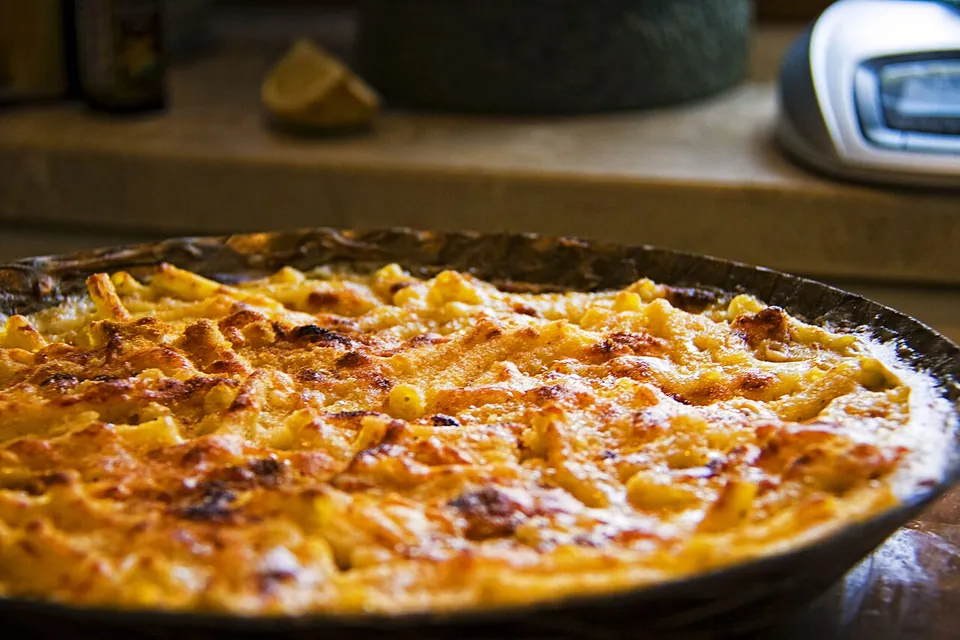
Macaroni and cheese is boiled macaroni bound in a cheese sauce and baked, and it is one of the defining dishes of the American home kitchen. Easy, warm, and filling, it spread out of Southern households across the country and settled in as everyday comfort food.
Pasta and cheese met in Europe before they met in America. A fourteenth-century Neapolitan manuscript, the Liber de coquina, describes a dish that uses cheese with pasta, and in the same century an English cookbook, The Forme of Cury (1390, compiled by the cooks of Richard II), records it under the name makerouns. In eighteenth-century England, Elizabeth Raffald included a macaroni dish made with Parmesan in her 1769 cookbook The Experienced English Housekeeper. The boiled macaroni goes into a pan with cream and a piece of butter rolled in flour, and simmers for about five minutes. It is then turned out onto a dish, covered all over with Parmesan and browned, and, because it cools quickly, sent to the table on a dish kept warm with hot water. It did not go into the oven, and the cheese sat on top rather than melting into a sauce. Some see American macaroni and cheese as carrying on this English line of pasta with cheese; others hold that it took shape as a dish in its own right on the American table, and where its origin should be placed remains unsettled.
Both macaroni and cheese came from the Old World, carried to America through eighteenth-century colonial trade until they were always to hand. In 1802 a macaroni dish was served as a novelty at a dinner in the presidential residence, and in 1824 an American cookbook became the first to print a recipe for macaroni and cheese. Between the late eighteenth and early nineteenth centuries, the dish became a fixture of American home cooking. The boxed Kraft product launched in 1937 carried a dish that was already being made at home further across the country; it was not where the dish began.
How we know
"Thomas Jefferson invented macaroni and cheese"—or, in another version, "his enslaved cook James Hemings was the first to bring it to America." A founding-era hero's tale clings to this humble dish. Yet the foundation that runs Jefferson's estate at Monticello rejects the story itself.
According to Monticello's own encyclopedia, a dish of pasta baked with cheese was already widely eaten in France before Jefferson set sail for the country in 1784. Hemings learned the method during his training in Paris; he did not conjure it out of nothing, nor carry an unknown dish to the New World. What he did was not invention but the cooking, serving, and popularizing of the dish in America.
Jefferson's handwritten macaroni recipe (undated, held by the Library of Congress), sometimes offered as proof of invention, does not show him to be its author either. It was most likely dictated to him by one of the enslaved cooks in his household (the foundation names James Hemings and Edith Hern Fossett as examples), and a hand on the page is not the same as a mind behind the dish.
The 1802 record that the same encyclopedia cites does not map neatly onto today's cheese dish. On February 6 of that year, Manasseh Cutler, who was at dinner in the presidential residence, wrote in his diary of "a pie called macaroni." To Cutler it looked like "a rich crust" filled with strips of onion or shallot. But a man named Lewis, who was at the same table, told him then and there that there were no onions in it: it was an Italian dish, and what looked like onions was made of flour and butter. The diary says nothing of cheese, and whether this pie was the same thing as the cheese dish we picture today cannot be established.
The first recipe for the dish published in the United States appears in Mary Randolph's The Virginia House-Wife, which came out in 1824. In the 1830 edition, the method is to boil macaroni in milk and water, lay it in a dish, add layers of cheese and butter, and bake it in a hot oven; no sauce is made. Only macaroni, cheese, and butter are layered in the dish. The macaroni that had reached the President's table as a novelty had, some twenty years on, become something whose method could be found in a cookbook for the home.
The full set of origin theories and the detailed verification log — traceable all the way to their sources — are available on the Japanese edition.
See the full origin theories and verification log (Japanese) →