All dishes / Western Europe
Sachertorte Period BOrigin theory BVerified
Some fields (dish name, region and gates) are shown from the Japanese-edition data.
The famous origin story—that a 15- or 16-year-old court apprentice baked the first one in 1832—has no contemporary record behind it. The tale was spread half a century later by a son trying to promote the family name.
Verification highlight popular claim → verdict → evidence
Points remain open on how the lawsuit between Sacher and Demel unfolded and on how the original recipes differ (such as where the jam layer sits).
The three gates
- Ingredient-supply gate
- Cocoa (chocolate) is a New World crop, so its adoption in European confectionery sets the earliest possible date for this dish. Wheat, sugar, and eggs were local ingredients.
- Cooking-technique gate
- Pastry-making technique for a chocolate sponge, plus a chocolate glaze coating and a layer of apricot jam.
- Venue gate
- The kitchen of the noblemen's casino (a social club) in Pressburg (now Bratislava). The cake was served to the great nobles gathered there for sessions of the Hungarian Diet, who liked it so much that it was served every day (Franz Sacher's own account, 1906). It went on to become a signature cake at his son Eduard's Hotel Sacher and in Vienna's café culture.
Overview
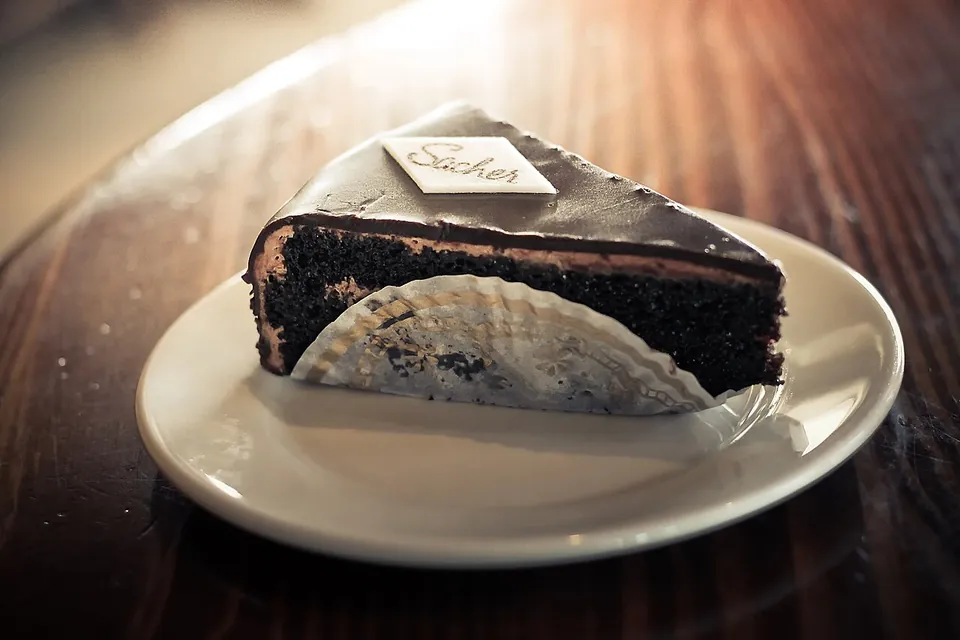
Sachertorte is a Viennese cake: a chocolate sponge layered with apricot jam and coated in a smooth chocolate glaze. Its defining ingredient is cacao. The bean had crossed from the New World to Europe, and the nobility were drinking it as chocolate in Vienna by the late 17th century, and in Hungary by the mid-18th century at the latest, so the ground for baking with it had long been prepared. Flour, sugar, and eggs were ingredients Central European kitchens had always worked with.
The person who turned this cake into a Viennese icon was the second generation of the Sacher family. Franz Sacher's son Eduard founded the Hotel Sacher in 1876 and made the chocolate cake the hotel's signature. Within the coffee-house culture of Vienna, the Sachertorte became a dish that stood for the city itself.
The glossy form we eat today, however, is not the cake of the mid-19th century, when it was created. The smooth, gleaming chocolate that coats the surface only became possible after Rodolphe Lindt devised conching—the process of working chocolate for hours until it turns silky—in 1879. The shiny-glazed version we know was refined not in Franz's day but in the generation of Eduard, who had learned his craft at Demel, a confectioner's shop in Vienna.
How we know
Two houses fought over which was the true home of the Sachertorte: the Hotel Sacher and the old confectioner Demel. Their rivalry, a century-long affair known as the "cake war," was taken to court as well, and was settled in 1963. The name "Original Sacher-Torte" went to the Hotel Sacher, while on the number of sponge layers Demel's form was accepted. Yet both houses' recipes, traced back far enough, lead to the Sacher family.
What was not settled was the story that comes before it. The widely repeated account holds that in 1832, at the court of Chancellor Metternich, a 15- or 16-year-old apprentice named Franz Sacher invented the cake. But no contemporary record supports this. The tale traces back to promotional remarks made by Franz's son Eduard in 1888. And Franz himself, in a newspaper profile published in 1906, told a quite different story. After his marriage in 1840, he said, he was engaged as head cook of the noblemen's casino, a social club, in Pressburg (present-day Bratislava) for the sessions of the Diet. It was around then that he came up with a chocolate torte, which the great nobles gathered for the Diet liked so much that it had to be served every day. The article gives no year for the invention, but Pressburg was the capital of Hungary until 1848, and the story is told as belonging to those years. This, too, is the recollection of a man of ninety, not a contemporary record. The food historian Michael Krondl, in his book Sweet Invention (2011), framed the matter as a choice between the memory of an old man and the promotion of a publicity-minded son.
The historical encyclopedia published by the city of Vienna likewise calls the 1832 court story a tale "often and gladly retold," and judges it more likely that Sacher created the cake in Hungary in the 1840s. The house is Sacher, beyond dispute, and Franz invented the cake. But the glamorous origin story—a 15- or 16-year-old apprentice creating it at court—bears the strong marks of an invented tradition, shaped in the course of promoting a brand.
The losing party, Demel, did not vanish either. During the economic crisis of the 1930s, Eduard's son of the same name, Eduard Sacher Jr., Franz's grandson, sold the recipe to Demel, and in 1934 the firm began selling it as the "Eduard Sacher-Torte." Its form, with a single layer of apricot jam placed just beneath the surface, was not struck down in the 1963 settlement. The name "Original" went to the Hotel, but Demel still sells its own Sachertorte, alongside the Hotel's, in Vienna.
The full set of origin theories and the detailed verification log — traceable all the way to their sources — are available on the Japanese edition.
See the full origin theories and verification log (Japanese) →