All dishes / Latin America
Mole poblano Period BOrigin theory CVerified
Some fields (dish name, region and gates) are shown from the Japanese-edition data.
Mexico's festive mole poblano is famous for its birth story: a nun in Puebla, flustered by an archbishop's sudden visit, improvised it on the spot. But this convent-origin tale lacks support in the historical record; it is a tradition invented in later times.
Verification highlight popular claim → verdict → evidence
The popular legend that a nun at Puebla's Santa Rosa convent improvised the dish for a visiting archbishop has no support in the historical record; it is a tradition invented in later times, and the documentary trail for mole poblano before the 19th century is very thin. The dish appears in writing as the clemole of a 1791 manuscript recipe collection and, in print, in El Cocinero Mexicano and Novísimo Arte de Cocina (both 1831), whose mole poblano contains no chocolate; the chocolate in today's version came later. Mole poblano is thought to have taken shape gradually during the colonial period, with no single inventor, as Indigenous chili sauces (mōlli, described by Sahagún in the 16th century) came together with the Old World spices and the bread-and-nut thickening techniques brought after the 1521 conquest. Which of the two formed the foundation is disputed. The food historian Rachel Laudan (2007) sees thickening with bread, nuts, and spices as the principal technique and the rehydrated, ground chiles as a secondary element, and judges that mole quite likely has Mediterranean origins; a view in Mexico holds instead that an Indigenous dish reached its finished form in the colonial period.
The three gates
- Ingredient-supply gate
- Chili pepper, cacao, and turkey are indigenous; the Old World spices essential to the composite dish -- cinnamon, pepper, almonds, sesame, and the like -- arrived only after the conquest (1521 onward), so the dish's earliest possible date falls after that.
- Cooking-technique gate
- Rehydrating dried chilies and grinding them on a metate into a thick sauce, then long simmering.
- Venue gate
- Convent kitchens; religious/semi-privileged stratum; festive and ceremonial occasions.
Overview
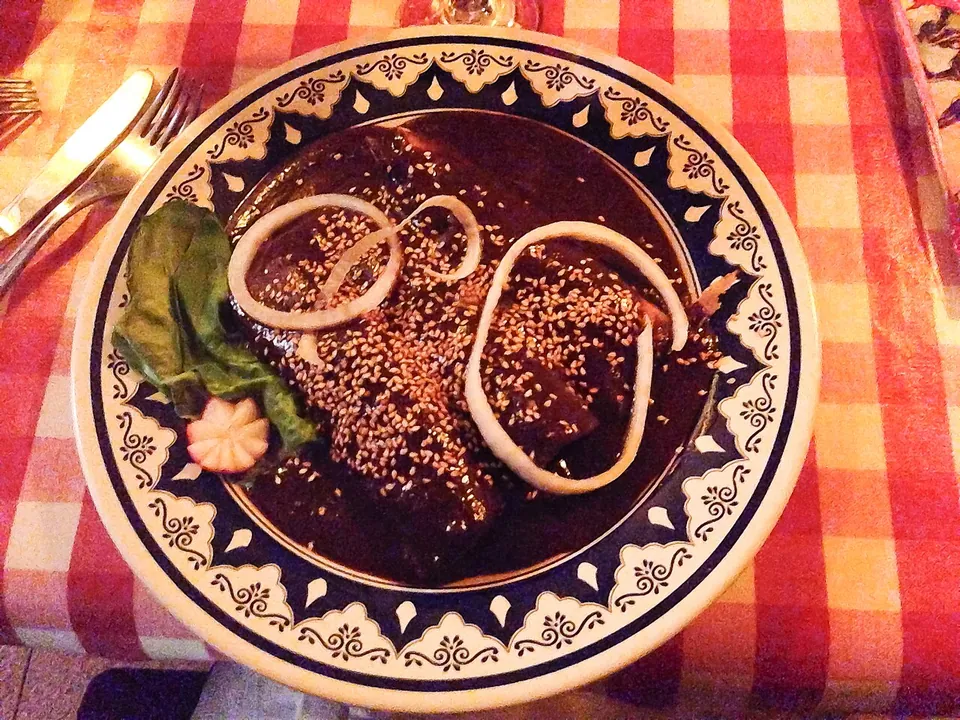
Mole poblano is a festive dish of Puebla, a city in central Mexico. Turkey is served under a generous helping of thick sauce (mole) ground together from chiles and spices. The dish is thought to have taken shape in the Spanish colonial period, in the 17th and 18th centuries.
The turkey at its center is a fowl long established in Mesoamerica, and chiles and cacao, too, were local crops on the table from early times. The technique of soaking dried chiles in water and grinding them on a grinding stone (metate) into a thick sauce also belonged to Indigenous kitchens. The records left by the Spanish friar Sahagún in the 16th century describe Indigenous people eating sauces of ground chiles and seeds. In Nahuatl, the Indigenous language, such sauces were called mōlli.
After the Spanish conquest in 1521, Old World spices and nuts such as cinnamon, pepper, cloves, cumin, sesame, and almonds reached the region by way of Spain. With them came a way of cooking that thickened and flavored sauces by grinding in bread or nuts. During the colonial period, the technique of grinding chiles into a sauce and the technique of thickening with spices, bread, and nuts came together in a single pot. Rehydrating and grinding the chiles and then simmering for hours made this a laborious dish, and the convent kitchens and festive tables of Puebla were among the places where its flavor was nurtured.
Which of the two techniques formed the foundation, however, is a matter on which views differ. In a 2007 essay, the food historian Rachel Laudan points out that thickening and flavoring with bread, nuts, and spices was widespread in the medieval Islamic world and in Europe. She takes this to be mole's principal technique, and the rehydrating and grinding of dried chiles to be a secondary element added in Mexico; in her view, mole quite likely has Mediterranean origins. In Mexico, on the other hand, there is a view that an Indigenous dish reached its finished form in the colonial period. A book published by a university press in Puebla in 2017 puts that idea in its very title: El mole poblano, platillo prehispánico logra su inmortalidad en el siglo XVII ("Mole poblano: a pre-Hispanic dish achieves immortality in the 17th century").
How we know
Puebla has a famous story about how this dish was born. A nun of the Santa Rosa convent, thrown into a panic by the sudden visit of an archbishop (a viceroy, in some tellings), ground together whatever was in the kitchen and improvised a sauce. Sometimes the tale even comes with a name and a date: Sor Andrea made it around 1680.
But the story has no support in the historical record. The food historian Laudan has pointed out that the convent tradition has no documentary basis. The culinary-history materials published by the library of the University of Texas at San Antonio likewise note that mole poblano's documentary trail before the 19th century is very thin. An anecdote this detailed, complete with the nun's name and the year of the visit, is a tradition invented and polished in later times.
The documents that do survive tell a different story. Sahagún's 16th-century records tell of Indigenous people eating sauces of ground chiles and seeds. Sauces containing cinnamon and cloves appear in writing much later. The clemole in the Recetario Novohispano, a manuscript recipe collection of 1791, combines chiles with sesame, coriander, cumin, garlic, cloves, pepper, cinnamon, and ginger. Among printed cookbooks, El Cocinero Mexicano and Novísimo Arte de Cocina, both from 1831, include mole poblano. The year a dish first appears in writing is not the year it was born, but it does mean that sauces of this kind were in kitchens by the end of the 18th century at the latest.
The mole poblano of 1831 contains no chocolate. Today's mole poblano is known for the chocolate melted into it, but chocolate was added at a still later date.
In place of a nun's improvisation in a single night, what comes into view is a much longer stretch of time. Mole poblano took shape as the Indigenous technique of grinding chiles into a sauce and the technique of thickening with Old World spices, bread, and nuts were combined across the colonial period. As to which of the two was the foundation, Laudan's view, which sees the Mediterranean technique as primary, still stands alongside the Mexican view that an Indigenous dish reached its finished form in the colonial period.
The full set of origin theories and the detailed verification log — traceable all the way to their sources — are available on the Japanese edition.
See the full origin theories and verification log (Japanese) →