All dishes / Middle East & North Africa
Harees Period BOrigin theory BVerified
Some fields (dish name, region and gates) are shown from the Japanese-edition data.
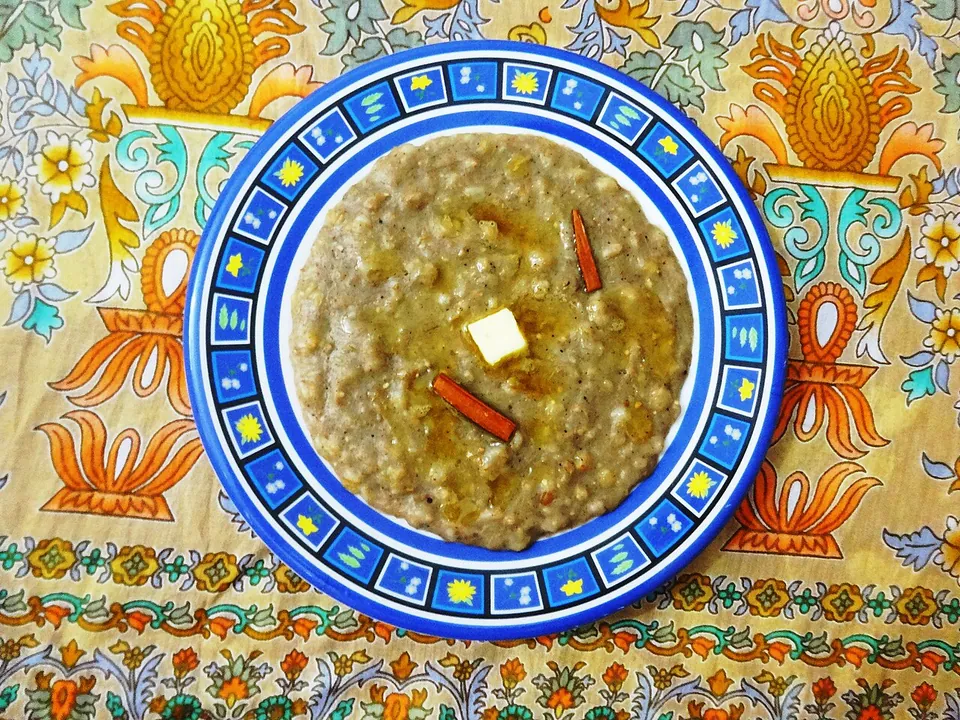
Harees is a porridge of wheat and meat pounded together, cooked in great pots on the Gulf coast of the Arabian Peninsula for Ramadan and for feasts. In Armenia a story is told that a fourth-century saint made the same kind of porridge and gave it its name, but the story has no support beyond the legend itself, and the dish's name is explained by the way the wheat is pounded.
Verification highlight popular claim → verdict → evidence
Armenian legend credits Saint Gregory the Illuminator, in the 4th century, with both inventing this wheat-and-meat porridge and naming it: boiling a sheep for the poor and running short, he is said to have thrown in wheat and shouted "harekh" (stir it), giving the dish its name. The story has no support beyond the legend itself. The name is explained without the shout: a 10th-century Baghdad cookbook by Ibn Sayyar al-Warraq already gives several recipes for harisa, and its English translator explains the word as meaning crushed and pounded, matching the technique of beating wheat into porridge. Attaching a saint's name to a festive dish after the fact is a recurring pattern elsewhere, and the claim that one saint invented and named this dish is rejected. That does not take away from the dish's long history in Armenia as a charitable, festive food; whether Armenian harissa came from the Arab and Persian harisa or arose separately there remains unsettled.
The three gates
- Ingredient-supply gate
- Both wheat and lamb are Old World natives; the limiting factor was access to cracked wheat.
- Cooking-technique gate
- Wheat and meat are simmered for a long time and pounded into a porridge-like consistency.
- Venue gate
- Served at Ramadan and festive gatherings; a Gulf home-cooked dish.
Overview
What the dish is
Harees is cracked wheat and lamb or chicken cooked together in one pot for a long time, then pounded and worked into a thick porridge. It has been handed down on the Gulf coast of the Arabian Peninsula, in Bahrain and Kuwait. It is cooked at home, and when the Ramadan fast is broken or on feast days it is made by the potful to feed the many who gather.
Wheat and lamb, the two at the heart of the dish, have long been on people's tables. The pot stays on the fire for hours and the pounding goes on, until the meat comes apart into threads and merges with the grain into one smooth, sticky mass. The name, harīsa, is a word that the English translator of a tenth-century cookbook explains as meaning crushed and pounded, and it describes this way of cooking exactly.
How we know
A dish with the same name already appears in the cookbook compiled in tenth-century Baghdad by Ibn Sayyār al-Warrāq. It gives several recipes for harīsa, in which meat and hulled, crushed wheat are cooked together in one pot. The book's English translator places harisa made with crushed wheat in the line of humble Arab cooking from before Islam, and writes that it was a popular food that could be bought at the market early in the morning. Persian-language writings from the Middle Ages also describe harisa as an everyday dish that cooks made in stalls in the bazaar, and the History of Bukhara tells of a fire that started in a harisa stall in the Bukhara bazaar. Gulf harees shares both its name and its method, wheat and meat cooked and worked into a paste, with this medieval harisa, and the most natural reading is that it was handed down from it. How the dish travelled from medieval Baghdad to the Gulf, though, is something no record found so far shows directly.
In Armenia, the same kind of wheat-and-meat porridge is called harissa, and its beginning is told through the story of a saint. In the fourth century, it goes, Saint Gregory the Illuminator was boiling sheep as alms for the poor. There was not enough meat for everyone, so he added wheat and, as he stirred, called out "harekh," meaning "stir it." That word became the name of the dish, and the saint became the one who created it.
The story has no support beyond the legend itself. The name, too, can be explained without the saint's shout. The English translator of the tenth-century cookbook mentioned above explains harisa as meaning crushed and pounded, which fits the real method of beating the wheat down into a pulp. On top of that, a tale of a local saint starting a festival dish is a familiar type, one often attached after the fact to festival dishes in many places. That leaves no reason to think Gregory began this dish or named it. None of this denies that the porridge has long been eaten in Armenia, or that it carries religious meaning there as a dish of almsgiving.
What remains unsettled is the lineage of the Armenian porridge. The Armenian highlands are a land where wheat has grown since early times, and the same kind of wheat-and-meat porridge has long been rooted there as a dish for festivals and for alms. Whether it came from the Arab and Persian harisa, or arose separately in a land where grain farming and herding overlap, cannot be said with certainty. In 2011, when keşkek, a closely related dish of wheat and meat, was inscribed by UNESCO as part of Turkey's cultural heritage, Armenia protested over the claim to its origin. Keşkek appears in the fourteenth-century Danishmendname, written in 1360, later than the tenth-century Baghdad cookbook. The medieval Arab cookbooks may record this porridge early, but that does not rule out the possibility that Armenia's porridge arose there on its own. That question is separate from the question of where the Gulf's harees came from.
The slow-cooked haleem that became a specialty of Hyderabad in India is said to have come from this harees.
The full set of origin theories and the detailed verification log — traceable all the way to their sources — are available on the Japanese edition.
See the full origin theories and verification log (Japanese) →
Related dishes
Cross-links Sister dishes & same-name dishes (separate lineage)
Shares the key ingredient
- Railway mutton curryIndia (British Indian Railways)C
- MansafJordan (Levant)C
- MantiAnatolia (Turkey)C
- SajjiBalochistan (Pakistan)C
- KhorkhogMongoliaC
- BoodogMongoliaC
- Instant-boiled mutton (shuan yangrou)Beijing (China)B
- LahmacunAnatoliaC
- Manti (Central Asian)Central Asia (Uzbekistan / Kazakhstan)C
- KarahiLahore (Pakistan)C
- KoftaLevantB
- Seekh kebabLahore (Pakistan)C
- ZarbJordan (Levant)B
- HaggisScotlandC
- Jingisukan (Genghis Khan)Hokkaido (Japan)D