All dishes / North America
Reuben sandwich Period BOrigin theory CVerified
Some fields (dish name, region and gates) are shown from the Japanese-edition data.
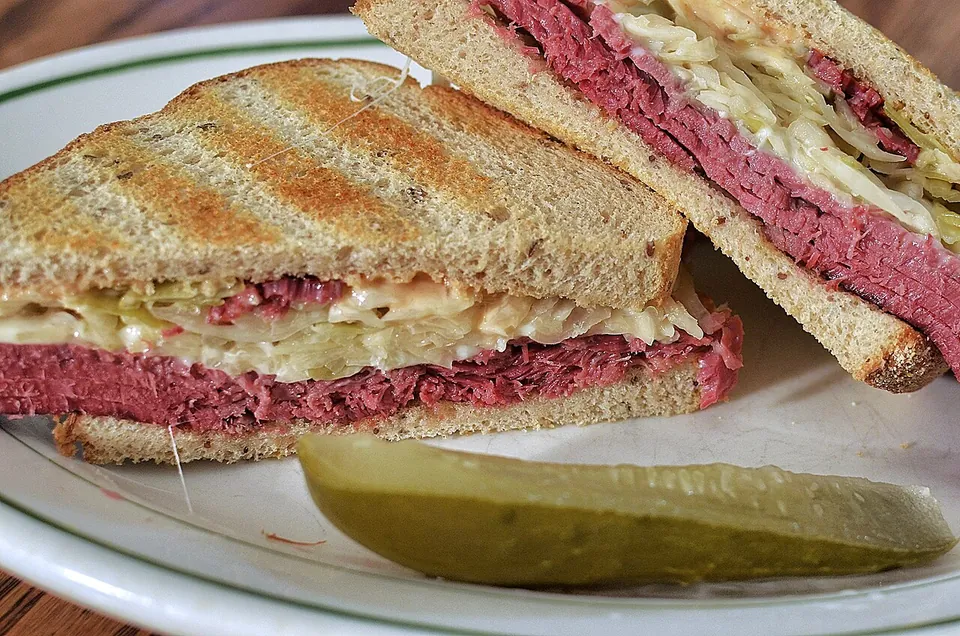
The Reuben sandwich—corned beef, sauerkraut, and Swiss cheese grilled on rye—is claimed by both Omaha, Nebraska, and New York. Its name is reported on a Nebraska hotel menu of the mid-1930s, and an early written record of its fillings appears in a 1941 cookbook by an author living in New York, yet who grilled the first one has not been settled for either city.
Verification highlight popular claim → verdict → evidence
Two rival origin stories compete: Omaha (invented at a poker game at the Blackstone Hotel, credited to Reuben Kulakofsky and the Schimmel family) versus New York (Arnold Reuben's delicatessen). Verdict: the earliest known menu matching the current form (corned beef, sauerkraut, Swiss cheese, rye) is an October 9, 1937 menu from the Cornhusker Hotel in Lincoln, Nebraska, supporting the Omaha attribution. Arnold Reuben's own original 'Reuben Special' was a different sandwich (roast beef or turkey with coleslaw and Russian dressing), so the New York story describes a same-named but different sandwich rather than a direct ancestor of today's Reuben.
The three gates
- Ingredient-supply gate
- Rye, cabbage (as sauerkraut), and beef (as corned beef) are all Old World foods already established in the US; no ingredient was a bottleneck.
- Cooking-technique gate
- Grilled or pressed as a hot sandwich.
- Venue gate
- Delicatessens and hotels (the exact founding site is disputed).
Overview
The Reuben is a hot sandwich of corned beef (salt-cured beef), sauerkraut (fermented cabbage), and Swiss cheese, set between slices of rye bread and pressed on a griddle. As the outside browns, the cheese melts, and the sourness of the sauerkraut and the saltiness of the corned beef come together in a single bite.
Rye bread, salt-cured beef, and fermented cabbage had all come from the Old World and taken root in America, and delicatessens and hotel kitchens handled them as part of the daily prep.
The sandwich takes its shape from the way these are cooked. Rather than being stacked cold, they are layered between slices of rye and grilled under pressure on a griddle. The places that grilled warm sandwiches like this to order were the delicatessens and hotel restaurants of cities where immigrant food cultures met.
The stories of its invention split between Omaha in the 1920s and New York in the 1930s. The name Reuben is reported on a Nebraska hotel menu of the mid-1930s, and a 1941 cookbook records a Reuben with the same fillings used today.
How we know
In the story told in Omaha, sometime in the 1920s a grocer named Reuben Kulakofsky asked for the sandwich at a poker game held at the Blackstone Hotel, and the Schimmel family made it for him. The man who told this story was Ed Schimmel, manager of the Blackstone. He had it from his father, Charles, who sat in on the game, and he told it in 1965 and again in 1968, on a Chicago radio show. Ed himself was not at the table, and there is no firsthand account from anyone who was. In 2016 a grandchild of the Schimmel family member credited with inventing the sandwich wrote about that night in a magazine, and told it, too, as a family story.
The name Reuben turns up on Nebraska menus of the 1930s. At the Blackstone, a 1934 menu from the main dining room is reported to list it at 40 cents, and a 1937 coffee-shop menu at 35 cents (50 cents with chicken), but what went between the bread is not reported. It was also reported that a reader of a newspaper column had produced a menu from the coffee shop of the Cornhusker Hotel in Lincoln, the state capital, dated October 9, 1937, with the sandwich on it; its fillings are not reported either. Around 1943 to 1946 the sandwich appears, spelled 'Rueben' and priced at 60 cents, on the menu of the Plush Horse, a restaurant inside the Blackstone. In 1956 Fern Snider, a former Blackstone waitress, won a national sandwich contest with it. A citation card at the dictionary publisher Merriam-Webster, dated January 19 of that year, copies a line from a Cornhusker Hotel menu: 'corned beef, Sauer Kraut, Swiss cheese on Russian Rye.'
New York has two stories, both centered on Arnold Reuben, owner of Reuben's, a delicatessen in Manhattan. The first goes back to around 1914, when Arnold is said to have made the 'Reuben's Special' for the leading lady of a Charlie Chaplin film: Virginia ham, turkey, Swiss cheese, coleslaw, and Russian dressing on rye. It shares meat, cabbage, and cheese with today's Reuben, but it has neither the corned beef nor the sauerkraut. Jim Rader, an etymology editor at Merriam-Webster, took it for a sandwich whose name happened to coincide with the Nebraska one, and wrote that, going by the menus, he leaned toward a Nebraska origin.
The second story belongs to the 1930s. Alfred Scheuing, a chef at Reuben's, is said to have grown tired of watching Arnold's son eat hamburgers. He took freshly made corned beef, layered it on Russian dark pumpernickel that he had buttered and toasted, and finished it with Swiss cheese and sauerkraut. The account comes from the son's own recollection, printed in the St. Petersburg Times in 1993. Rader remarked that, because the son tells it as something he took part in, it is either the truth or a very faulty memory.
The food historian Andrew Smith argued for a New York origin. Among his evidence was a 1941 book on menu planning for quantity cooking, which lists a Reuben as 'Rye Bread, Switzerland Cheese, Sliced Corn Beef, Sauerkraut, Dressing'; its author lived in New York. This is an early dated record of what goes into today's Reuben, though where the author lived does not show where the sandwich was invented. Later, shown the old Omaha menus, Smith granted that they were the earliest record of the name 'Reuben sandwich.' The exchange was written up in Saveur magazine by the Schimmel grandchild mentioned above.
The Reuben's Special of around 1914 was a different sandwich from today's Reuben. But the Omaha poker night survives only as a story passed from father to son, and the New York kitchen only as a son's memory. The name is on Nebraska menus of the 1930s and the fillings are in a 1941 cookbook, but who grilled the first one, and where, cannot be said for either city.
The full set of origin theories and the detailed verification log — traceable all the way to their sources — are available on the Japanese edition.
See the full origin theories and verification log (Japanese) →