All dishes / East Asia
Japanese-style twice-cooked pork Period BOrigin theory BVerified
Some fields (dish name, region and gates) are shown from the Japanese-edition data.
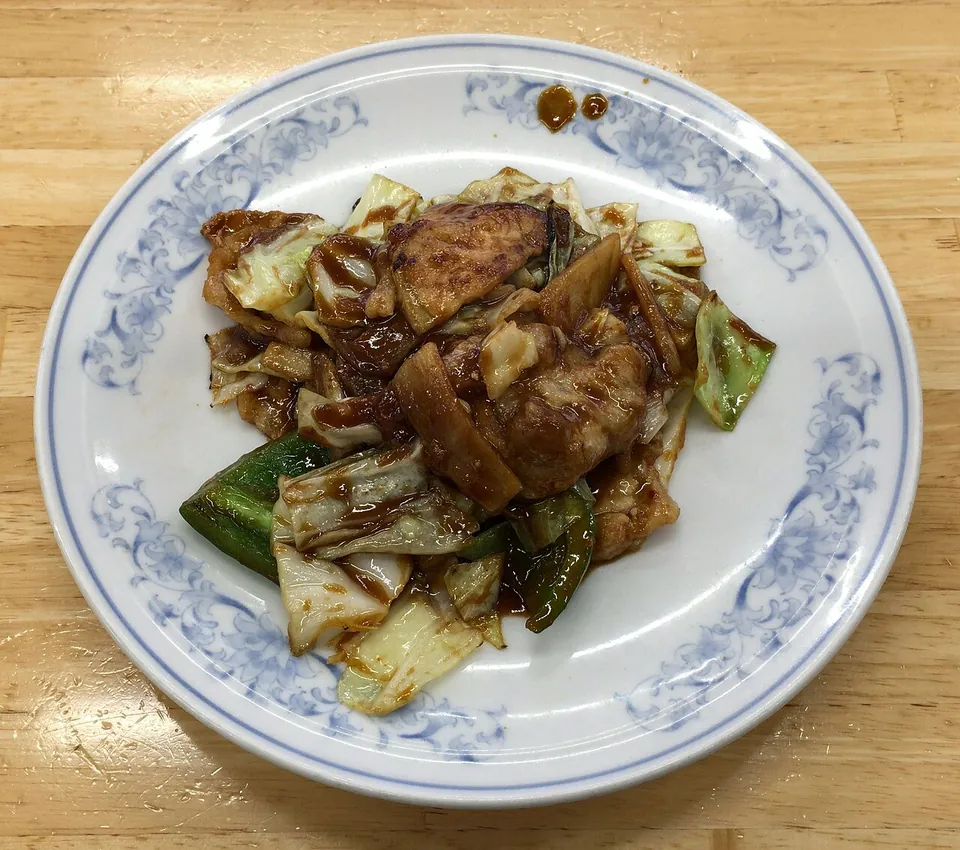
The hui guo rou familiar on Japanese tables, cabbage and pork stir-fried in a sweet miso sauce, is a different dish from the fiery Sichuan hui guo rou it shares a name with: rebuilt in Japan, with different lead ingredients and a different seasoning. The chef known for reworking the original to suit Japanese kitchens and spreading it through television is the Sichuan-born Chen Kenmin.
Verification highlight popular claim → verdict → evidence
Chef Chen Kenmin introduced this Japanese adaptation of Sichuan twice-cooked pork on NHK's Kyo no Ryori in 1967 as pork and cabbage stir-fried with miso. Despite sharing a name with Sichuan's huiguorou, it is a distinct dish shaped by ingredient substitutions Chen made for the Japanese market, not the same dish under a different name.
The three gates
- Ingredient-supply gate
- Pork, cabbage, and miso were all reliably available in Japan (cultivated cabbage became established domestically in the Meiji era); this gate was already satisfied and is not the limiting factor.
- Cooking-technique gate
- Chef Chen Kenmin adapted the original Sichuan technique — boiling or steaming a block of pork, slicing it, then stir-frying it with garlic shoots and peppers in doubanjiang and tianmianjiang — by substituting cabbage for garlic shoots, red miso and soy sauce for tianmianjiang, and stir-frying thinly sliced raw pork directly.
- Venue gate
- Postwar Japanese Chinese restaurants and homes; introduced on NHK's Kyo no Ryori in 1967, later cemented as a home dish once food makers began selling ready-made seasoning blends.
Overview
In Japan, hui guo rou usually calls to mind a plate of thin-sliced pork and cabbage tossed quickly in a sweet-savoury miso sauce. That picture is quite unlike the original from Sichuan.
The Sichuan hui guo rou starts with a block of skin-on pork, first boiled or steamed, then thinly sliced and stir-fried hot with garlic sprouts and peppers in doubanjiang and tianmianjiang. Because the already-cooked meat is returned to the wok, the dish is called hui guo, 'back to the pot'. It is a fiery, rich dish that takes the trouble of cooking twice.
The Japanese version reworks that method substantially. First, the garlic sprouts, hard to find in Japan at the time, were replaced with familiar cabbage. Cabbage had spread in Japanese cultivation from the Meiji era and become a vegetable any household could use. Second, in place of tianmianjiang, Aichi's hatcho miso was combined with soy sauce for sweetness and depth. This is what gives the Japanese version its sweet flavour. Third, the two-step cooking of boiling a block of pork before frying was dropped in favour of simply stir-frying thin-sliced pork.
So the fiery original was remade into a sweet stir-fry to suit the ingredients and steps at hand in a Japanese kitchen. It spread through postwar Chinese restaurants and homes, and once food makers put premixed sauces on the market, the sweet Japanese hui guo rou took firm hold as home cooking. Sharing a name yet differing in taste and in its lead ingredients, the Sichuan and the Japanese dishes stand side by side as separate dishes.
How we know
Ask when and where Japan's sweet hui guo rou came from, and the first name you hear is Chen Kenmin, a chef born in Sichuan province.
Chen came to Japan after the war and is known as the man who bridged Sichuan cooking to the Japanese table. From 1966 he appeared on NHK's Kyo no Ryori (Today's Cooking), introducing Sichuan dishes, mapo tofu, dan dan noodles and hui guo rou among them, in versions for Japanese viewers. In 1967 the show presented hui guo rou as 'pork and cabbage stir-fried with miso', and that became the major turning point for its spread in Japan.
Chen did not invent the dish from nothing. He adapted the long-standing Sichuan original to the ingredients and seasonings available in the Japan of his day, swapping hard-to-find garlic sprouts for cabbage and tianmianjiang for hatcho miso and soy sauce, and dropping the two-step cooking. Chinese-cuisine trade media, encyclopedias and Chen's own writing, including his memoir Sasurai no Mabo Dofu, record this account.
Yet hui guo rou made with cabbage and miso was already in print before the 1967 broadcast. Kyofu Katei Ryori Hyakudai (A Hundred Kyoto-Style Home Dishes), a home cookbook by Ogawa Akira published in Kyoto by Shirakawa Shoin in 1961, lists 'hui guo rou (pork cooked in miso)' among its dishes for March. A bar of pork belly is boiled, cut crosswise into slices, stir-fried with cabbage, green onion, shiitake and bamboo shoots, and worked together with red miso. The cabbage and miso point toward the Japanese version, while boiling the pork before frying it keeps the two-step method of the original. Whether this Kyoto dish should be read as an early form of the sweet Japanese version that later spread into homes is not yet settled.
The Sichuan hui guo rou and the Japanese one are separate dishes under one name. The Sichuan type, built on the heat of chili and doubanjiang, is a dish of the Qing era and after, and it carries on as such in Sichuan. The Japanese version took that Sichuan type as its starting point and became independent as a sweet stir-fry localized in postwar Japan. Keeping the two apart, and seeing each as its own plate, brings into view how a single dish name crossed the sea and was remade.
The full set of origin theories and the detailed verification log — traceable all the way to their sources — are available on the Japanese edition.
See the full origin theories and verification log (Japanese) →
Related dishes
Cross-links Sister dishes & same-name dishes (separate lineage)
Shares the key ingredient
- TonkatsuJapanC
- Tacos al pastorMexicoB
- FeijoadaBrazilB
- Barbecue ribsSouthern United StatesC
- CurrywurstBerlin (Germany)B
- Twice-cooked reheated pork (Huiguorou precursor)Sichuan, ChinaC
- ChicharrónPeru / Latin AmericaB
- ChicharrónMexicoB
- ChicharrónColombiaB
- BaoziChinaC
- Chop sueyUSA (Cantonese diaspora) / Guangdong (China)C
- Cochinita pibilYucatán (Mexico)C
- LechonPhilippines (Cebu, etc.)C
- SaloUkraineC
- Bak kut tehSingaporeC
- GolonkaPolandC
- GyrosGreeceB
- EisbeinBerlin (Germany)C
- SchweinshaxeBavaria (Germany)C
- ManchamantelesPuebla (Mexico)C
- PernilPuerto RicoC
- ChoripánRío de la Plata (Argentina)C
- Char siuGuangdong (China)C