All dishes / Southeast Asia
Lechon Period COrigin theory CVerified
Some fields (dish name, region and gates) are shown from the Japanese-edition data.
Lechon is the whole roast pig that Filipinos cook for celebrations and fiestas. Its name comes from Spanish, but it is still not known when that name came to mean this dish, or whether islanders were roasting pigs whole before the Spanish arrived.
Verification highlight popular claim → verdict → evidence
Claim: lechon is a dish the Spanish brought. A rival view holds that roasting a pig whole was a pre-Hispanic Austronesian custom and that Spain added only the name. Verdict: unresolved. Antonio Pigafetta's 1521 account (Blair & Robertson, The Philippine Islands 1493-1898, Vol. 33) records pigs sacrificed and eaten in Cebu and the Visayas, and pork served with its gravy at a king's supper before the fleet reached Cebu, but contains no description of a pig being roasted, so it settles neither view. Five Tagalog and Visayan dictionaries published between 1711 and 1885 give lechón only as a word for the pig itself, not as the name of a dish. Roasted lechón appears by 1887 at the latest, in José Rizal's Spanish-language novel Noli Me Tángere. When pigs were first roasted whole in the islands, and when the Spanish name came to the dish, has yet to be established.
The three gates
- Ingredient-supply gate
- Pigs, brought to the Philippines as domestic animals about 4,000 years ago, are a long-established local food.
- Cooking-technique gate
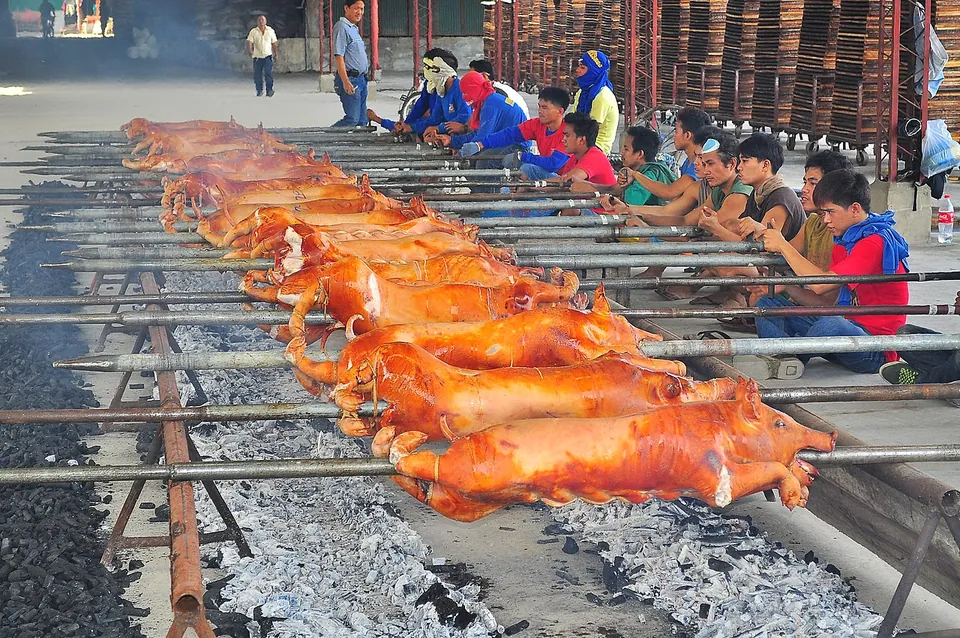
- A whole pig is skewered on a bamboo spit and roasted for several hours, turned constantly. The fire differs by region: lechon from the Visayas, including Cebu, is usually roasted over coconut-husk charcoal, and lechon from Luzon, including Manila, over a wood fire. In the Philippines weaned or adult pigs are most often used; a roasted suckling pig is called lechon de leche.
- Venue gate
- A dish for special occasions, fiestas and holidays. On Christmas Eve it is the centerpiece of the table.
Overview
Lechon is a Filipino dish of a whole pig, run through on a bamboo spit and roasted for several hours while it is turned without pause. It is made for special occasions, fiestas and holidays, and on Christmas Eve it sits at the center of the table. How it is made depends on where you are. In Cebu and elsewhere in the Visayas, the pig is stuffed with herbs such as lemongrass and usually roasted over charcoal made from coconut husks. On Luzon it is usually not stuffed with herbs, or at most with salt and pepper, and in Manila it is more often roasted over a wood fire.
The pig itself is an animal long kept in the islands. According to archaeological research, pigs were brought to the archipelago as domestic animals about 4,000 years ago, in the Neolithic.
The name comes from the Spanish lechón, a word built on leche, milk. In Spanish it means a piglet still at the teat, and by extension any male pig. In the Philippines today the name is used mostly for roasted pigs that have been weaned or are fully grown. A roasted suckling pig is set apart as lechon de leche, which in Spanish says the same thing twice.
How we know
Lechon is sometimes said to be a dish the Spanish brought. Its name is Spanish, and one view holds that the word arrived during the Spanish colonial period, when roasted pigs came to be called by it. Another view holds that roasting a pig whole was an Austronesian custom already present in the islands before the Spanish came, and that Spain added only the name.
In 1521 Antonio Pigafetta, who sailed with Magellan, wrote down what he saw and heard in the Visayan islands (his account is known in English as the First Voyage Around the World). On March 28 the fleet anchored at an island that his text calls Mazaua and that the editors of the printed edition identify as Limasawa. The next day, Good Friday, the king of that island gave a supper at which pork was served with its gravy. In his account of Cebu, which the fleet entered on April 7, Pigafetta describes pigs offered in sacrifice and their flesh eaten; the hair of the sacrificed hog was removed with fire. Yet neither his Italian text nor its English translation says anything about roasting a pig.
Pigafetta's record shows no more than this: before colonization, pigs in Cebu and the Visayas were offered in sacrifice and eaten. One encyclopedia, the English Wikipedia article "Suckling pig", says the Philippine tradition of roasting pigs goes back before colonization, but it names no historical source for that statement.
The history of the name is just as hard to pin down. In five Tagalog and Visayan dictionaries published between 1711 and 1885, lechón appears only as a word for the animal itself, a piglet or a pig, and not as the name of a dish. Roasted lechón does turn up in two scenes of Noli Me Tángere (1887), the novel José Rizal wrote in Spanish. Both scenes are set in the Tagalog region. One comes in a passage about a pilgrimage to Antipolo, which mentions lechón asado, roast lechón. The other is a party held beside a stream in a forest, where people bustle about plucking chickens, washing rice and roasting lechón. Neither passage says whether the pig was roasted whole or whether it was a suckling pig. And because the novel is in Spanish, it cannot tell us whether people in the Tagalog region also called the dish by this name in their own language.
Cebu has a name of its own for the dish: inasal, a whole pig roasted slowly over live coals. A local writer, in a column for a Cebu newspaper, recalls from personal experience that it was only some time after 2000 that Cebuanos began calling their inasal lechon, the way the Tagalogs do. The dish that is explicitly said to come from the Spanish way of roasting lechón is known in the Philippines as cochinillo: a suckling pig split open and roasted in an oven. It differs from lechon in both name and method.
By 1887 at the latest, roast pig was being written of as lechón in Rizal's novel. When pigs were first roasted whole in the islands, and when the Spanish name came to this dish, the surviving records have yet to show.
The full set of origin theories and the detailed verification log — traceable all the way to their sources — are available on the Japanese edition.
See the full origin theories and verification log (Japanese) →
Related dishes
Shares the key ingredient
- TonkatsuJapanC
- Tacos al pastorMexicoB
- FeijoadaBrazilB
- Barbecue ribsSouthern United StatesC
- CurrywurstBerlin (Germany)B
- Twice-cooked reheated pork (Huiguorou precursor)Sichuan, ChinaC
- ChicharrónPeru / Latin AmericaB
- ChicharrónMexicoB
- ChicharrónColombiaB
- BaoziChinaC
- Chop sueyUSA (Cantonese diaspora) / Guangdong (China)C
- Cochinita pibilYucatán (Mexico)C
- SaloUkraineC
- Bak kut tehSingaporeC
- GolonkaPolandC
- GyrosGreeceB
- EisbeinBerlin (Germany)C
- SchweinshaxeBavaria (Germany)C
- Japanese-style twice-cooked porkJapanB
- ManchamantelesPuebla (Mexico)C
- PernilPuerto RicoC
- ChoripánRío de la Plata (Argentina)C
- Char siuGuangdong (China)C