All dishes / Middle East & North Africa
Ghormeh sabzi Period COrigin theory BVerified
Some fields (dish name, region and gates) are shown from the Japanese-edition data.
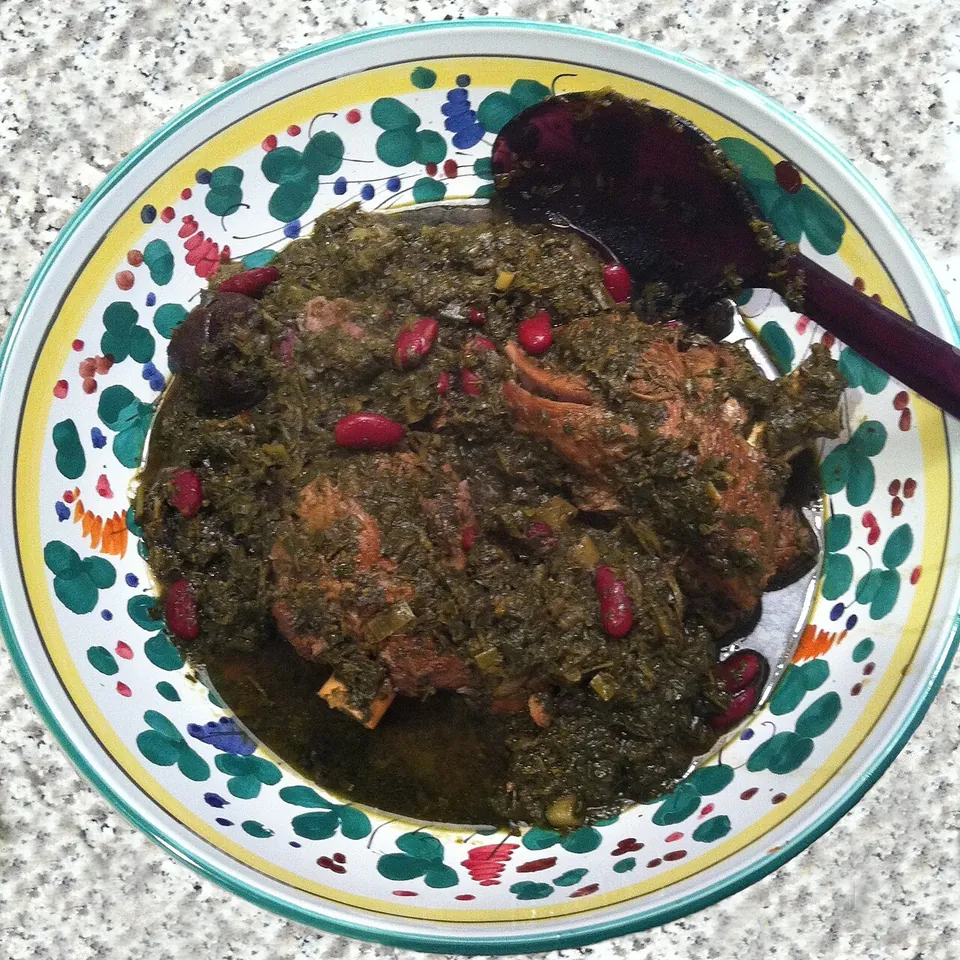
Ghormeh sabzi, a deep-green stew of parsley and fenugreek fried in generous handfuls, is one of the defining dishes of the Iranian table. It is sometimes described as a legacy of ancient dynasties thousands of years old, yet the version everyone knows today only took shape after kidney beans crossed the ocean from the Americas.
Verification highlight popular claim → verdict → evidence
Ghormeh sabzi is often called an inheritance of two and a half to five thousand years, handed down from the Pishdadian or Kayanian kings. The beans forbid that reading: the kidney bean (Phaseolus vulgaris) came from the Americas and reached Europe only after 1492 (Bitocchi et al., Nature Communications, 2023); when and by what route it reached Persia is not known. Stewing herbs with lamb may go back to before the Safavids, and sharply sour khoresh dishes are already there in the Karnama, the Persian manual of about 1521, while the word ghormeh comes from the Turkic qavurma, to fry, a borrowing of the medieval centuries. The dish as it is cooked now, though, cannot do without the bean, and so cannot be older than the bean's arrival. Its earliest known appearance in a cookery book is in the one written by Nader Mirza under the Qajars in the nineteenth century.
The three gates
- Ingredient-supply gate
- Herbs, lamb and dried limes were all at hand locally. The haricot (kidney) bean that the present-day dish cannot do without came from the Americas, and it reached Europe only after 1492 (Bitocchi et al., Nature Communications, 2023). Its arrival in Iran, for which no date has been found, sets the earliest possible date for ghormeh sabzi as it is cooked now.
- Cooking-technique gate
- Frying the herbs first, then simmering the stew for a long time.
- Venue gate
- Home cooking, and one of the national dishes of Iran.
Overview
Ghormeh sabzi is a home-cooked stew. Herbs such as parsley, coriander, green onions and fenugreek are chopped in large amounts and fried slowly in oil; lamb and dried limes then go into the pot, which simmers for a long time until the stew turns thick and smooth. The word ghormeh comes from the Turkic qavurma, meaning to fry or sear, and sabzi means green herbs. Its deep green color and the distinctive sourness of the dried limes are what define it, and it is served with plain white rice.
The herbs, the lamb and the dried limes are all long rooted in Iranian soil and were part of everyday cooking from early on. The tradition of frying herbs and then stewing them with meat, known as khoresh, is old as well: the Persian cookbook that Bavarchi completed in 1521 already lists a whole range of stews sharpened with a sour note.
Into that old line of stews came the kidney bean. The bean was originally a crop of the Americas; in time it crossed the ocean, reached Iranian kitchens and found its way into the pot of herbs and lamb. That gave ghormeh sabzi the familiar form that sets it apart from other herb stews. The dish first appears in writing in the cookbook of Nader Mirza, from the Qajar era of the 19th century, so by then, at the latest, it was already on the table.
How we know
Ghormeh sabzi is often said to have come down from ancient Persia in the distant past. Folk tradition and news reports sometimes present it as a legacy of the Pishdadian or Kayanian dynasties, 2,500 to 5,000 years ago.
This proud claim to age does not fit the history of the kidney bean, which today's version cannot do without. The kidney bean is a crop native to the Americas, and it entered Europe only after 1492 (Bitocchi et al. 2023, Nature Communications). Ghormeh sabzi as it is made now, with kidney beans, cannot have existed thousands of years ago. The story of an origin thousands of years back dresses the dish in a pedigree older than the real one: an origin myth made up after the fact.
The line of herb-and-lamb stews itself, though, is genuinely old. Bavarchi's cookbook of 1521 (translated by Hassibi and Sayadabdi) already contains a group of sour stews, and it is thought that this tradition of braising may reach back to before the Safavid period. The name ghormeh sabzi is written into a cookbook only in the 19th century, but the year a dish is first written down is not necessarily the year it was born. The old tradition of herb stews is real, and when the bean from the Americas joined it, today's standard version took shape. The history of ghormeh sabzi is made of two things from different eras laid one over the other: an old way of stewing and a newer bean.
The full set of origin theories and the detailed verification log — traceable all the way to their sources — are available on the Japanese edition.
See the full origin theories and verification log (Japanese) →