All dishes / Eastern Europe
Lobio Period BOrigin theory BVerified
Some fields (dish name, region and gates) are shown from the Japanese-edition data.
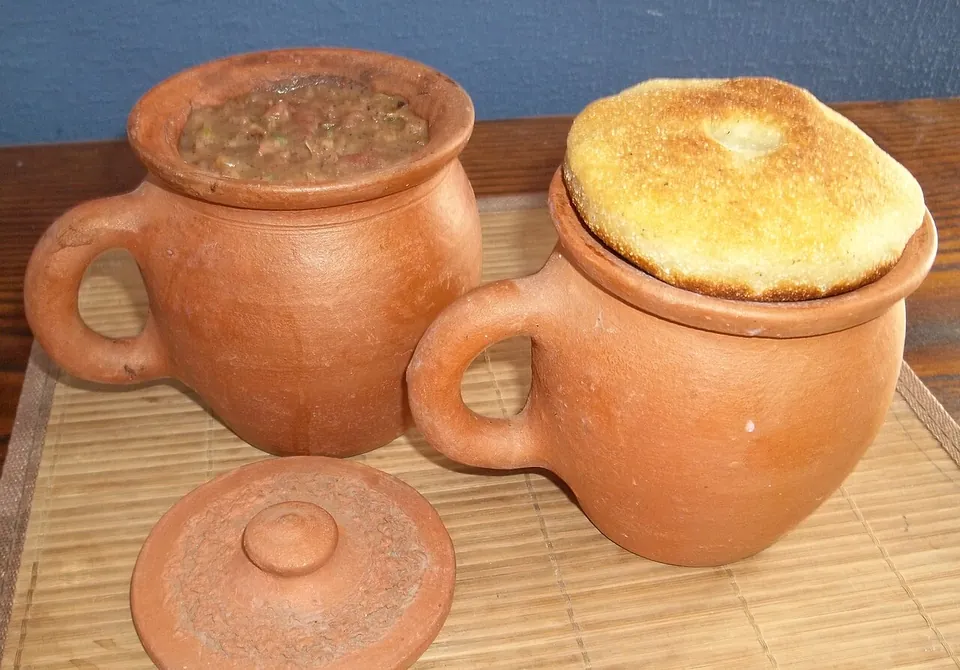
Lobio is the Georgian bean dish that dresses red kidney beans with walnuts and herbs. The notion that the whole dish must be a newcomer, because the kidney bean came from the New World, overlooks the older line of bean cookery that the sources record.
Verification highlight popular claim → verdict → evidence
Because today's lobio is made with red kidney beans, a New World crop, it is sometimes taken for a newcomer that could not exist without them. The dish is older than that. Lobio, Georgian for "beans", was first made with Old World legumes such as hyacinth beans (Dolichos), lentils and peas. Kidney beans later reached the Caucasus and in time replaced the older beans; some accounts say they were first grown in western Georgia, in Guria and Samegrelo. When and by what route they arrived is not known: a genetic study of the European common bean (Bitocchi et al. 2023) shows only that the bean reached Europe after 1492. The coming of the kidney bean sets only the earliest possible date for the red-bean version eaten today, not the age of lobio itself.
The three gates
- Ingredient-supply gate
- Kidney beans (Phaseolus) are a New World crop, and they reached Europe only after 1492 (Bitocchi et al. 2023). Their arrival in Georgia, for which no date has been found, sets the earliest possible date for the red-bean lobio of today. Walnuts and herbs had long been at hand locally.
- Cooking-technique gate
- Kidney beans are stewed, then dressed or simmered with walnuts and herbs.
- Venue gate
- Georgian home cooking, and a dish for the fasting periods of the Orthodox Church.
Overview
In Georgian, lobio means simply "beans," and the name belongs to a stewed bean dish rooted deep in the Caucasian table. Red kidney beans are simmered soft, then dressed with ground walnuts, coriander and other herbs, garlic and vinegar, or cooked down together with them. Because it uses no meat, lobio is valued as a dish for the fasting periods of the Georgian Orthodox calendar, and as home cooking it comes in countless versions from one region to the next.
The red kidney bean (Phaseolus vulgaris) that gives today's lobio its character is a crop native to the Americas. It crossed the Atlantic in the wake of Columbus's voyages, reaching Europe only after 1492. In time the bean took root in the fields of the Caucasus as well. There it met walnuts and herbs long at home in the region, and a kitchen craft of grinding, simmering and dressing, and out of that meeting came the kidney-bean lobio of today.
Still, when the now-familiar kidney-bean version took shape is one question, and how old lobio is as a dish is another. Georgian bean cookery itself goes back far earlier than the New World bean's crossing. That distinction is the crux of the question of where this dish came from.
How we know
Lobio has long been shadowed by the view that it is a newcomer, a dish that could not exist without the New World bean. Because its most conspicuous ingredient, the red kidney bean, came from the Americas, the reasoning leaps to the conclusion that the dish itself must be young.
Follow the sources, though, and Georgian lobio turns out to have an older layer made with Old World pulses. Before the common bean arrived, the dish was made with Old World beans such as the hyacinth bean (Dolichos, or lablab), and with lentils and peas. The genre itself is old enough to predate the divisions of Georgia as a state. Into this tradition came the bean native to the Americas. It reached Europe only after 1492 and in time made its way to the Caucasus as well; by some accounts, its cultivation began in the western regions of Guria and Samegrelo. Little by little the red kidney bean displaced the older Old World pulses, and the lobio best known today became established.
The newcomer story mistakes the moment the familiar kidney-bean version took shape for the age of the dish. Georgian kitchens had long made lobio with Old World beans; then the New World bean arrived, and the beans going into the pot changed. The accepted view today is not that a new dish was born, but that an old bean dish took in a new bean.
The full set of origin theories and the detailed verification log — traceable all the way to their sources — are available on the Japanese edition.
See the full origin theories and verification log (Japanese) →