All dishes / Eastern Europe
Bigos Period COrigin theory CVerified
Some fields (dish name, region and gates) are shown from the Japanese-edition data.
At the end of the fourteenth century, King Jagiełło served it to his hunting guests: so runs the legend of how bigos, Poland's long-simmered stew, began. But the word "bigos" first turns up in writing in the sixteenth century, and there it names a chopped dish with no cabbage in it at all.
Verification highlight popular claim → verdict → evidence
A popular legend credits Jogaila, who became king of Poland at the end of the 14th century, with serving bigos to his hunting guests, but the word itself first appears in writing only in 1534, in Falimirz's herbal, about 150 years after the legend's time, and there it names a minced dish with no cabbage at all. Czerniecki's 1682 cookbook still uses bigos for minced meat or fish. The version soured with cheap sauerkraut, known as "bigos hultajski," became common under King Augustus III (1734-1763) and displaced the other forms in the 19th century; no source has been found showing when that version began.
The three gates
- Ingredient-supply gate
- Cabbage and sauerkraut are long-established Old World crops, so no ingredient sets an earliest possible date for the dish. Some later regional versions add tomato, but it is no part of what bigos essentially is.
- Cooking-technique gate
- Lactic-acid fermentation (sauerkraut) combined with long simmering and repeated reheating, topped up over time like a perpetual stew.
- Venue gate
- Eaten at hunts and banquets by the szlachta, the nobility of the Polish-Lithuanian Commonwealth, it spread no further than the region itself, shared across the Polish-Lithuanian lands.
Overview
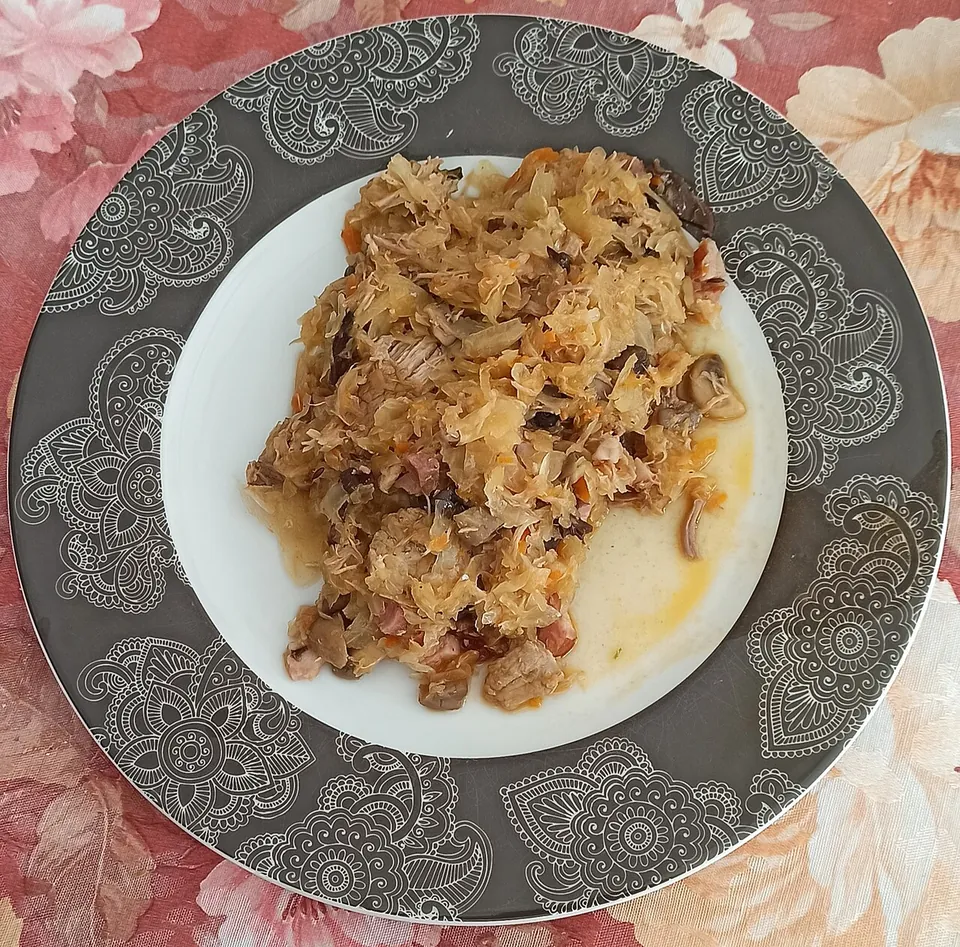
Bigos is a Polish stew of cabbage and sauerkraut (cabbage salted and left to ferment until sour), cooked slowly with game, pork, and sausage. It is not meant to be finished in one sitting: more is added to what is left in the pot, and the whole thing is brought back to the heat again and again. This form, soured with sauerkraut, was widely made by the eighteenth century.
Cabbage and sauerkraut, the backbone of the dish, are a vegetable and a preserve that have long been eaten on Polish soil.
The name, though, did not always belong to this pot. In a seventeenth-century cookbook, bigos is finely chopped meat or fish dressed with something sour, such as vinegar, lemon, or sorrel, and with spices. The version that swapped the vinegar or lemon for cheap sauerkraut was called bigos hultajski ("scoundrel's bigos"), and it became common during the reign of Augustus III, King of Poland (1734–1763). In the nineteenth century this form pushed the other ways of making it aside and became the bigos of today.
How we know
The legend goes like this. At the end of the fourteenth century, Jogaila, Grand Duke of Lithuania, who became King of Poland and is known there as Jagiełło, served bigos to his hunting guests, and that was how the dish began. No contemporary record of the story has come to light, and no medieval recipe for bigos has surfaced either.
The word "bigos" first appears in writing in 1534, in O ziołach i o mocy ich ("On Herbs and Their Powers"), the herbal of Stefan Falimirz. That is some hundred and fifty years after the time of the legend, and what the herbal describes is a medicine: rinse a wolf's lungs in wine, chop them, and cook them into bigos. There is no cabbage in it, and no assortment of meats. A dictionary of 1621 likewise explains bigos as a dish of chopped meat. And in Compendium Ferculorum, published by Stanisław Czerniecki in 1682, bigos is chopped capon, carp, or pike. Bigos began as the name of a chopped dish. Hunted meat stewed in a pot may be an older kind of cooking, but a story that puts bigos, the cabbage stew, in the fourteenth century does not fit these records.
Another view sees bigos as a dish of the nobility. It holds that the nobles of the early modern Polish-Lithuanian Commonwealth, the szlachta, carried bigos along on hunts and journeys and spread it as a pot to be topped up with meat and sauerkraut and warmed again. The picture appears in Book IV of Pan Tadeusz, the epic poem Adam Mickiewicz published in 1834, where the hunters sit down to bigos after a bear hunt. The scene shows that the literature of the early nineteenth century portrayed bigos as a hunting dish. No contemporary record has yet been found, however, telling that the dish was born at the hunts of early modern nobles.
When and where did bigos, once the name of a chopped dish, meet sauerkraut? By the eighteenth century the pot was already widely made, but a record of how it began has yet to be found.
The full set of origin theories and the detailed verification log — traceable all the way to their sources — are available on the Japanese edition.
See the full origin theories and verification log (Japanese) →
Related dishes
Shares the key ingredient
- Gołąbki (Polish cabbage rolls)PolandC
- HolubtsiUkraineC
- SarmaBalkans (Ottoman sphere)C
- KåldolmarSwedenC