All dishes / North America
Key lime pie Period BOrigin theory CVerified
Some fields (dish name, region and gates) are shown from the Japanese-edition data.
Local lore in Key West credits "Aunt Sally" with inventing key lime pie in the nineteenth century. But the pie appears in print only in the 1930s, and no contemporary source backs that telling.
Verification highlight popular claim → verdict → evidence
Key West tradition credits Aunt Sally, cook to the ship owner William Curry (1821-1896), with inventing the pie in the later nineteenth century, or else the fishermen who are said to have made it aboard their boats. Nothing in print supports either: the oldest telling of the Aunt Sally story dates from 1995, in promotional material for a bed and breakfast in Curry's old house. The pastry chef and food historian Stella Parks traced the earliest documented recipe to a promotional brochure issued by Borden, the condensed milk company, in 1931, headed Magic Lemon Cream Pie: a graham cracker crust filled with an uncooked custard of condensed milk, egg yolks and citrus juice. A Tropical Lime Chiffon Pie follows in a Miami paper in 1933, an icebox lime pie as a Keys speciality in 1935, and the name Key Lime Pie only in 1940. Despite public appeals for anything earlier, no older source has surfaced. The pie also rests on sweetened condensed milk. Gail Borden's US patent of 1856 did not start it: that patent covered condensed milk with no sugar, and a method of adding sugar to milk and condensing it was already set out in a British patent by 1835 at the latest.
The three gates
- Ingredient-supply gate
- Key limes from the Florida Keys, and sweetened condensed milk. Adding sugar to milk and condensing it was already described in a British patent by 1835 at the latest, before Gail Borden's US patent of 1856, which was for condensed milk with no sugar mixed in. The oldest record of the recipe is from 1931, and the pie belongs to the 1930s.
- Cooking-technique gate
- Setting condensed milk and egg yolks with raw citrus juice, without cooking, and the refrigerated trade that lets it travel.
- Venue gate
- Home kitchens in the Florida Keys, later a state speciality sold to visitors.
Overview
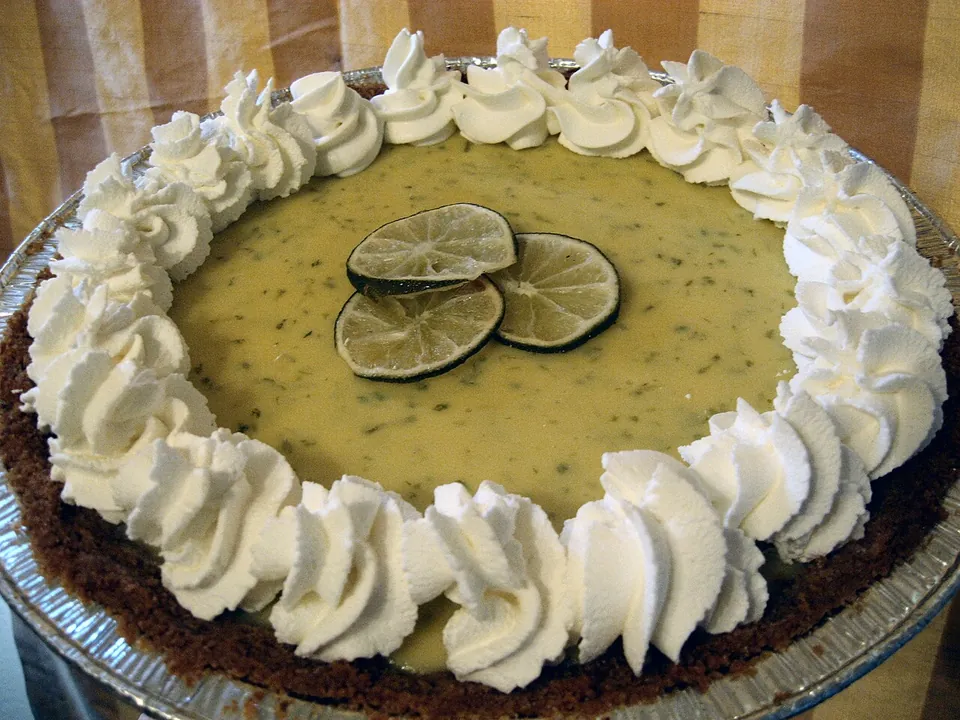
Key lime pie is a cold pie in which the juice of small, fragrant Florida Keys limes sets sweetened condensed milk and egg yolks. A crust of crushed graham crackers holds a cream of condensed milk, yolks, and juice. The trick at work is that citrus acid, not the oven, thickens the milk and eggs: with almost no baking, the acid acts on the proteins in the condensed milk and sets it to a smooth firmness.
The key to the dish is sweetened condensed milk: milk with sugar dissolved in it, evaporated until thick, so that the sugar keeps it from spoiling. The method was written down in a British patent no later than 1835. A rich, long-keeping milk became a base for dessert in the warm South, where refrigeration was scarce, and this method of setting a filling with citrus acid makes direct use of that milk's properties.
Still, condensed milk reaching Southern kitchens did not, by itself, produce the pie. The pairing of key lime juice with condensed milk shows up in print only much later, in the 1930s. In 1933 a Miami newspaper ran a related lime pie; in 1935 an "icebox lime pie" was recorded as a Florida Keys specialty; and in 1940 the name "key lime pie" itself first appears. What began as a home dessert of the Florida Keys was in time carried into tourism as a dish that came to represent the state.
How we know
Key lime pie has an origin legend fitting for the Florida Keys. A cook called "Aunt Sally," in the household of the Key West shipowner William Curry (1821-1896), is said to have devised it in the late nineteenth century, or else Key West fishermen made the first version aboard their boats. This is the account given by David Sloan, a cookbook author and co-organizer of a key lime festival.
But no contemporary record for the legend has surfaced. The earliest surviving telling of the Aunt Sally story dates to 1995, in promotional material for a bed-and-breakfast set up in Curry's former house, roughly a century after the invention it claims. Despite an open call for evidence, no reliable source predating 1931 has been found.
The pastry scholar Stella Parks, meanwhile, points to a different first appearance. The oldest form documented in print is a recipe titled "Magic Lemon Cream Pie," in a promotional brochure that the condensed-milk maker Borden handed out in 1931: a graham-cracker crust with an unbaked custard of condensed milk, egg yolks, and citrus juice. Key lime pie is likely to descend from it.
How old, then, is the sweetened condensed milk the pie rests on? The patent Gail Borden obtained in the United States in 1856 was for a way of condensing milk in a vacuum, and it covered condensed milk with no sugar mixed in. In the specification Borden notes that William Newton and many others had already patented ways of evaporating milk and combining it with sugar, and he does not claim that as his own invention. Newton's British patent of 1835 describes dissolving sugar in milk, driving off the water, and letting the sugar preserve it. Borden's 1856 patent was for unsweetened condensed milk; it marks the beginning of neither sweetened condensed milk nor key lime pie.
What is set aside as folklore is the single claim that a particular nineteenth-century person invented the pie; that key lime pie took root as a dessert of the Florida Keys stands untouched.
The full set of origin theories and the detailed verification log — traceable all the way to their sources — are available on the Japanese edition.
See the full origin theories and verification log (Japanese) →