All dishes / North America
Fettuccine Alfredo Period AOrigin theory BVerified
Some fields (dish name, region and gates) are shown from the Japanese-edition data.
Fettuccine Alfredo, the story goes, was created by Alfredo in Rome in 1908. But the original had no cream in it, and the cream-sauce version we know is a different dish, remade across the ocean in America.
Verification highlight popular claim → verdict → evidence
Myth: Fettuccine Alfredo, the cream-sauce dish beloved in the United States, was invented in Rome in 1908. Verdict: what Alfredo di Lelio actually created in Rome around 1907/08 was fettuccine al triplo burro, an emulsion of butter and Parmesan with no cream at all -- the American cream version barely exists in Italy and was essentially reinvented there, crystallizing in a 1966 Pennsylvania Dutch egg-noodle package recipe. The dish took shape in two stages: the cream-free Roman original, then an American remake once local butter and cheese proved too mild to match it. Main sources: Wikipedia; Italy Segreta; a 1927 Saturday Evening Post account of di Lelio's restaurant.
The three gates
- Ingredient-supply gate
- Both wheat pasta and dairy are Old World staples that had long been available; ingredient availability is not a constraint here.
- Cooking-technique gate
- Fresh pasta-making and an emulsified butter-and-Parmesan sauce; the American version relies heavily on added cream.
- Venue gate
- Originated in a Rome restaurant, then spread to the United States via Hollywood celebrities and became a restaurant staple there.
Overview
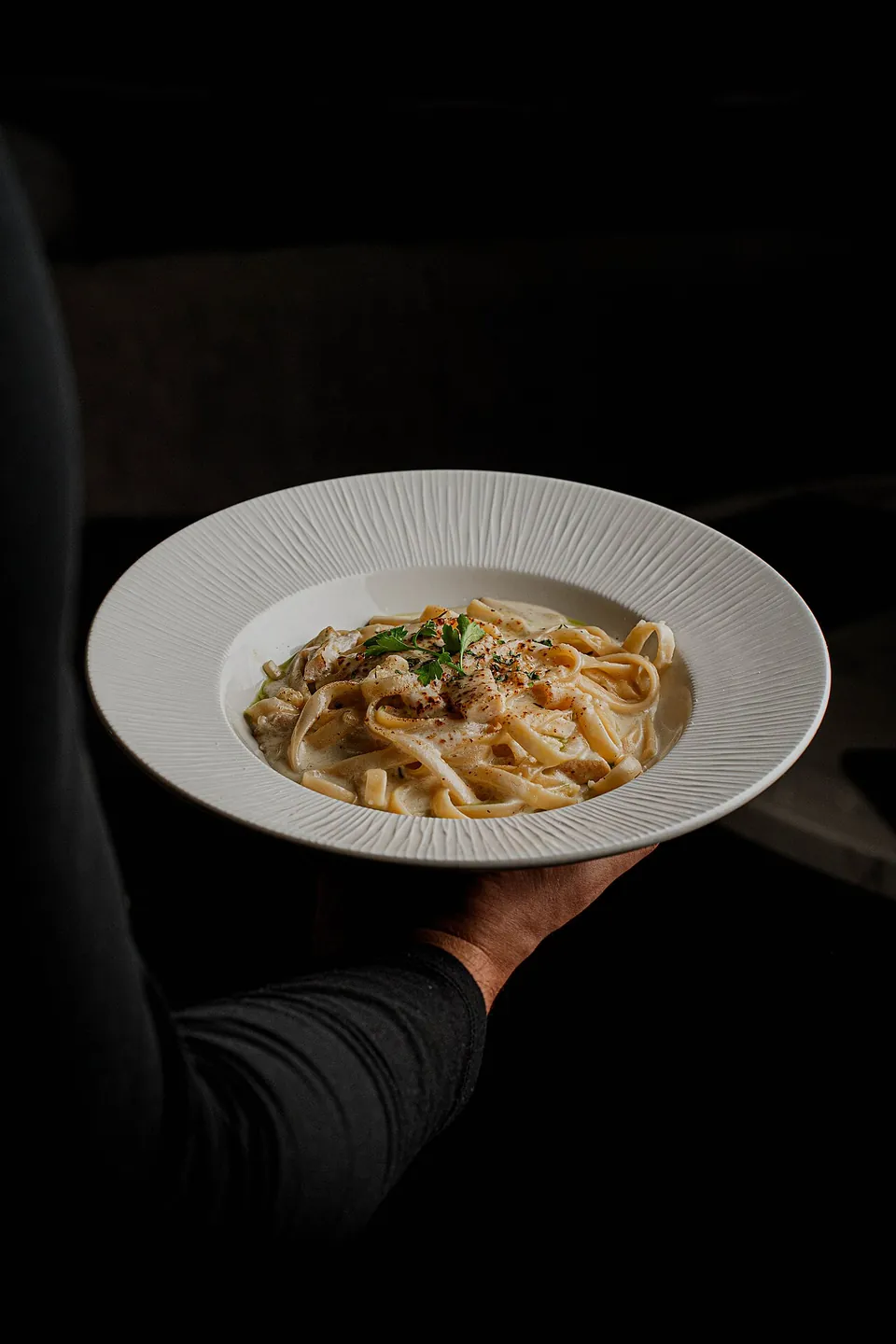
Fettuccine Alfredo became a restaurant staple in America as a rich plate of flat fresh pasta bound in a sauce of butter, Parmigiano cheese, and cream. The wheat pasta and the dairy are both long-established Old World ingredients; nothing in the materials stood in the way of the dish coming into being.
The dish has two stages, and it began in Rome. As the restaurant and the family tell it, in 1907 or 1908 Alfredo di Lelio devised a plate for his wife after she had given birth, emulsifying generous amounts of butter with Parmigiano. Known in the restaurant's telling as fettuccine al triplo burro, or triple-butter fettuccine, this original contained no cream at all.
The dish's name is said to have become known in America through the actors Mary Pickford and Douglas Fairbanks. Married in 1920, the couple are said to have visited the restaurant on a trip some time afterward and later to have presented it with a gold fork and spoon. Through those Hollywood names the dish is said to have found its way into American restaurants, and there a version with cream added spread. Recipes such as the one printed on a 1966 package of dried pasta from the company Pennsylvania Dutch are said to have settled the cream version in place. The cream-sauce dish of today comes from this second stage, the remaking in America.
How we know
Fettuccine Alfredo was created by Alfredo di Lelio in Rome in 1908: this is the familiar account, and the fact that the inventor really existed makes it all the easier to believe. The date of 1907 or 1908 comes from the restaurant and the family, and no record from those years has yet been found. Of the records that mention the restaurant and its dish, the oldest that can be traced is a British travel guide published in 1925, Southern Italy in the Blue Guides series, whose list of Roman restaurants includes "d'Alfredo, 104, Via della Scrofa, noted for fettuccine al burro." The dish is still simply fettuccine with butter; it does not yet carry Alfredo's name. On November 19, 1927, George Rector's "A Cook's Tour" in the American magazine The Saturday Evening Post told of the dish, and in 1928 an American travel guide, Clara E. Laughlin's So You're Going to Rome!, wrote that "most travellers would blush to admit they had been in Rome and had not eaten Alfredo's fettucine al burro." Earlier still, the 1922 novel Babbitt mentions the fettuccine of a little trattoria on the Via della Scrofa, but it names neither the restaurant nor the dish, so it cannot be tied to Alfredo's. What can be said for certain is that the dish was known in Rome by 1925 at the latest. Still, the tradition itself, that di Lelio devised a plate around 1907 or 1908, has not been disproved.
The trouble lies in treating this origin tale as the origin of today's American cream sauce. What di Lelio devised was the "triple butter," made with butter and cheese alone, a different thing from the cream-based sauce of today. And, ironically, the cream version that spread in America is scarcely to be found in Italy itself. In Rome, places such as Il Vero Alfredo still keep to the butter-and-cheese original, while the American cream version is hard to find on an Italian table at all.
So this dish has come down to us with its origin tale (Rome, 1908) and the dish people actually eat (the American cream version) out of step with each other. It is one example of what the historian Eric Hobsbawm called an invented tradition: an old pedigree held up in front, while the substance was made later, in another land. The heart of this dish's history lies in not confusing the year the original is said to have been devised with the year today's cream version was born, and in seeing that, behind the label of the authentic native dish, the substance had been swapped out.
The full set of origin theories and the detailed verification log — traceable all the way to their sources — are available on the Japanese edition.
See the full origin theories and verification log (Japanese) →