All dishes / South Asia
Tandoori chicken Period BOrigin theory BVerified
Some fields (dish name, region and gates) are shown from the Japanese-edition data.
The grand backstory that Tandoori chicken descends from the Indus Valley civilization tells us only how old it is to roast a bird in a clay oven. The dish we know now, in its red marinade, could only appear after New World chili peppers reached northern India, and it took its present shape in early-twentieth-century Punjab. It is a thoroughly modern plate.
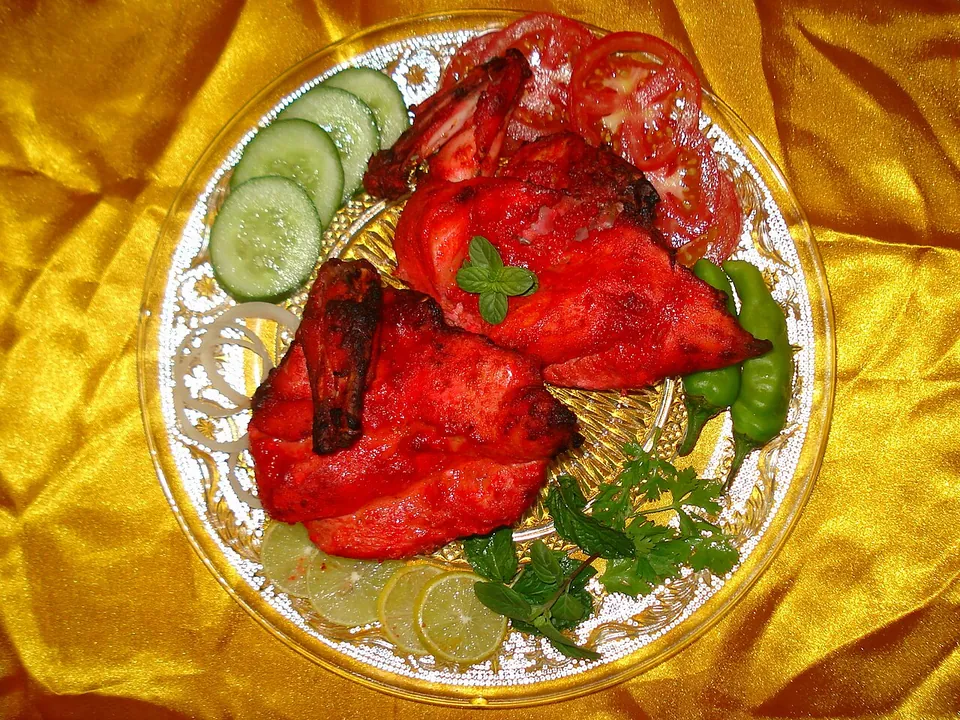
Verification highlight popular claim → verdict → evidence
Popular claim: a direct, unbroken line back to Harappan-era (c. 3000 BCE) clay-oven roasted meat. Verdict: the age of oven-roasting itself is not disputed, but the modern red-marinade dish cannot predate the chili pepper's arrival in North India (18th century, per Lizzie Collingham). The current form is credited to Moti Mahal and Kundan Lal Gujral, whose restaurant moved to Delhi after the 1947 Partition; the food historian Colleen Taylor Sen (Curry: A Global History, 2009) writes that Gujral invented the dish, though the invention story traces back to Gujral's own account in a 1988 interview, and sole credit versus co-founder Kundan Lal Jaggi remains disputed. Key sources: Sen, Curry: A Global History (2009); Al Jazeera (2024) on the Moti Mahal/Daryaganj dispute; Collingham for the chili's arrival.
The three gates
- Ingredient-supply gate
- Chicken and yogurt are native. The chili pepper in the red marinade is a New World ingredient, brought by the Portuguese to Goa and other parts of the Indian coast in the 16th century. It is said to have reached North India later, in the 18th century; per the food historian Lizzie Collingham, this was the period when the Marathas attacked Delhi in 1719. The current form of the dish could not have taken shape before this arrival.
- Cooking-technique gate
- High-heat skewer-roasting in a tandoor (clay oven). The oven tradition is old, but the modern dish's form was established only in the modern era.
- Venue gate
- Punjabi eatery culture, then a restaurant in postwar Delhi (Moti Mahal), where the dish became popular.
Overview
Tandoori chicken belongs to northern India, to the belt running from Punjab to Delhi. Its present form came together in the early twentieth century, and it spread across the country from Delhi only after the Second World War.
The red, fiery marinade is the dish's signature. Chicken and yogurt were long at hand in northern India, but the chili that gives the marinade its color is native to the Americas, and it reached India late. Chilies landed on the Goan coast in 1510; the record of that red heat travelling inland to northern India is later still, in the eighteenth century, carried in the wake of the Maratha forces who struck Delhi in 1719 (as the food historian Lizzie Collingham describes it). Until that red reached the kitchens of the north, no dish claiming a red marinade could have come into being.
The roasting is done in a tandoor, a clay oven fired to high heat. Cooking skewered meat in such an oven was an old craft, but the tandoor was really an oven for bread. Turning it to a yogurt-marinated bird was the move that set the modern dish apart.
Tandoori chicken began as regional restaurant food, and it reached tables across the country once it found the right setting to be eaten out. Punjabi cooks moved to Delhi, and in the postwar restaurants of the city everyone from working people to the growing middle class began to order it. From there it became a dish of the whole north, and in time one that crossed India's borders.
How we know
Two stories run alongside each other in the history of Tandoori chicken, and they work on wholly different time scales.
The first concerns the origin of the dish as we now know it. From the 1920s, at a restaurant called Moti Mahal in Peshawar (now in Pakistan), cooks worked out how to roast a yogurt-marinated bird in the tandoor, an oven meant for bread. The cook usually credited is Kundan Lal Gujral. With Partition in 1947 the restaurant moved to Daryaganj in Delhi, and the dish is said to have been served at an official dinner hosted by Prime Minister Nehru. Through the late 1940s and 1950s it spread across the country and then abroad. The food historian Colleen Taylor Sen, in Curry: A Global History (2009), writes that Gujral, a refugee from Pakistan, invented tandoori chicken, and that the tandoori restaurants of 1970s Britain were all essentially imitators of Moti Mahal. That the modern dish in its red marinade came out of the Moti Mahal kitchen is widely accepted. Follow the invention story back, though, and it leads to Gujral's own account, recorded in a 1988 interview.
Who the single inventor was has not been settled either. Was it Gujral alone, or a joint creation with his co-founder Kundan Lal Jaggi? The men left no written recipe. In 2024 the Moti Mahal side and the descendants of Jaggi (the Daryaganj side) went to the Delhi High Court over the claim to have invented butter chicken and dal makhani. It is one example of how recipe attribution is disputed within culinary families.
The second story pulls the origin all the way back to antiquity. Chicken roasted in a tandoor-like oven, it holds, reaches back to the Indus Valley civilization (around 3000 BCE), and the ancient medical treatise Sushruta Samhita records spiced oven-roasted meat. The sheer age of roasting a bird in an oven is not in doubt.
But that old layer and the plate in its red marinade are two different things. The chili that makes the red did not reach the kitchens of northern India until the eighteenth century, and before that no Tandoori chicken of the modern kind could have come to the table. The grand tale reaching back to antiquity may speak to the long history of oven-roasted fowl as a genre, but it is not the beginning of the Tandoori chicken we know today.
The full set of origin theories and the detailed verification log — traceable all the way to their sources — are available on the Japanese edition.
See the full origin theories and verification log (Japanese) →
Related dishes
Shares the key ingredient
- KimchiSouth KoreaC
- Mapo tofuSichuan (China)C
- Doro watEthiopian HighlandsB
- Indigenous molli (chilmolli chili sauce, before Old World spices)MexicoB
- RendangMinangkabau, West Sumatra (Indonesia)C
- Tom yum goongThailandC
- SambalMalay Archipelago (Indonesia)C
- TteokbokkiKorean PeninsulaC
- LaksaPenang (Straits Settlements)C
- MuhammaraAleppo, SyriaC
- VindalooGoa (India)C
- Piri piri chickenMozambique (Portuguese colonial sphere)C
- HarissaTunisiaC
- BibimbapSouth KoreaC
- Twice-cooked pork (huiguorou)Sichuan (China)C
- LarbLaos / Isan (Thailand)C
- Chili con carneTexas, USA (San Antonio)C
- Dan dan noodlesChengdu, Sichuan (China)C
- General Tso's chickenNew York (USA)C
- Pol sambolSri LankaB
- Chapli kebabPeshawar (Pakistan)C
- ShiroEthiopian HighlandsB
- Hiroshima soupless dandan noodlesHiroshima (Japan)B
- Kung pao chickenSichuan (China)C
- Fuqi feipianSichuan (China)D
- Nasi lemakMalaysiaC
- LampraisSri LankaC
- Nigerian pepper soupNigeria (West Africa)C
- MerguezMoroccoB