All dishes / Latin America
Tamale (tamal) Period BOrigin theory BVerified
Some fields (dish name, region and gates) are shown from the Japanese-edition data.
Images, excavated remains, and written records together show that tamales, the steamed dish of Mesoamerica, were Indigenous food before Europeans arrived. But the familiar taglines—'one of the world's oldest dishes, born eight thousand years ago,' 'first made by a goddess'—are tales that no source supports.
Verification highlight popular claim → verdict → evidence
Myth: tamales are 8,000-10,000 years old, among the oldest dishes in the world, and the first tamale was made by the Aztec goddess Tzitzimitl, who sacrificed her grandchild. Verdict: neither claim has support in the sources. The creation myth is a story, not a record of how the dish began, and the 8,000-year figure confuses the age of maize cultivation with the time the tamale shows up in images and remains. A Late Preclassic mural at San Bartolo, Guatemala (roughly the 1st century BC to the 1st century AD), shows a woman offering a basket of tamales (Taube, Saturno & Stuart 2004). A carbonized crumb of maize dough and chia seeds from a Teotihuacan offering (300-350 CE) most likely comes from a tamale, though the researchers cannot rule out a tortilla (Cagnato et al. 2025). Sahagún's 16th-century account of Aztec festivals describes a festival meal at which many kinds of tamales, each with its own name, are handed out. These different kinds of sources point the same way: the tamale was an Indigenous Mesoamerican food before European contact. Which civilization made it first (Olmec, Maya, or Toltec), and when, remains unsettled.
The three gates
- Ingredient-supply gate
- The lead ingredient, maize, is native to Mesoamerica. No arrival constraint applies to the limiting ingredient.
- Cooking-technique gate
- Dough preparation and steaming via nixtamalization (lime treatment).
- Venue gate
- From ritual/communal offering food to everyday food
Overview
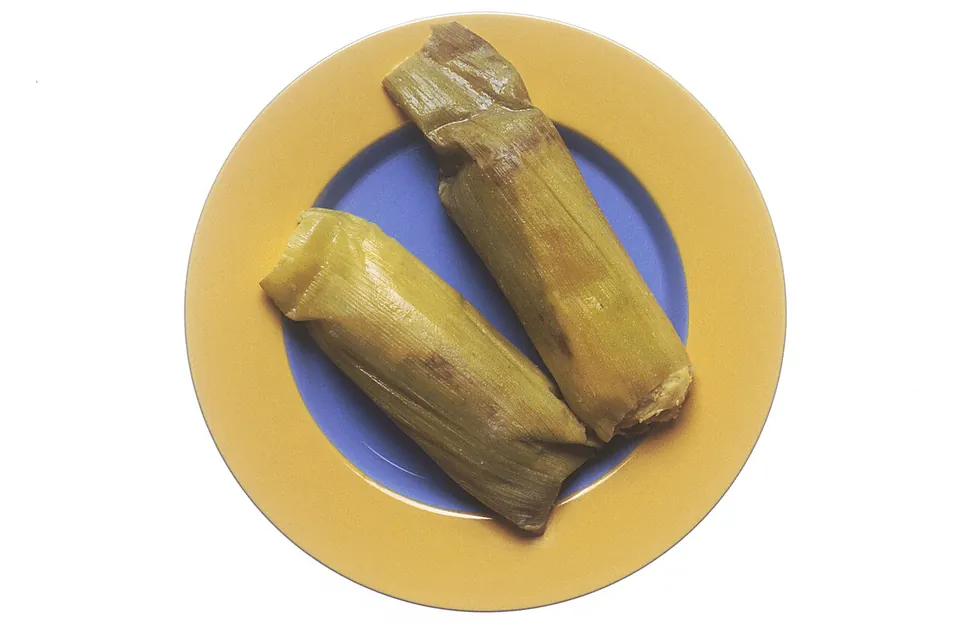
A tamale is a parcel of corn dough wrapped around a filling and steamed in its husk, a dish of Mesoamerica, Mexico included. It was made as a ritual offering and as food that could be carried along, and from the offerings of the community it came down, in time, to the everyday table.
The corn at its centre is a crop native to Mesoamerica, long at hand for the people who lived there.
The dough rests on a technique: treating corn with lime and then working it into dough. The technique is said to go back to the second millennium BC, and the tamale's dough is built on that old practice. The kneaded dough is wrapped in a corn husk and steamed.
How we know
Tamales carry two things worth pausing over: a tale to be unmade, and the line between what is known and what is not.
Take the tale first. Aztec myth tells that the goddess Tzitzimitl sacrificed her grandchild to make the first tamale. And a popular tagline circulates widely: that the tamale emerged eight to ten thousand years ago and is among the oldest dishes in the world. But a myth is not a record of how something began, and the figure of eight thousand years confuses the antiquity of corn cultivation itself with the time when the tamale as a dish appears in images and excavated remains. The tamale shows itself as a dish in a mural from around the turn of the era inside the pyramid at San Bartolo in Guatemala, where, within a mountain cave, a woman holds out a basket of tamales. At Teotihuacan, a burned offering pit dated to AD 300–350 yielded carbonized fragments of food; the researchers who analysed one of them describe it as corn dough combined with chia seeds and judge it most likely to be a piece of a tamale. The same researchers add that they cannot rule out a tortilla (Cagnato et al. 2025).
On that footing, one thing is firm: this was Indigenous food. There is the painted image, there are the fragments from the offering pit, and there is the account of Aztec festivals that Sahagún wrote down in the sixteenth century, which includes a scene in which many kinds of tamales, each under its own name, are handed out at a festival meal. Image, material remains, and text—three separate lines of evidence—meet at the single point that Indigenous people were making this dish.
What stays unsettled is what lies beyond. Whether the Olmec, the Maya, or the Toltec made it first, and how far back it reaches—the sources disagree on both the date and the maker, and do not settle on a single answer. The tamale comes down to us with the certainty of its origin and the vagueness of its founding date living side by side.
The full set of origin theories and the detailed verification log — traceable all the way to their sources — are available on the Japanese edition.
See the full origin theories and verification log (Japanese) →
Related dishes
Shares the key ingredient
- UgaliEast Africa (Kenya / Tanzania)C
- CornbreadSouthern United StatesB
- ArepaColombia / VenezuelaB
- Indigenous maize bread (corn pone / ashcake, before leavened cornbread)North America (Indigenous maize-cultivation range)B
- PupusaEl SalvadorC
- GritsAmerican SouthB
- PozoleMexicoC
- Pre-Columbian ceremonial pozole (turkey or dog with nixtamalized maize, before pork)Mesoamerica (pre-Columbian Mexico)C
- Indigenous corn-dough dish (humita family)Araucanía (Chile)B
- Brunswick stewSouthern United StatesC
- NachosPiedras Negras (Northern Mexico)B
- MukimoKenya (Kikuyu country)C
- PanuchoYucatán (Mexico)C
- PapSouth AfricaB
- Mukbil polloYucatán (Mexico)C
- KenkeyGhanaC