All dishes / South Asia
Gulab jamun Period COrigin theory CVerified
Some fields (dish name, region and gates) are shown from the Japanese-edition data.
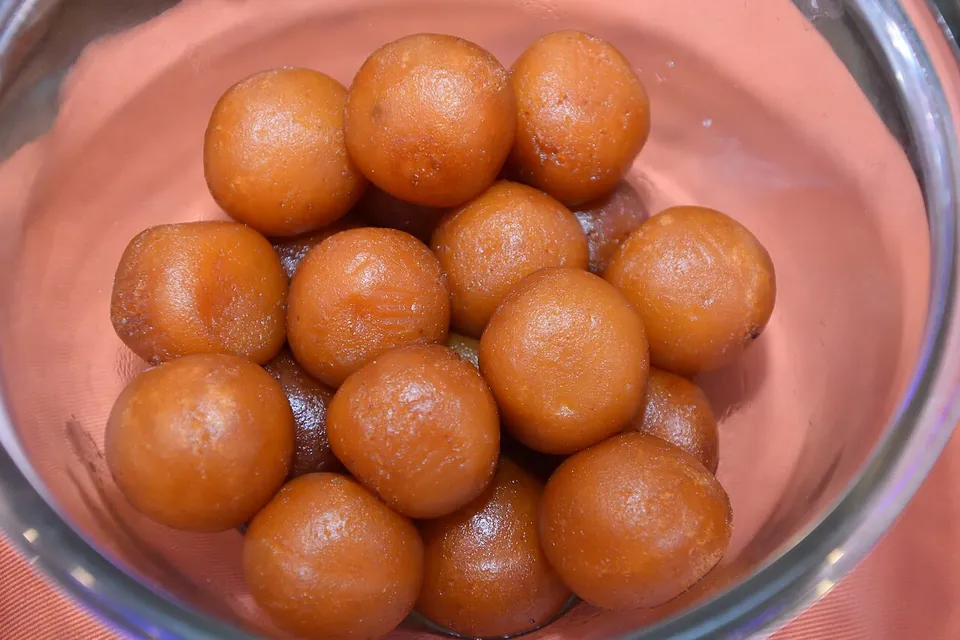
A South Asian sweet of khoya (milk cooked down to solids), rolled into balls, fried and steeped in rose-scented syrup. The well-known tale that a cook of the Mughal emperor Shah Jahan created it by accident has no contemporary record put forward to support it.
Verification highlight popular claim → verdict → evidence
The popular legend that Mughal emperor Shah Jahan's court cooks accidentally invented gulab jamun is unsubstantiated: it appears nowhere in contemporary Mughal chronicles such as the Ain-i-Akbari, and food historian Colleen Taylor Sen does not mention it either -- rejected as an unsupported origin myth. The real, still-debated question is narrower: whether the dish descends from the 13th-century Persian/Arab fried sweet luqmat al-qadi, or whether the koya-based form was an independent Mughal-era Indian invention.
The three gates
- Ingredient-supply gate
- Milk solids (koya), sugar, and rosewater are all Old World staples; no limiting ingredient constrains the earliest possible date.
- Cooking-technique gate
- Milk is reduced to koya, rolled into balls, fried, then soaked in sugar syrup.
- Venue gate
- Royal courts, festivals, and sweet shops (halwai).
Overview
Gulab jamun is one of the signature sweets of festive tables and sweet shops across the Indian subcontinent. Khoya, made by slowly simmering milk until its water has cooked away, is rolled into balls, fried to a deep golden brown, and dropped straight into a syrup of sugar and rose water so that the sweetness soaks through to the center. Its appeal lies in two textures meeting in a single bite: the fragrant, toasty outside and the soft, almost melting inside.
Khoya is a South Asian milk product, made by keeping milk on the fire for a long time until it reduces to something close to a solid. Gulab jamun takes that khoya, fries it and steeps it in sweet syrup, a sweet built around concentrated milk.
The name itself is a clue to where the sweet came from. Gulab is Persian for flower water, that is, rose water, and jamun echoes the name of a fruit. Steeping the balls in rose-scented syrup carries a trace of Persian confectionery. When the name gulab jamun first appears in the written record has not yet been traced. Today it is a fixture of festivals and of the shops of the halwais, the sweet-makers of the street.
How we know
One story has been told, plausibly enough, as the beginning of gulab jamun: that a cook of the Mughal emperor Shah Jahan, taking inspiration from Persian and local sweet-makers (halwais), created the sweet by accident. An invention born in the emperor's kitchen makes for a good story. Yet if the emperor's own cook had produced it, one would expect at least the dish's name or a recipe to turn up somewhere in the records of the time. No such passage has been put forward, and Colleen Taylor Sen, a food historian who writes in detail about how the Mughals ate, does not mention the story either. For now, no independent support for the anecdote has been put forward.
Set the palace legend aside, and two more plausible accounts of the sweet's origins remain.
One looks to the Persian and Arab world. Medieval Arab cooks made a sweet called luqmat al-qadi ("the judge's morsel"), in which dough was fried and steeped in a syrup containing rose water. Its oldest surviving recipe is recorded in the thirteenth-century Baghdad cookbook Kitab al-Tabikh (1226). The scenting and the steeping in sweet syrup are so alike that, on this view, the Arab sweet was the prototype, carried to India in the Mughal period. The Persian word for rose water in the name lends the view support.
The other holds that the present form took shape in India itself. The rose-water syrup may look the same on the surface, but the body of the sweet is entirely different. The Arab sweet fries a dough; inside gulab jamun is khoya, milk cooked down to solids. With the substance this different, calling one the descendant of the other on the strength of the syrup alone goes too far. On this reading, the present form, fried balls of khoya, was put together in Mughal-period kitchens against the background of South Asia's tradition of working with milk.
Food-history scholarship keeps both faces in view, a Persian fried sweet as the ancestral form and a reworking through India's milk craft, without discarding either. Dressed in the shared coat of rose water and sweet syrup, does this sweet carry a memory of Persia, or is it a form that South Asia's own milk craft arrived at independently? That line has not yet been clearly drawn.
The full set of origin theories and the detailed verification log — traceable all the way to their sources — are available on the Japanese edition.
See the full origin theories and verification log (Japanese) →