All dishes / South Asia
Dal bhat Period COrigin theory CVerified
Some fields (dish name, region and gates) are shown from the Japanese-edition data.
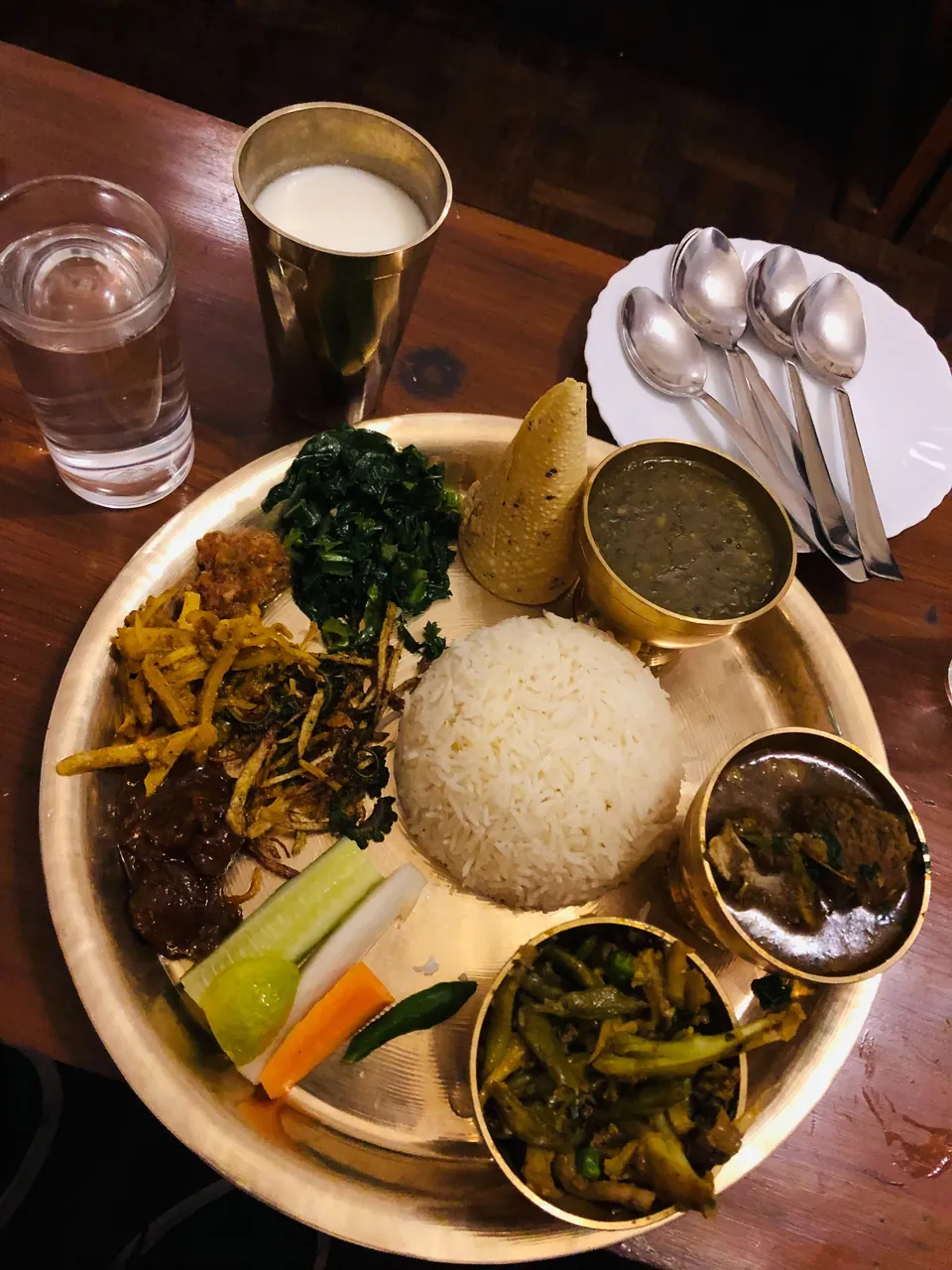
Dal bhat is the everyday meal of Nepal. Ask who invented it, and the record offers no name. A set meal pairing rice and lentils, two old staples long rooted in the land, is thought to have spread little by little from place to place.
Verification highlight popular claim → verdict → evidence
The record names no inventor or founding event for dal bhat. Rice and pulses were both native South Asian staples, grown together at Indus Civilization settlements (c. 3200–1500 BCE, per Petrie et al. 2016). A pairing of rice and pulses appears in Vedic-era terms such as khicca; this marks when such food first appears in the record, not when dal bhat began. A 2018 news report quotes the excavator of the Ter site in Maharashtra as saying that pots from around the first century held rice and mung beans cooked together. The set meal of rice, lentil soup and side dishes is thought to have spread little by little across the region; when and where it took that form, the record cannot say.
The three gates
- Ingredient-supply gate
- Both rice and lentils were native staples.
- Cooking-technique gate
- Steamed rice served with a lentil soup and side dishes, as a set meal.
- Venue gate
- An everyday Nepali set meal.
Overview
Dal bhat pairs cooked rice (bhat) with a thin lentil soup (dal), rounded out with a vegetable side. In Nepal it is the plainest and most common shape a meal can take, the food people eat day after day.
Its two leads, rice and lentils, are both staples with deep roots across South Asia. Rice with a lentil soup and a vegetable side is a well-balanced plate: it supplies protein and carbohydrate from plants alone, without strain.
Eating rice and pulses together is an old habit. At settlements of the Indus civilisation, rice and pulses have been found grown side by side in the same places. The rice-and-pulse pair also surfaces in the word khicca, which appears in Vedic-era texts. According to a 2018 newspaper report, the excavator of the site of Ter in Maharashtra said that a layer there from around the first century yielded pots holding burnt grains of rice and mung beans cooked together.
Within Nepal, dal bhat took hold in the rice-growing lowlands of the Terai and the Kathmandu Valley. In the high country, where rice gives way to millet, the staple was dhindo, a stiff millet porridge; dal bhat spread according to what the land would grow.
How we know
Most famous dishes come with an inventor or a founding tale. Dal bhat has no such story. No record names a person who devised it, and none marks a place or moment where it began.
Whether the clues were simply lost, or the dish never had a single birthplace to begin with, the record cannot say. It is thought that in the farming societies of South Asia, where rice and pulses were both native staples, the habit of eating the two together took hold naturally in many places.
The age of the rice-and-pulse pairing can be read from crop remains at old settlements and from texts. At Indus settlements rice and pulses were raised on the same ground. On the textual side, from the Vedic khicca to early medical treatises, a one-pot dish of rice and pulses keeps reappearing. But each of these marks only the earliest sign that such food already existed; none tells us the year dal bhat was born. As for traces of the cooked dish, a news report says that pots from around the first century at Ter in Maharashtra held the residue of rice and mung beans cooked together. When the plated meal itself—rice, dal and side served in separate dishes—took its settled form remains an open question.
The search for a single origin of dal bhat stays open.
The full set of origin theories and the detailed verification log — traceable all the way to their sources — are available on the Japanese edition.
See the full origin theories and verification log (Japanese) →
Related dishes
Shares the key ingredient
- BiryaniSouth Asia (Deccan / Mughal)C
- DosaSouth India (Tamil Nadu / Karnataka)C
- PaellaValencia, SpainB
- Risotto alla milaneseMilan (Lombardy, Italy)B
- Nasi gorengIndonesia (Java)C
- JambalayaNew Orleans (Louisiana, USA)C
- MujaddaraLevant (Syria, Lebanon, Palestine)B
- DoriaYokohama, JapanB
- IdliSouth IndiaC
- MaqlubaPalestine / LevantC
- White mixed rice (hondon-ban / goldong-ban)Korean PeninsulaC
- MandiHadhramaut (Yemen)C
- Rice and native-grain upma (sada upma, before semolina)South IndiaC
- KiribathSri LankaD
- KabsaSaudi ArabiaC
- PlovUzbekistan (Samarkand / Fergana)C
- MachboosPersian Gulf (Bahrain / Kuwait)B
- Gallo pintoCosta Rica / NicaraguaC
- KoshariEgyptC
- PilauEast Africa (Swahili Coast)C
- Rice-and-lentil koshari (before pasta and tomato)EgyptC
- Bánh cuốnVietnamB
- MahshiEgyptB
- PolowIranC
- PulaoNorth IndiaB
- PilavAnatoliaC
- Kabuli palawAfghanistanC
- Pilaf (French)FranceC
- Pilaf (Japanese-style)JapanC
- Arroz de mariscoAlgarve (Portugal)C
- CasadoCosta RicaC
- Nan gyi thokeMyanmarC
- Mont diMyanmarC
- AranciniSicily (Italy)C
- Mazbi (madhbi)Yemen (Hadhramaut)C