All dishes / Southeast Asia
Hainanese chicken rice Period BOrigin theory CVerified
Some fields (dish name, region and gates) are shown from the Japanese-edition data.
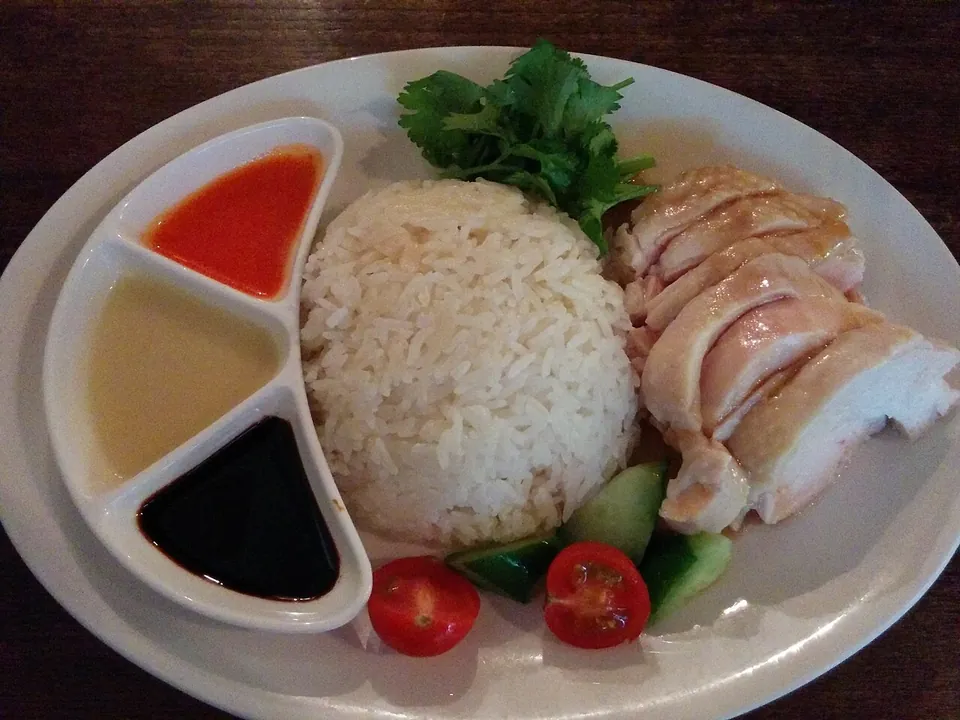
A glistening chicken with rice cooked in its own broth. Hainanese chicken rice, often called Singapore's national dish, grew from a chicken dish of China's Hainan Island and was raised in the eating houses of Southeast Asia by migrants from Hainan. A shop was already advertising itself as the dish's originator in 1950, yet who actually came first is still unsettled.
Verification highlight popular claim → verdict → evidence
Myth: a single named founder invented the dish (Wang Yiyuan, Yet Con, or Moh Lee Twee's Swee Kee). Verdict: unresolved. The dates attached to these names come from later accounts and disagree with one another. In a 1950 Straits Times advertisement, a Singapore shop was already offering HAINAN CHICKEN RICE "Specially prepared by the Originator of HAINAN CHICKEN RICE": by 1950 at the latest the dish was sold under that name, and at least one shop was already claiming to have originated it. No record from the period has yet surfaced that settles who came first. The lineage itself is the accepted view: the dish grew out of Hainan's Wenchang chicken, carried to Southeast Asia by Hainanese migrants, with the earliest Singapore shops said to have opened in the 1930s-1940s. The Singapore vs. Malaysia dispute also stays open. Hainanese migrants lived in many parts of British-ruled Malaya; Singapore became a separate British crown colony in 1946, joined Malaysia in 1963 and separated in 1965. In 1950 neither present-day Malaysia nor Singapore yet existed as a country, so the dish cannot be called either country's invention. Key sources: Singapore Intangible Cultural Heritage record; advertisements in The Straits Times (1950) and The Singapore Free Press (1951); Parliament of Singapore, Historical Development.
The three gates
- Ingredient-supply gate
- Both chicken and rice are native staples (unlikely to be the limiting ingredient).
- Cooking-technique gate
- The chicken is poached whole just below boiling point, and the rice is cooked in the resulting broth and chicken fat with ginger, garlic, and pandan.
- Venue gate
- A community dish of Hainanese migrants that spread through urban eating houses, coffee shops, and hawker stalls in the British colonial period.
Overview
Hainanese chicken rice is a whole chicken poached slowly in water held just below the boil, served with rice cooked in that broth and the bird's rendered fat along with ginger, garlic, and pandan leaf. In Singapore it is a fixture of neighbourhood eating houses, coffee shops, and the hawker centres where food stalls cluster. Chicken and rice were long-established foods on everyday tables in the region, and the way of cooking that draws the chicken's savour, broth and fat together, into the rice has been passed down as the heart of the dish.
Its source is Wenchang chicken, a celebrated chicken dish of Hainan said to date back to the Qing dynasty. Migrants who left Hainan for Southeast Asia in the nineteenth and early twentieth centuries carried it with them, together with the habit of cooking rice in chicken stock. Made in the towns of their new home, the dish slowly changed. Wenchang chicken is steamed; Hainanese chicken rice is cooked by steeping the bird in hot water. The bird itself changed too: Cantonese cooks later turned from the bony Wenchang chicken to younger, more tender birds.
The earliest shops in Singapore built around chicken rice are said to have opened in the 1930s and 1940s. Hainanese migrants lived not only in Singapore but across the Malay Peninsula, and the same line of chicken rice also reaches Thailand, where it became khao man kai.
How we know
That Hainanese chicken rice came from Hainan is hardly in doubt. Singapore's National Heritage Board, in its record of the country's intangible cultural heritage, says the dish is believed to have evolved from the Wenchang chicken of Hainan, and that migrants brought the recipe with them and changed it over time under local influences.
What remains open is a different question: who, or which shop, first gave it its present form. Three names come up most often. One is Wang Yiyuan, said by some accounts to have begun selling balls of chicken rice wrapped in banana leaf in the 1920s. Other accounts, though, have him arriving in Singapore in 1936, or hawking chicken rice from a shoulder pole in the 1940s, so even the decade is uncertain. The second is Yet Con, a shop said to have opened in the early 1940s. The third is Swee Kee, the shop of Moh Lee Twee, which is said to have opened in 1947 or in 1949, depending on the account. The Hong Kong food writer Chua Lam regards Moh Lee Twee as the creator of the dish.
All of these dates come from accounts written later. The newspapers of the time offer something firmer. On 15 June 1950, The Straits Times carried an advertisement from a Singapore establishment, the Ta Tong Restaurant Bar, announcing that from that Thursday on it would serve HAINAN CHICKEN RICE daily, "Specially prepared by the Originator of HAINAN CHICKEN RICE." The following year, Swee Kee ran its own advertisement for "Hainan Chicken Rice" in another English-language paper. By 1950 at the latest, then, the dish was being sold to diners under that name, and at least one shop was already claiming to have originated it. Whom the advertisement meant by "the Originator" is not known, and no record from the period has yet surfaced that settles who was first.
A contest between nations has tangled the story further. Hainanese chicken rice is widely known as Singapore's national dish, but Malaysia also claims it. In 2009 the Malaysian tourism minister Ng Yen Yen called it uniquely Malaysian and said it had been hijacked by other countries. She later said she had been misquoted on any intention to patent the dish, and added that she would look into its origins and apologise if she was wrong. In 2018 the finance minister Lim Guan Eng made a joking reference to chicken rice and char kway teow. Yet Hainanese migrants lived in many parts of British-ruled Malaya, in places that now belong to Malaysia and to Singapore. In 1946 Singapore did not join the Malayan Union and became a separate British crown colony; it joined Malaysia in 1963 and separated in 1965 to become independent. When The Straits Times advertisement ran in 1950, neither present-day Malaysia nor Singapore yet existed as a country, and there is no way to call the dish either country's invention.
The trunk of the story, the journey from Hainan, holds firm; the branch tips, who was first and which country it belongs to, remain open.
The full set of origin theories and the detailed verification log — traceable all the way to their sources — are available on the Japanese edition.
See the full origin theories and verification log (Japanese) →
Related dishes
Cross-links Sister dishes & same-name dishes (separate lineage)
- Spread from hereKhao man gaiThailandB
- Diffusion prototypeWenchang chicken riceWenchang, Hainan (China)C
Shares the key ingredient
- Chicken tikka masalaUnited KingdomC
- Wat (Ethiopian stew before chili)Ethiopian HighlandsC
- AjiacoBogotá, ColombiaB
- Jerk chickenJamaicaC
- Soto ayamJava (Indonesia)C
- ShkmeruliGeorgiaB
- MoambeCongo (Central Africa)C
- Nyembwe chicken (Poulet nyembwe)Gabon (Central Africa)C
- Chicken yassaSenegalC
- Chicken KievKyiv (Ukraine)C
- Circassian chicken (Çerkez tavuğu)Turkey (Ottoman court) / CaucasusB
- Sopa de limaYucatán (Mexico)C
- White cut chickenGuangdong (China)C
- Ohn no khao swèMyanmarC
- Kedjenou (canari steam-braise, before tomato)Côte d'IvoireC
- WaterzooiFlanders (Belgium)C
- Soup currySapporo (Japan)B