All dishes / Eastern Europe
Chicken Kiev Period COrigin theory CVerified
Some fields (dish name, region and gates) are shown from the Japanese-edition data.
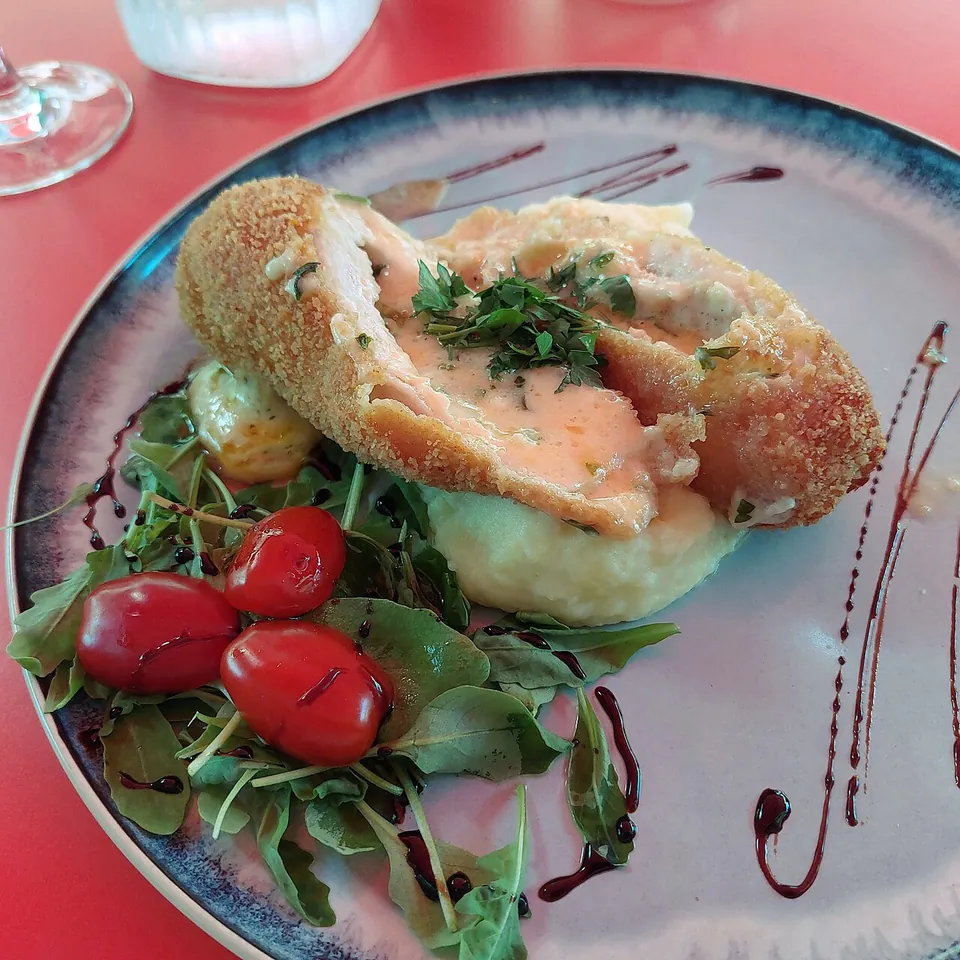
Cut into Chicken Kiev and melted butter spills out. The name carries Kyiv, but its origin remains undecided to this day among Ukraine, Russia, and France.
Verification highlight popular claim → verdict → evidence
Several accounts compete over the earliest source and the naming (Kiev vs. Kyiv). The best-documented line traces it through the Russian court's adoption of French cuisine from the 18th century, via the early-19th-century Pozharsky cutlet (minced chicken with butter), to the "Kiev-style cutlets of chicken or veal" in a 1915 cookbook collecting recipes said to come from a 1913–14 housewives' magazine. That cutlet wraps well-chilled butter in minced chicken or veal and is fried in breadcrumbs; it is not today's form, made by opening out a chicken breast around the butter. The story that it was invented at a Kyiv hotel rests mainly on oral tradition and is weakly documented. The source usually cited for the claim that Carême invented it in 1818 is a 1981 cookbook, which puts it as a guess ("most likely"), so it too is weak as an attribution. Chicken, butter, and wheat were all native ingredients, so no imported ingredient constrained when the dish could form.
The three gates
- Ingredient-supply gate
- Chicken, butter, and wheat were all already native ingredients, so there is no limiting ingredient.
- Cooking-technique gate
- The dish depends on the technique of encasing a butter core and coating it in breadcrumbs before frying (the cotelette method).
- Venue gate
- It began in upscale restaurants and later spread as banquet and restaurant fare during the Soviet era.
Overview
Chicken Kiev is a cutlet of chicken breast wrapped around cold butter, shaped, breaded, and fried. Put a knife to it and the butter sealed inside runs out. It is made from chicken, butter, and wheat—all long available in this region. The butter is set at the core, the thinly spread chicken folded firmly around it, coated in crumbs, and fried. This cutlet technique, of French descent, is what produces a dish that releases butter the moment it is cut open, and it is what lifts the plain materials of chicken and butter into something finer.
The dish first appeared as a fine-restaurant item, and over the Soviet twentieth century it spread into the standard fare of dining out and banquets, and so became widely known.
How we know
Chicken Kiev comes with several competing accounts of whose dish it really is.
The strongest documentary support belongs to a gradual development out of the Russian court. From the eighteenth century the Russian court took up French haute cuisine, and by the first half of the nineteenth the Pozharsky cutlet—minced chicken with butter—had emerged. Further along that line, a 1915 recipe collection published by the magazine Zhurnal dlya khozyaek ('Housewives' Journal'), said to gather recipes the magazine had run in 1913–14, records a Kiev-style cutlet of chicken or veal built around a core of cold butter. A paste of minced chicken or veal is wrapped around butter chilled as cold as possible, shaped into a cone, coated in egg and breadcrumbs, and fried; it is not today's form, made by opening out a chicken breast around the butter. This is the oldest document now traceable. The Soviet-era standards for public catering later fixed the name. Recent reporting (The Moscow Times, 2024) has also taken up this line.
Kyiv, whose name the dish carries, has its own tradition. The story goes that early in the twentieth century it was devised at the restaurant of Kyiv's Continental Hotel, which opened in 1897, as a 'Kiev-style côtelette de volaille.' This is where the dish's name comes from, but its basis is chiefly oral and thin on documents. There is a French claim as well: that the celebrated cook Carême devised it during his 1818 visit to Saint Petersburg. But the source usually cited for this attribution is the 1981 Russian Tea Room Cookbook, which puts it as a guess ("most likely"). His truffled dish came earlier but did not directly produce the modern Chicken Kiev, and no recipe for the modern form is found in French cuisine. As an attribution it is weak.
Apart from these theories, there is one that spread widely and was then broken by the sources. The Soviet food historian William Pokhlebkin held that Chicken Kiev was born in 1912 at a Saint Petersburg merchants' club as the 'Novo-Mikhailovskaya cutlet' and was renamed 'Kiev-style cutlet' in a Soviet restaurant in 1947. But the primary sources do not fit. A cookbook by Alexandrova-Ignatieva, said to have been published in 1909, already includes the Novo-Mikhailovsky cutlet and states that it was first made at the rural landowners' club on Mikhailovskaya Street in Saint Petersburg, which does not square with an invention in 1912. Its method, too, works butter into chicken pounded fine, rather than wrapping a core of cold butter. And the name 'Kiev-style cutlet' already appears in that same 1915 recipe collection, which does not square with a renaming in 1947 either. The origin anecdote is vivid, but no contemporary record supports it.
Which land's dish it is remains an open question. What can be said for certain is this one thing: the earliest the dish's name survives in the sources is the beginning of the twentieth century.
The full set of origin theories and the detailed verification log — traceable all the way to their sources — are available on the Japanese edition.
See the full origin theories and verification log (Japanese) →
Related dishes
Shares the key ingredient
- Chicken tikka masalaUnited KingdomC
- Wat (Ethiopian stew before chili)Ethiopian HighlandsC
- AjiacoBogotá, ColombiaB
- Jerk chickenJamaicaC
- Soto ayamJava (Indonesia)C
- ShkmeruliGeorgiaB
- Khao man gaiThailandB
- Hainanese chicken riceHainan (China) → SingaporeC
- MoambeCongo (Central Africa)C
- Nyembwe chicken (Poulet nyembwe)Gabon (Central Africa)C
- Chicken yassaSenegalC
- Circassian chicken (Çerkez tavuğu)Turkey (Ottoman court) / CaucasusB
- Sopa de limaYucatán (Mexico)C
- White cut chickenGuangdong (China)C
- Ohn no khao swèMyanmarC
- Kedjenou (canari steam-braise, before tomato)Côte d'IvoireC
- WaterzooiFlanders (Belgium)C
- Soup currySapporo (Japan)B