All dishes / Latin America
Carne asada Period BOrigin theory CVerified
Some fields (dish name, region and gates) are shown from the Japanese-edition data.
The weekend ritual of grilling beef in Monterrey has long been credited to Sephardic Jews among the city's early settlers. The origin story is told with confidence—yet nothing in the record supports it.
Verification highlight popular claim → verdict → evidence
A story told in Monterrey holds that the city's early settlers, Sephardic Jews who had converted to Christianity (conversos), brought the habit of grilling meat over an open fire, and that the weekend carne asada grew from it. Local media repeat it with the words "according to historians", but no historian is named, and no contemporary record linking converso cooking to open-fire grilling has been found. The historian Tito Sabinas points instead to Tecate beer television commercials of the 1980s as what spread the modern weekend custom, which explains how the habit spread, not how the dish began. Carne asada took shape gradually in the cattle-ranching life of colonial northern Mexico, with no known inventor or date; a Mexican cookery dictionary of 1845 already describes thin slices of lean meat grilled over embers, but under the entry carbonada, also calling it asado del pastor, "the herdsman's roast", and has no entry for carne asada. Whether the dish began in Sonora or in Nuevo León is still disputed.
The three gates
- Ingredient-supply gate
- Cattle are not native to the Americas; they were brought over in the colonial period. Beef is the heart of the dish, and the spread of cattle ranching to Sonora and the rest of northern Mexico, between the late 16th and the late 17th century, sets its earliest possible date.
- Cooking-technique gate
- Grilling thinly sliced beef over an open charcoal or wood fire.
- Venue gate
- From outdoor cooking on ranches and at home to a staple of street food and festive gatherings.
Overview
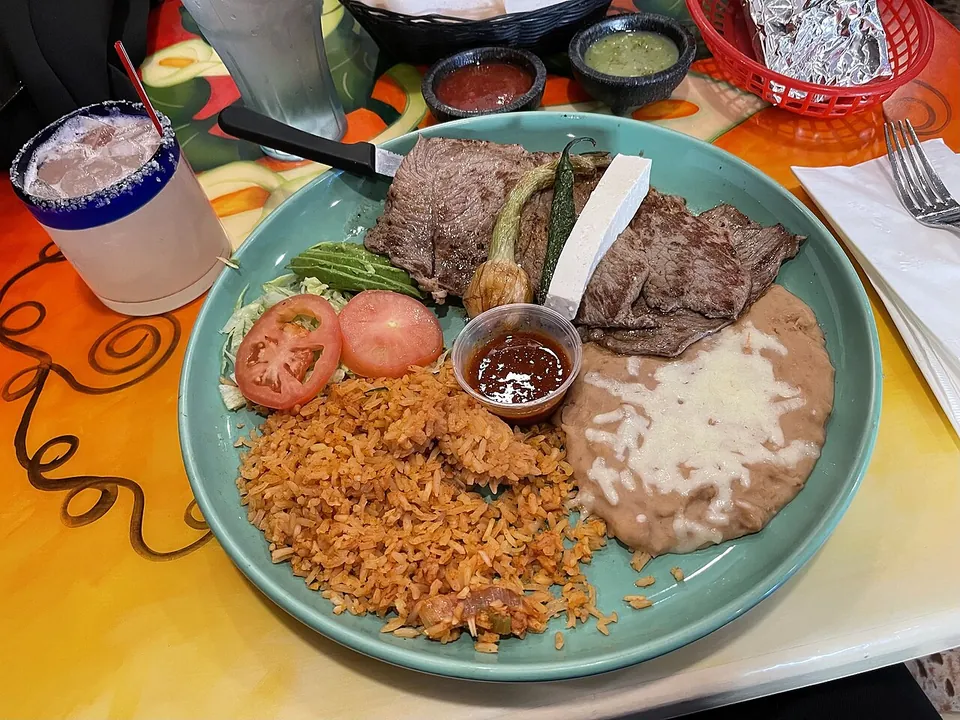
Carne asada is a plain and direct dish: thin slices of beef laid on a charcoal or open-flame grill and seared hard and fast. You squeeze lime over it and eat it with corn tortillas.
The beef at its center was never a native animal here. During the Spanish colonial period, from the 16th century onward, Old World cattle crossed the ocean into these lands, and large ranches (haciendas) and a vaquero herding culture grew up across the northern states of Sonora, Nuevo León, and Chihuahua. Where beef was cheap and plentiful, slicing it thin and grilling it over coals came naturally out of that ranching life. It began at the ranch yard and the household outdoor fire, then spread to street stalls and became a fixture of celebrations.
No single person invented it, and there is no clear founding year. As cattle spread through the north across the late 16th and 17th centuries and a ranching economy and culture took root, the dish gradually took its form.
How we know
In Monterrey, families and friends gather on weekends to grill beef—a deeply rooted habit. Around it, one origin story has long circulated locally: that the city's early settlers, Sephardic Jews—conversos who had fled persecution—brought with them the custom of grilling meat over an open flame. Local media have retold it again and again, prefaced with 'according to historians.'
But look for anything to hold the story up, and nothing turns up. No named historian appears, and no contemporary record ties converso cooking customs to an open-flame grilling tradition. There is only the passed-down telling. The historian Tito Sabinas points instead to something else: the modern habit of weekend grilling spread through a consumer culture, driven by 1980s television commercials for Tecate beer. That is not the dish's origin but the later story of how a way of eating caught on.
So where did carne asada come from? The founding state is still disputed—some say Sonora, others Nuevo León—and no primary source settles it. Yet both sides agree on one point: the seedbed that raised this dish was the ranching life that took hold once Old World cattle settled into the northern land. It was invented by no single ethnic group and devised by no one cook; it came slowly into form out of the needs of a land living alongside cattle. That is the picture drawn by scholarship on cattle in Latin American history and by studies of the ranching cultures of Sonora and Nuevo León.
The full set of origin theories and the detailed verification log — traceable all the way to their sources — are available on the Japanese edition.
See the full origin theories and verification log (Japanese) →
Related dishes
Shares the key ingredient
- PhoVietnamB
- Beef StroganoffRussiaC
- Chicago Italian beefChicago (USA)C
- Salt beef (before canning)Ireland (Cork / Dublin)C
- AsadoRío de la Plata (Argentina / Uruguay)B
- Lomo saltadoLima (Peru)C
- BulgogiKorean Peninsula (South Korea)B
- ĆevapčićiBalkans (Serbia, etc.)C
- Native grilled meat (maekjeok and neobiani, before bulgogi)Korean PeninsulaC
- Forerunner of goulash (the herdsmen's meat stew before paprika)HungaryC
- KharchoGeorgia (Caucasus)B
- Merendang (beef and coconut milk, before chili rendang)West Sumatra (Minangkabau), IndonesiaC
- Nyama chomaEast Africa (Kenya, Tanzania)C
- Philly cheesesteakPhiladelphia (USA)B
- Pastel de chocloChileC
- NihariNorth India (Delhi / Awadh)C
- NikujagaJapanC
- Australian meat pieAustraliaC
- FajitasRio Grande Valley, Texas (USA)B
- Loco mocoHilo, Hawaii (USA)B
- KitfoGurage (Ethiopia)C
- Ropa viejaCubaC
- MachacaNorthern Mexico (Sonora / Sinaloa)C
- Ropa vieja (Iberian prototype)Canary Islands, SpainB
- TibsEthiopian HighlandsB
- BiltongSouth AfricaC
- Lok lakPhnom Penh (Cambodia)C
- Hamburg steakHamburg (Germany)B
- Bò lúc lắc (Vietnamese shaking beef)Southern VietnamC
- Montreal-style smoked meatQuebec (Canada)D
- Kare-karePhilippinesC
- PastramiNew York (USA)D
- BraaiSouth AfricaC
- French dip sandwichLos Angeles, California (USA)C