All dishes / South Asia
Nihari Period BOrigin theory CVerified
Some fields (dish name, region and gates) are shown from the Japanese-edition data.
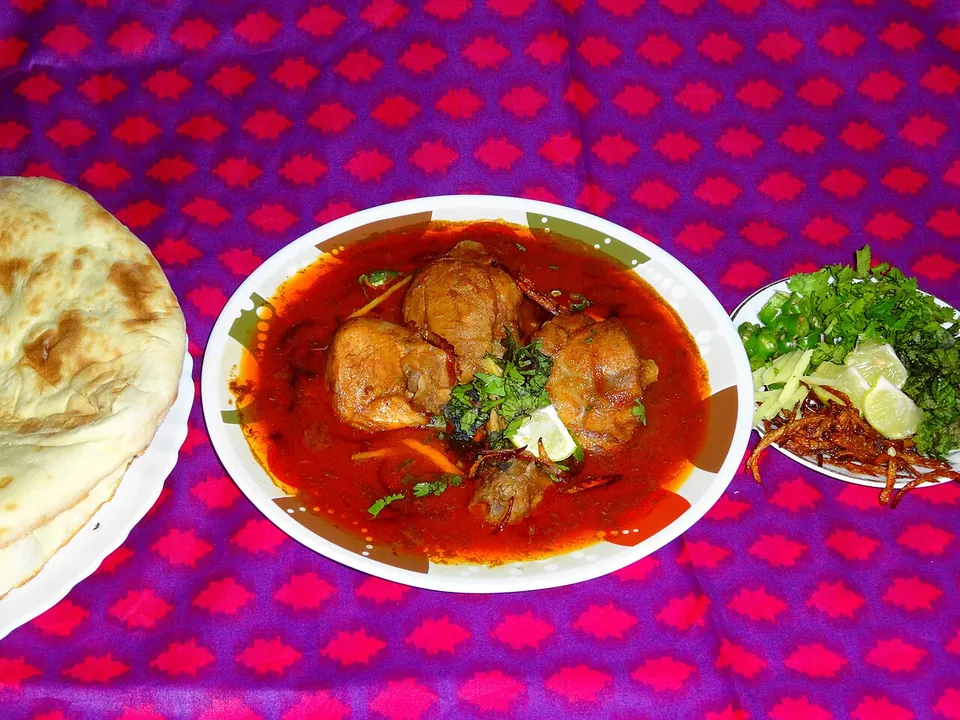
A rich stew of beef or mutton, meats long at home in South Asia, simmered over a low flame through the night. The well-known anecdote that a Mughal emperor's court physician devised it as a medicinal dish is not supported by contemporary records, and where this morning dish was born is still undecided: one tradition places it at the late-eighteenth-century court of Awadh (Lucknow), while another account places it in Delhi, a version some set as far back as medieval times.
Verification highlight popular claim → verdict → evidence
Myth: a court physician (hakim) under Mughal emperor Shah Jahan (r. 1628-58) invented nihari as a preventive remedy against cold, spiced with fenugreek and turmeric. Verdict: rejected — this popular restaurant/pop-history legend has no contemporary documentation, and academic references (the Bloomsbury Handbook of Indian Cuisine) place the dish's actual origin about a century later, in the late 18th century. Two undecided traditions remain for that later origin: the Lucknow/Awadh Nawabi court (best supported, with an anchor in the 1784 famine-relief construction of the Bara Imambara) and Mughal-era Delhi (Jama Masjid backstreets) — scholars have not settled between the two.
The three gates
- Ingredient-supply gate
- Not limiting: beef and mutton were native to South Asia (zebu cattle domesticated independently there from c. 6500 BCE), so ingredients placed little constraint on origin.
- Cooking-technique gate
- Overnight, low-heat dum-style slow cooking of bone marrow and shank meat, seasoned with spices such as long pepper (pippali), thickened with wheat flour — a Mughal/Awadhi court cooking technique.
- Venue gate
- The kitchens of Nawabi/Mughal nobility; served after Fajr (dawn) prayer as breakfast (the name nihari derives from Arabic nahar, 'morning'); later spread to laborers such as those building the Rumi Darwaza. The court setting and breakfast timing are what limit the dish's origin.
Overview
Nihari is a meat stew that has taken root across northern India, from Delhi to Lucknow. Shin of beef or mutton and the marrow are simmered with spices such as long pepper (pippali) and thickened with wheat flour. Take a spoonful and you get a deep, dense broth in which marrow, melted out of the bone over a whole night, clings to the tongue.
The heart of the dish is the length of that simmer. The pot is set over a weak flame and cooked slowly through the night. This long simmer (the dum method), refined in court kitchens from the Mughals to Awadh, turns tough shin into a dish so tender it falls apart under a spoon. All night the broth, thick with melted marrow, reduces quietly over the low fire, and by morning the savor of the marrow has gathered into a single bowl.
The name itself tells where the dish comes from. Nihari derives from the Arabic nahâr, "morning." In the kitchens of the Nawabs and the Mughal nobility it was served as breakfast to those who had finished the dawn prayer (Fajr). A bowl that had simmered in the kitchen through the night came to the table steaming after the daybreak prayer: a morning dish to warm the body and give strength at the start of the day.
In time the court breakfast spread to working people too. There is a story that it was made for the labourers gathered to build the Rumi Darwaza (Rumi Gate) in Lucknow, but this does not go beyond tradition. Having come down from the court kitchen to the street corner, Nihari became a popular food with deep roots in the cities of northern India.
How we know
One origin story for Nihari remains popular. In the reign of the fifth Mughal emperor Shah Jahan (r. 1628-1658), it goes, a court physician (hakim) in old Delhi devised a mutton stew with fenugreek and turmeric as a remedy against chills and colds, so Nihari began life as a medicinal dish. Restaurant owners and popular history pieces have liked to retell this tale of a seventeenth-century physician.
The broader style of dish may well be old, but no contemporary record has come to light that places this anecdote in the seventeenth century. Reporting that traced the origin legends (Open The Magazine) states plainly that the founding stories, the physician's tale among them, are wrapped in serious doubt. The story of a physician creating the dish as medicine is best read as a court-founder legend that lacks support.
Where, then, did it really begin? Here too two places put forward claims. One is Awadh, with the tradition that the dish arose in the late eighteenth century at the Nawab's court in its capital, Lucknow. The other is Delhi, where a story has it starting in the lanes behind the Jama Masjid in the old city, with no settled date. According to the English Wikipedia's summary, The Bloomsbury Handbook of Indian Cuisine, an academic reference on Indian food, also gives the town of origin as Lucknow or Delhi, and which of the two it was has not been settled.
The two accounts differ not only on the town but also on the period; some versions of the Delhi account reach back to medieval times. No single founder has been identified, and Nihari most likely took shape within a court food culture in which meat was simmered overnight in noble kitchens and served after the dawn prayer.
The full set of origin theories and the detailed verification log — traceable all the way to their sources — are available on the Japanese edition.
See the full origin theories and verification log (Japanese) →
Related dishes
Shares the key ingredient
- PhoVietnamB
- Beef StroganoffRussiaC
- Chicago Italian beefChicago (USA)C
- Salt beef (before canning)Ireland (Cork / Dublin)C
- AsadoRío de la Plata (Argentina / Uruguay)B
- Lomo saltadoLima (Peru)C
- BulgogiKorean Peninsula (South Korea)B
- ĆevapčićiBalkans (Serbia, etc.)C
- Native grilled meat (maekjeok and neobiani, before bulgogi)Korean PeninsulaC
- Forerunner of goulash (the herdsmen's meat stew before paprika)HungaryC
- KharchoGeorgia (Caucasus)B
- Merendang (beef and coconut milk, before chili rendang)West Sumatra (Minangkabau), IndonesiaC
- Nyama chomaEast Africa (Kenya, Tanzania)C
- Philly cheesesteakPhiladelphia (USA)B
- Pastel de chocloChileC
- NikujagaJapanC
- Australian meat pieAustraliaC
- FajitasRio Grande Valley, Texas (USA)B
- Loco mocoHilo, Hawaii (USA)B
- KitfoGurage (Ethiopia)C
- Ropa viejaCubaC
- MachacaNorthern Mexico (Sonora / Sinaloa)C
- Ropa vieja (Iberian prototype)Canary Islands, SpainB
- TibsEthiopian HighlandsB
- BiltongSouth AfricaC
- Lok lakPhnom Penh (Cambodia)C
- Carne asadaNorthern Mexico (Sonora)C
- Hamburg steakHamburg (Germany)B
- Bò lúc lắc (Vietnamese shaking beef)Southern VietnamC
- Montreal-style smoked meatQuebec (Canada)D
- Kare-karePhilippinesC
- PastramiNew York (USA)D
- BraaiSouth AfricaC
- French dip sandwichLos Angeles, California (USA)C