All dishes / Oceania
Australian meat pie Period BOrigin theory CVerified
Some fields (dish name, region and gates) are shown from the Japanese-edition data.
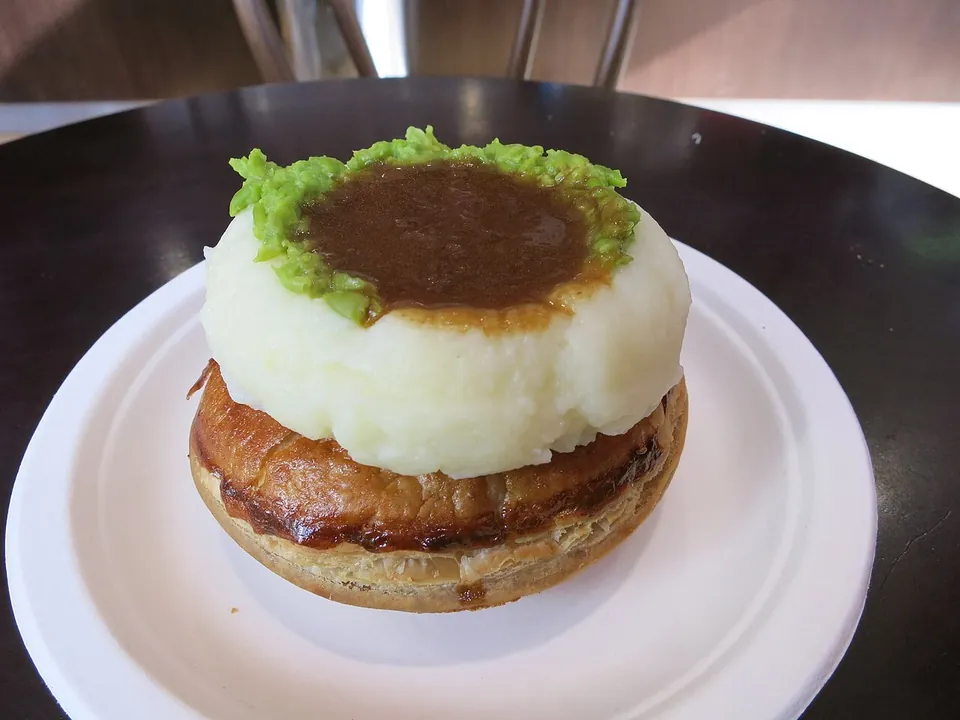
Australia's hand-held pie of beef and gravy. The British pie arrived with the settlers in 1788 and spread through the towns' pie sellers and the railway refreshment rooms, but no record has yet been found of who gave it its present form, or when.
Verification highlight popular claim → verdict → evidence
Myth: the Australian meat pie was invented during the gold rush of the 1850s. Who first put that view in writing is unclear. Verdict: set aside, because pies were already being sold on the streets of Sydney before the gold rush began in 1851. The 1788 journal of George Worgan, a First Fleet surgeon, mentions a kangaroo pie on 14 May, a goat pie made for a wedding meal on 2 June, and pies at the King's Birthday dinner on 4 June. In the early nineteenth century pie sellers cried their wares in the town streets, and William Francis King, the pie seller known as the 'Flying Pieman', began his walking exhibitions in 1842. Even so, the origin remains open: no source names an inventor or a year of invention, and no contemporary record has been found of when the present beef-and-gravy form took shape. Key sources: George Worgan's 1788 journal; Australian Dictionary of Biography (William Francis King); 'The great Australian pie', Australian Food Timeline.
The three gates
- Ingredient-supply gate
- Beef and wheat became locally established through British settlement, drawing on established livestock farming.
- Cooking-technique gate
- Pastry is rolled and folded around a filling, then baked—standard pie-making technique.
- Venue gate
- Workers' street stalls, pubs, and handheld food at sporting events.
Overview
The Australian meat pie is a palm-sized snack: beef and gravy sealed in pastry and baked. One in the hand at a street stall, in a pub or in the stands at a sporting match is an everyday sight in this country.
The pie came across the sea with the settlers. George Worgan sailed with the First Fleet as a surgeon, and his journal for 1788 mentions a cold kangaroo pie eaten on 14 May, a pie made on 2 June for a wedding meal from the meat of a goat that had died, and pies on the table at the King's Birthday dinner on 4 June (what was in them is not recorded). The craft of enclosing a filling in pastry and baking it travelled out from Britain with the people.
The cattle for the filling came with the same fleet. Four cows and two bulls landed in January 1788 and escaped early in June. In 1795 a herd of more than a hundred head in all was found beyond the Nepean River. The report of J. T. Bigge, the commissioner sent to inquire into the colony, published by the British House of Commons in 1823, states that the horned cattle of New South Wales increased fivefold between 1810 and 1820, and that the 1820 returns counted 54,103 head. Bigge himself doubted how accurate those returns were. Whatever the exact figure, by around 1820 beef had become an easy meat to come by in the colony. Wheat, too, arrived with the settlers and came to be grown on the land.
From there the pie worked its way into town life. In the early nineteenth century the streets rang with the cries of pie sellers, and from the mid-1850s pies were a staple of the railway refreshment rooms. In South Australia a way of serving it called the pie floater appeared around the 1890s. The bakery Sargent's was founded in 1891, and in the mid-1940s the Four'N Twenty brand of pie went on sale in Bendigo. In 2003 Bob Carr, the Premier of New South Wales, campaigning for the state election, gathered reporters at a pie shop in his own electorate and called it the "national dish."
How we know
One view has it that the meat pie was invented during the gold rush of the 1850s. Who first put that idea in writing, and where or how widely it has been told, is unclear. And on the streets of Sydney, pies were being hawked before the gold rush began in 1851.
The Sydney of those years had pie sellers known as "the Flying Pieman." Nathaniel McCulloch, an earlier man to go by that name, died in May 1839. The one who later became a local celebrity under the same name was William Francis King (1807-1873), an itinerant pie seller who walked the streets in extravagant dress. When he began selling pies is unclear, but his walking exhibitions, in which he made a spectacle of distance and speed, began in 1842 and went on until about January 1851. Before the crowds headed for the goldfields, the pie was already a street food of the town.
So who created the "Australian meat pie," and when? From the journal kept in the first year of settlement, through the town pie sellers and the railway refreshment rooms, to the founding of a bakery, the record of the pie runs without a break, yet none of it names an inventor or a year of invention. Nor has any contemporary record yet been found showing when the present form, filled with beef and gravy, took shape.
What the records do trace is a path: a pie carried out from Britain, made, sold and eaten on this land from 1788 onward, gradually becoming an Australian food.
The full set of origin theories and the detailed verification log — traceable all the way to their sources — are available on the Japanese edition.
See the full origin theories and verification log (Japanese) →
Related dishes
Shares the key ingredient
- PhoVietnamB
- Beef StroganoffRussiaC
- Chicago Italian beefChicago (USA)C
- Salt beef (before canning)Ireland (Cork / Dublin)C
- AsadoRío de la Plata (Argentina / Uruguay)B
- Lomo saltadoLima (Peru)C
- BulgogiKorean Peninsula (South Korea)B
- ĆevapčićiBalkans (Serbia, etc.)C
- Native grilled meat (maekjeok and neobiani, before bulgogi)Korean PeninsulaC
- Forerunner of goulash (the herdsmen's meat stew before paprika)HungaryC
- KharchoGeorgia (Caucasus)B
- Merendang (beef and coconut milk, before chili rendang)West Sumatra (Minangkabau), IndonesiaC
- Nyama chomaEast Africa (Kenya, Tanzania)C
- Philly cheesesteakPhiladelphia (USA)B
- Pastel de chocloChileC
- NihariNorth India (Delhi / Awadh)C
- NikujagaJapanC
- FajitasRio Grande Valley, Texas (USA)B
- Loco mocoHilo, Hawaii (USA)B
- KitfoGurage (Ethiopia)C
- Ropa viejaCubaC
- MachacaNorthern Mexico (Sonora / Sinaloa)C
- Ropa vieja (Iberian prototype)Canary Islands, SpainB
- TibsEthiopian HighlandsB
- BiltongSouth AfricaC
- Lok lakPhnom Penh (Cambodia)C
- Carne asadaNorthern Mexico (Sonora)C
- Hamburg steakHamburg (Germany)B
- Bò lúc lắc (Vietnamese shaking beef)Southern VietnamC
- Montreal-style smoked meatQuebec (Canada)D
- Kare-karePhilippinesC
- PastramiNew York (USA)D
- BraaiSouth AfricaC
- French dip sandwichLos Angeles, California (USA)C