All dishes / Middle East & North Africa
Tahdig Period COrigin theory CVerified
Some fields (dish name, region and gates) are shown from the Japanese-edition data.
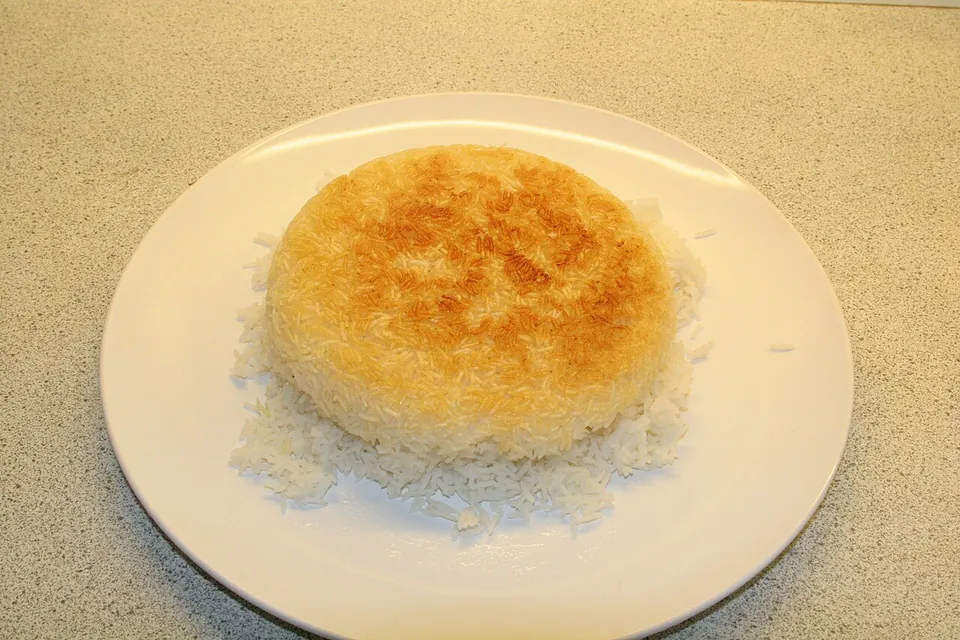
Tahdig, the golden crust of rice fried onto the bottom of the pot, is often said to have been born of a happy accident at a Qajar court. But a crust forms whenever rice is cooked with fat—it is an unavoidable by-product of the technique, not something with a single moment of invention.
Verification highlight popular claim → verdict → evidence
A golden crust at the bottom of the pot forms whenever rice is cooked with fat, so it has no single moment of invention and no early date can be fixed for it. Encyclopaedia Iranica says today's way of cooking rice (soaking, parboiling, then steaming) seems to have begun in the Qajar era, and the word tahdig first appears in 1848, in a Caspian dialect (Mehravari 2021). Popular tales of an accidental invention or of the court menus of two Qajar kings are not backed by any contemporary record, although their "1800s" date fits the dish in its present form.
The three gates
- Ingredient-supply gate
- Rice reached Iran in antiquity (around 300 BC); the cooking fat and saffron were native. Ingredients were not the limiting factor.
- Cooking-technique gate
- The crust that forms at the bottom of the pot when chelow/polow rice is cooked (a technique of browning the rice with fat over low heat).
- Venue gate
- A prized part of rice dishes served in both homes and royal courts.
Overview
Tahdig is the crisp, fragrant, golden crust of rice that clings to the bottom of the pot when Iranians cook chelow or polow. Persian rice is first parboiled and drained, then finished over very low heat with butter or another fat. Cooked this way—the abkesh method, in two stages—the rice against the bottom of the pot is browned in the fat into a savory layer. This is tahdig, and at many tables it is the most prized part of the meal.
The groundwork for this way of cooking rice is old. Rice itself reached Iran in antiquity, by way of the Caspian coast, and has been grown there ever since; fat and saffron were on hand from the start.
The refined form of this cooking is placed at its height in the Qajar era (1789–1925). Encyclopaedia Iranica's entry "Qajar Dynasty xiv" (Qajar cuisine, 2015) notes that in Safavid times even rice was cooked in a single pot, whereas a cookbook of 1883 sets out in detail a four-stage process of washing, soaking, boiling and baking. The same encyclopedia's entry "Berenj" (rice) likewise says that today's way of cooking rice—soaking, boiling, then steaming—seems to have begun in the Qajar period. The crust at the bottom of the pot could be older than that refinement, since rice cooked in fat can brown on the bottom even in the simpler one-pot method, dampokht. The earliest surviving Persian cookbooks, Kar-nama (1520–21) and Madat al-Hayat (1594–95), record the elaborate rice dishes of the Safavid court, among them a wide range of polow (rice cooked together with other ingredients). Whether either book describes the crust at the bottom of the pot itself is not known. Tahdig is the name of one part—the bottom of the pot—within that long tradition of rice cookery.
How we know
Tahdig often comes with an origin anecdote. It was, so the telling goes, "leftovers made good," born by accident from the scraps left in the pot, and it "first appeared on the court menus of two Qajar kings in the Persia of the 1800s." That version circulates widely on food blogs and in the general press.
But no contemporary record supports the plot of the story. First, the crust at the bottom of the pot forms unavoidably whenever rice is cooked in fat; it is not something anyone thought up in a single stroke. Since the days of the simplest one-pot cooking, the rice against the bottom would have browned. Second, the "1800s" date itself is not wrong for tahdig in its present form. Encyclopaedia Iranica's "Berenj" entry says that today's way of cooking rice seems to have begun in the Qajar period. The word tahdig itself surfaces earliest in 1848, in a record of a Caspian dialect, and mentions of the crust have yet to be traced back beyond the middle of the nineteenth century. But that is when the present form enters the record, not when the crust at the bottom of the pot began. What lacks support is the particular plot: the happy accident and the menus of two kings.
So when did it come about? Because the crust is an unavoidable by-product of the cooking, no single point of origin can be fixed. On one view the old layer of the technique may reach back to the rice dishes of the Safavid court (1501–1736): the cookbooks of that century record a court eating many kinds of polow, and rice cooked in fat browns at the bottom of the pot whether or not anyone means it to. No text from those years has yet turned up that describes tahdig itself. The later end is the firmer one. By the middle of the nineteenth century the word is being written down; under the Qajars the dish takes the refined form known today, and by the closing quarter of the century it is settled on the tables of the well-to-do. The story of tahdig runs between these two eras.
From the same abkesh cooking, the fluffy body of rice is called polow and the browned layer at the bottom is called tahdig. Both come from the same rice-centered technique and are loved in their own right, sisters on equal footing.
The full set of origin theories and the detailed verification log — traceable all the way to their sources — are available on the Japanese edition.
See the full origin theories and verification log (Japanese) →