All dishes / Middle East & North Africa
Polow Period BOrigin theory CVerified
Some fields (dish name, region and gates) are shown from the Japanese-edition data.
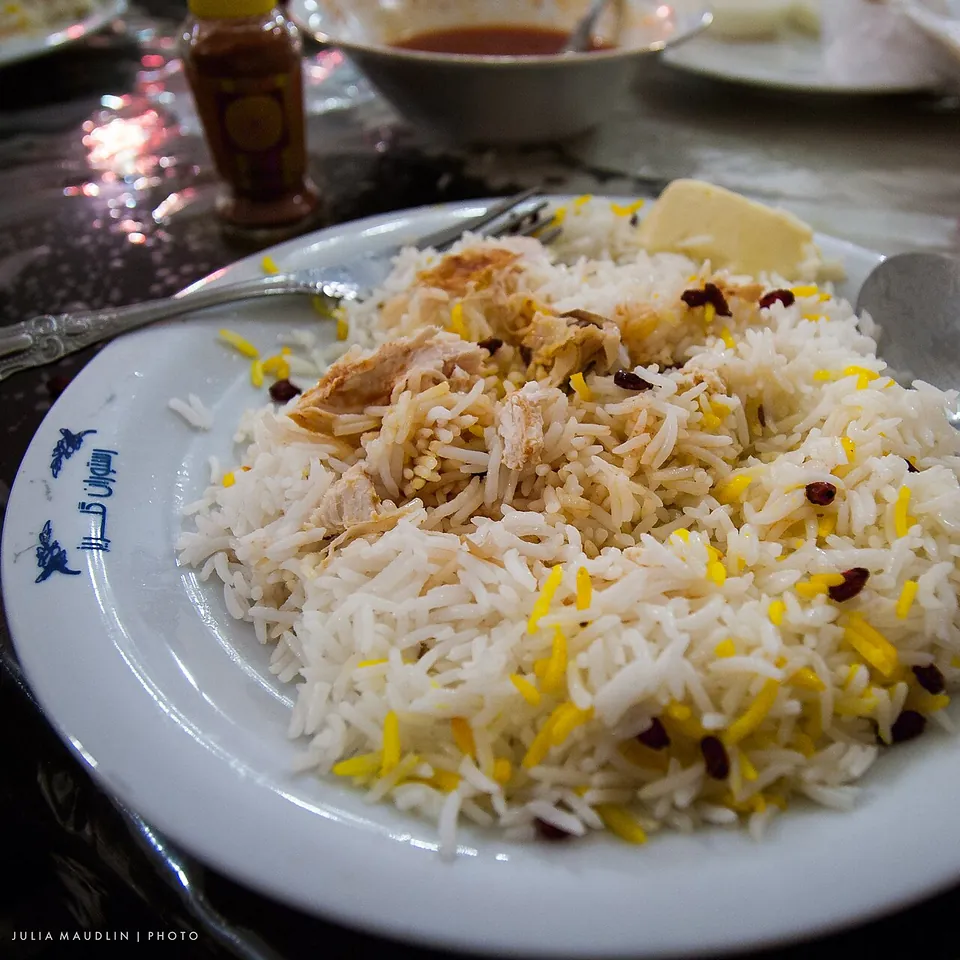
Persian polow, rice parboiled and then steamed until every grain stands plump and separate, is the ancestral form of the pilaf family that would later spread around the world. But the famous story that it began when the great physician Avicenna gave it to a lovesick prince as a restorative is told as a legend, with no contemporary record offered in support.
Verification highlight popular claim → verdict → evidence
Legends crediting a single inventor -- such as the physician Avicenna prescribing pilaf for a lovesick prince, or an origin tied to Alexander the Great -- turn out to be tourist lore with no independent documentation; the cooking technique is instead traced to the Abbasid era, attested in 13th-century Arabic cookbooks such as Kitab al-Wusla and Kitab al-Tabikh.
The three gates
- Ingredient-supply gate
- Rice is an Old World staple that reached the Iranian plateau in antiquity, with local cultivation and distribution as its precondition.
- Cooking-technique gate
- A two-stage method: rice is parboiled, then steamed (the chelow/polow technique), finished with fat for separate, fluffy grains.
- Venue gate
- Originated as Persian court cuisine before becoming an everyday urban dish.
Overview
Polow is a two-stage rice dish: the rice is half-boiled, then steamed slowly with fat over a low flame. Refined as a technique at the Persian court from the medieval era through the Safavid period, it went on to take root as a home dish in the cities.
The rice at its heart is an old grain of the Old World, and it had reached the Iranian plateau in antiquity. Along the Caspian shore, in Mazandaran and Gilan, rice was grown from early on and was a familiar ingredient rooted in the land. Cooks boiled that rice, drained it, coated it in butter, covered the pot with a cloth, and steamed it over the gentlest heat. Cooked this way, the grains do not stick together but come out firm and distinct. Saffron went in at the end for its golden color and scent.
At the Safavid court this rice cookery was held in particular esteem. The early sixteenth-century cookbook Kar-nama (by Bavarchi, 1521), written for an aristocratic patron, and the Madat al-Hayat of 1594–95, which records dishes made at the royal court and gives four of its six chapters on dishes to rice, both set down how polow was prepared. In time, rice dishes grew into one of the major branches of Iranian cuisine.
In Persian this way of cooking is called polow, and the name passed directly into the names of rice dishes in many lands: pulao in India, pilav in Turkey, plov in Central Asia, pilau in East Africa. From polow, a whole family spread east and west, all the way to biryani. When people tell where a dish comes from, polow sits at the very top of this family tree.
How we know
Some of the oldest written records of the polow method date from the Abbasid period, between the ninth and twelfth centuries. Later, in the thirteenth century, two Arabic cookbooks, the Kitab al-Wusla of Ibn al-Adim of Aleppo and al-Baghdadi's Kitab al-Tabikh, describe a procedure that differs little from modern pilaf: rice, meat, and chickpeas cooked together so that the grains stay separate. The English word pilau first appears in writing in 1609; it is said to have come from the Persian pulaw by way of Turkish.
A famous invention story clings to this family of dishes. The great medieval physician Ibn Sina (Avicenna), it goes, gave palov osh to a prince weakened by lovesickness as a restorative, and from there the dish spread. An Uzbek tourism guide itself presents this as a legend, and no contemporary record is offered in support.
So can anyone say exactly when and where polow was born? Here the views are cautious. The etymology and the oldest texts do cluster around the Persian language and the Abbasid period, and the chain of names, from polow to pilaf, pulao, pilav, and plov, starts from Persian. Yet this way of cooking rice also developed back and forth across the Islamic world, Persia, Central Asia, and Mesopotamia among them, through trade and conquest. There is no primary source that assigns the birthplace of modern polow to a single city or dynasty, and no single place of origin has been established.
Polow, then, looks less like a dish to be credited to one famous physician than like an ancestral form that took shape where the cultures of the Greater Iranian world flowed together. Its name and technique run deepest in Persia, and a cookbook of the Safavid court recorded what it looked like. That is why this dish stands at the head of the family of rice dishes.
The full set of origin theories and the detailed verification log — traceable all the way to their sources — are available on the Japanese edition.
See the full origin theories and verification log (Japanese) →
Related dishes
Cross-links Sister dishes & same-name dishes (separate lineage)
- Spread from herePulaoNorth IndiaB
- Spread from herePilavAnatoliaC
- Spread from hereKabuli palawAfghanistanC
- Spread from herePlovUzbekistan (Samarkand / Fergana)C
- Spread from herePilauEast Africa (Swahili Coast)C
- Spread from hereBiryaniSouth Asia (Deccan / Mughal)C
- Sister dish (shared ancestor)TahdigIranC
Shares the key ingredient
- DosaSouth India (Tamil Nadu / Karnataka)C
- PaellaValencia, SpainB
- Risotto alla milaneseMilan (Lombardy, Italy)B
- Nasi gorengIndonesia (Java)C
- JambalayaNew Orleans (Louisiana, USA)C
- MujaddaraLevant (Syria, Lebanon, Palestine)B
- DoriaYokohama, JapanB
- IdliSouth IndiaC
- MaqlubaPalestine / LevantC
- White mixed rice (hondon-ban / goldong-ban)Korean PeninsulaC
- MandiHadhramaut (Yemen)C
- Rice and native-grain upma (sada upma, before semolina)South IndiaC
- KiribathSri LankaD
- KabsaSaudi ArabiaC
- MachboosPersian Gulf (Bahrain / Kuwait)B
- Gallo pintoCosta Rica / NicaraguaC
- Dal bhatNepalC
- KoshariEgyptC
- Rice-and-lentil koshari (before pasta and tomato)EgyptC
- Bánh cuốnVietnamB
- MahshiEgyptB
- Pilaf (French)FranceC
- Pilaf (Japanese-style)JapanC
- Arroz de mariscoAlgarve (Portugal)C
- CasadoCosta RicaC
- Nan gyi thokeMyanmarC
- Mont diMyanmarC
- AranciniSicily (Italy)C
- Mazbi (madhbi)Yemen (Hadhramaut)C