All dishes / Western Europe
Melanzane alla parmigiana Period BOrigin theory CVerified
Some fields (dish name, region and gates) are shown from the Japanese-edition data.
A southern Italian dish of fried eggplant baked in layers with tomato sauce and cheese. The name "parmigiana" sounds like proof of an origin in Parma, yet the dish was scarcely eaten there, and neither where the name comes from nor which corner of the south shaped it first has ever been settled.
Verification highlight popular claim → verdict → evidence
The name parmigiana suggests Parma, but the dish belongs to Campania and Sicily and was hardly eaten in the north, so food historians are skeptical of any claim that it began in Parma. Where the name comes from is still open, with three explanations standing side by side: Parmesan cheese, or a Parma manner of layering vegetables; parmiciana, the Sicilian dialect word for the overlapping slats of a window shutter, which rows of fried eggplant resemble; and petronciana, an old word for the eggplant. In Naples the dish is melanzane alla parmigiana and in Sicily parmigiana di melanzane, the same dish under two names. Food historians place the tomato version in Naples and Campania, while Sicily also claims it, and which of the two shaped it first has not been settled. A Neapolitan cookbook of the late 18th century layers eggplant with Parmesan and no tomato at all, and the version with tomato and cheese is first recorded in Naples in 1837, which marks the earliest record rather than the year the dish was born.
The three gates
- Ingredient-supply gate
- Eggplant had come to southern Italy and Sicily with the Arabs in the Middle Ages, and cheese had long been at hand locally. The tomato came from the New World. In 1544 the naturalist Pietro Andrea Mattioli wrote that tomatoes were fried in oil with salt and pepper and eaten, the earliest record of the fruit as food in Italy, and by 1692 a Neapolitan cookbook was giving a recipe for tomato sauce. The year 1548, often given as the tomato's arrival, is the date of a Medici letter about a basket of tomatoes; it is the earliest record of the Italian word pomodoro, not evidence of the fruit's arrival. The tomato's arrival sets the earliest possible date for the dish as it is made today at 1544. The dish itself first appears in writing in 1837, nearly three centuries later, and no earlier record of it has been found.
- Cooking-technique gate
- Eggplant is fried, then layered with tomato sauce and cheese and baked in the oven, all methods long familiar in local kitchens.
- Venue gate
- Home cooking of ordinary households, rooted in the local community.
Overview
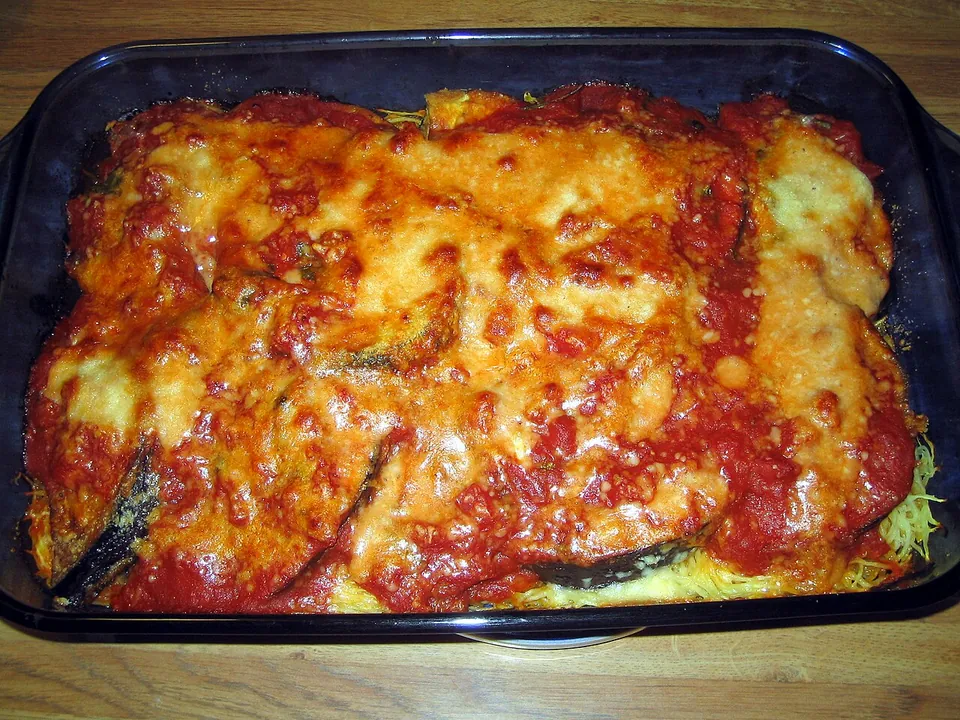
Melanzane alla parmigiana is a home-style dish of the Italian south: thin slices of eggplant, fried and stacked in layers with tomato sauce, melting cheese, and grated Parmesan, then baked. It is cooked as a local dish both in Campania, around Naples, and in Sicily across the water.
Its two leading players are eggplant and tomato. Eggplant was carried into southern Italy and Sicily by way of the Arabs during the Middle Ages and had long since settled into Mediterranean cooking. The tomato came the other way, across the Atlantic from the New World. The fruit appears on Italian ground in the middle of the sixteenth century: in 1544 the naturalist Pietro Andrea Mattioli wrote that it was fried in oil with salt and pepper and eaten, and a 2022 study of sixteenth-century tomatoes in Europe reads that passage as a sign that the plant was already being tried as food rather than kept for show. The year 1548 is often given as the tomato's arrival in Italy, but it is the date of a letter reporting a basket of tomatoes sent from a Medici estate to Cosimo I, which the same study reads as the earliest known record of the Italian word pomodoro rather than as proof of arrival. From there the tomato moved south, until by the close of the seventeenth century a Neapolitan cookbook was setting down a sauce made from it.
The cookbooks show the dish taking shape. Vincenzo Corrado's Il cuoco galante (Naples, first published 1773, enlarged 1786) gives a preparation called alla parmegiana with no tomato in it at all: eggplant layered with butter, herbs, and Parmesan. Half a century later, in 1837, Ippolito Cavalcanti's Cucina teorico-pratica, written in Naples, shows the dish as we know it, layers of tomato ragù and Parmesan together. Both books can still be read in full today on the Internet Archive.
Close to three centuries lie between the tomato's arrival in Italy and the page Cavalcanti wrote. Across that span the ingredients gathered in the fields and kitchens of the south, yet no book has yet surfaced from those years describing fried eggplant layered with tomato and cheese. The year 1837 is the earliest the dish can be traced to in writing, not the year it was born. David Gentilcore's history of the tomato in Italy puts its spread into everyday southern cooking in the eighteenth century, and the bake most likely took its shape in home kitchens from around then.
How we know
The name parmigiana points to the city of Parma. Where the word actually comes from is another matter: three readings still stand side by side.
The first ties it to Parmesan cheese, grated over the top, or to alla parmigiana in the sense of a Parma manner of layering vegetables. Dictionaries tend to prefer this reading. It sits awkwardly with the dish itself. Melanzane alla parmigiana belongs to Campania and Sicily, and in northern Italy, where Parma lies, it was hardly eaten at all. Even so, the birthplace of the dish itself is still said to be disputed among Sicily, Naples and Parma, and the view that it began in Parma has not been set aside.
The second traces the name to the Sicilian dialect word parmiciana, the overlapping wooden slats of a shutter. Fried eggplant, laid down in slightly staggered layers, looks like those slats. Pointing to how eggplant took root in southern Italy and Sicily through the Arabs, and to the dish's concentration in the south, food writers such as Mary Taylor Simeti and Vincent Schiavelli favor this account, and it stands as the strong rival to the Parma reading.
A third reading takes the name from petronciana, an old word for the eggplant itself, worn down over time. It travels as a brief note on the likeness between the two words, without the body of argument the other two have gathered.
The name splits by region as well. In Naples the dish is melanzane alla parmigiana; in Sicily it is parmigiana di melanzane; the plate is the same. Food historians place the making of the tomato-and-cheese version in Naples and Campania, while Sicily too has claimed it as its own.
Neither the origin of the name nor the question of which corner of the south shaped the dish first has been settled. What is plain is that this bake was cooked in the homes of the Italian south, and that a cookbook printed in Naples in 1837 set down what it looked like.
The full set of origin theories and the detailed verification log — traceable all the way to their sources — are available on the Japanese edition.
See the full origin theories and verification log (Japanese) →
Related dishes
Shares the key ingredient
- Pasta al pomodoroSouthern ItalyB
- Pizza MargheritaNaples (Italy)D
- ShakshukaMiddle East / North AfricaC
- Jollof riceWest AfricaC
- Butter chickenDelhi (India)C
- Khao SoiB
- GazpachoAndalusia (Spain)B
- LecsóHungaryC
- Chana masalaNorth India (Punjab)C
- RatatouilleProvence, France (Nice)C
- Thieboudienne (ceebu jën)SenegalB
- ChakalakaSouth AfricaC
- KedjenouIvory CoastB
- Caprese saladCapri (Italy)C
- SaloonaPersian Gulf (Bahrain and Kuwait)C
- Shan khauk hswè (Shan noodles)Myanmar (Shan State)C
- American pizzaUnited StatesC
- FrancesinhaPorto (Portugal)D
- ChakhokhbiliGeorgia (Caucasus)C
- KachumberGujarat (Western India)C
- SalmorejoAndalusia (Spain)C
- Greek salad (horiatiki)GreeceC
- Shopska saladBalkans (Bulgaria)B