All dishes / Western Europe
Ratatouille Period BOrigin theory CVerified
Some fields (dish name, region and gates) are shown from the Japanese-edition data.
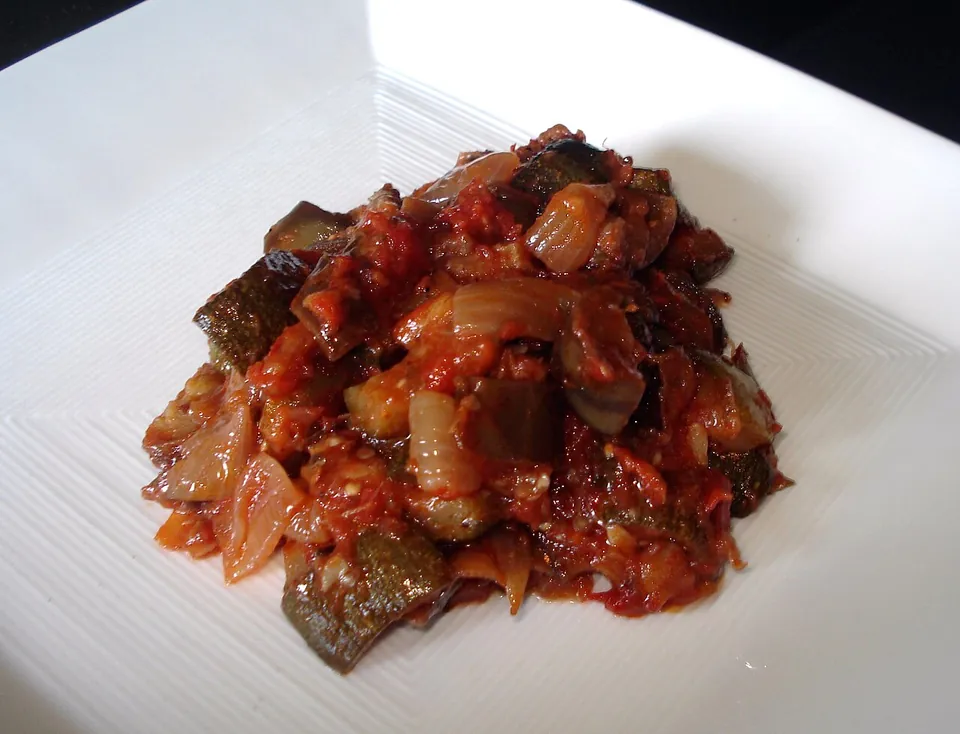
Ratatouille, the colorful summer-vegetable stew, sounds like an old traditional dish. Yet the name came to mean the dish we now picture only a little over a hundred years ago.
Verification highlight popular claim → verdict → evidence
The word "ratatouille" is often assumed to be as old as the dish, but it turns up in French in the 1770s, apparently as a disparaging term for bad food, and an 1831 military journal uses it for a soldier's ration of watery vegetables with a few lean ribs of veal or mutton floating in it, not the vegetable dish we know; the modern all-vegetable recipe (eggplant, tomato, courgette, pepper) first appears by name in print in Henri Heyraud's La Cuisine à Nice in the early 20th century. The pepper was already a crop that the peasants of Provence tended with care by 1789, according to an agricultural treatise edited by Rozier; the tomato is said to have entered the kitchens of southern France around 1790 (dated to 1750-1790), and the early end of that span, 1750, sets the earliest possible date for the dish.
The three gates
- Ingredient-supply gate
- The ingredients that determine the date are tomato and pepper, both New World crops. The tomato is said to have entered the kitchens of Provence and the rest of southern France around 1790, and its arrival is dated to the span 1750-1790. For the pepper (the fruit of the capsicum plant), the first secure record that it was grown and eaten in Provence is the 1789 Cours complet d'agriculture edited by Rozier, which says that the peasants of Provence and Languedoc spare no care in growing it and that people in the south prefer a small green pepper with their morning meal; Rozier describes the fruit as hot and does not set sweet varieties apart. The early end of its span is 1493, when capsicum first reached Europe; when it reached Provence is not known. The earliest possible date for the dish is set by the later of the two, the tomato, at the early end of its span: 1750.
- Cooking-technique gate
- Long, slow simmering of vegetables in olive oil over an open fire or hearth -- no special technique required.
- Venue gate
- Everyday home cooking among the common people of the Provence region.
Overview
Ratatouille is a peasant, home-kitchen dish that took root in Provence in southern France, and around Nice in particular. Eggplant, zucchini, tomato, and pepper—vegetables that ripen at the height of summer—are stewed slowly in olive oil. It needs no special tools or technique: it was the wisdom of the farmhouse hearth, a way to use up the flood of vegetables that a scorching field yields all at once.
Olive oil had long been the fat of the Provençal kitchen, pressed from the trees of the region's own hillsides, and the slow stewing of summer vegetables in that oil was probably an old habit of the local table. Into this Provençal pot came two vegetables from across the sea. The pepper was already at home there: a farming manual of 1789 describes the peasants of Provence and Languedoc tending it and sparing no pains. The tomato is said to have entered the kitchens of southern France around 1790, by way of Marseille, Corsica, and Provence; Provence was one of France's early adopters of the tomato, and the salade niçoise was born of this same ground. Alongside the eggplant and zucchini, these New World vegetables settled into the region's fields and gave the dish the colors we now picture.
How we know
The word ratatouille carries an old-fashioned ring. In fact, it is said to have first appeared at the end of the eighteenth century as a disparaging term in French for poor, unappetizing food. Its roots lie in the French verb touiller, "to stir up," and the Occitan ratatolha. The word does turn up in a French military journal of 1831, but what it names there is a sloppy vegetable stew with a little scrawny meat floating in it—an unappealing ration, not the vegetable dish served today.
So when does the modern ratatouille—a ragout of vegetables alone: eggplant, tomato, pepper, and zucchini—first appear by name in print? Following the food-history reporting of National Geographic, it is in Henri Heyraud's La Cuisine à Nice, of 1903 (though some antiquarian catalogues give 1909 for the first edition). French cooks did not take up the tomato until roughly two hundred years after it first arrived from the New World.
In other words, the age of the name "ratatouille" and the age of the present dish are two different things. The name was used from the eighteenth century for a poor stew, and it came to mean the colorful vegetable dish of today only after the style was fixed in Nice at the start of the twentieth century. The theories about its origin are still several, and no single one has won out; but tracing the word and the dish together, the present version stands out clearly as a product of modern Provence.
The full set of origin theories and the detailed verification log — traceable all the way to their sources — are available on the Japanese edition.
See the full origin theories and verification log (Japanese) →
Related dishes
Shares the key ingredient
- Pasta al pomodoroSouthern ItalyB
- Pizza MargheritaNaples (Italy)D
- ShakshukaMiddle East / North AfricaC
- Jollof riceWest AfricaC
- Butter chickenDelhi (India)C
- Khao SoiB
- GazpachoAndalusia (Spain)B
- LecsóHungaryC
- Chana masalaNorth India (Punjab)C
- Thieboudienne (ceebu jën)SenegalB
- ChakalakaSouth AfricaC
- KedjenouIvory CoastB
- Caprese saladCapri (Italy)C
- SaloonaPersian Gulf (Bahrain and Kuwait)C
- Shan khauk hswè (Shan noodles)Myanmar (Shan State)C
- American pizzaUnited StatesC
- FrancesinhaPorto (Portugal)D
- ChakhokhbiliGeorgia (Caucasus)C
- KachumberGujarat (Western India)C
- SalmorejoAndalusia (Spain)C
- Greek salad (horiatiki)GreeceC
- Shopska saladBalkans (Bulgaria)B
- Melanzane alla parmigianaItalyC