All dishes / Western Europe
Pizza Margherita Period COrigin theory DVerified
Some fields (dish name, region and gates) are shown from the Japanese-edition data.
Did Queen Margherita really give her name to this pizza? The well-known story that a Naples pizzaiolo baked it in the colors of the Italian flag for the visiting queen in 1889 and named it after her has been set aside, because the royal letter offered as its proof has been judged a forgery. When the pizza took its present form, and when it got its name, are both still unknown.
Verification highlight popular claim → verdict → evidence
The popular story that pizzaiolo Raffaele Esposito created this pizza for Queen Margherita in 1889 and named it after her has been set aside. The 1889 royal thank-you letter offered as its proof has been judged a forgery: the royal household kept no record of it, its seal is fake, and it is written in a different hand. The tale itself does not appear in print until the late 1930s or early 1940s. Tomato, mozzarella, and basil were each already used on Naples pizzas by the mid-nineteenth century, according to the volume of Francesco De Bourcard's 'Usi e costumi di Napoli' dated 1858 on its title page and 1866 on its cover, but that book does not describe the three together on one pie. When the present form appeared, and when the name 'Margherita' was first used, are still unknown.
The three gates
- Ingredient-supply gate
- Tomato, a New World crop
- Cooking-technique gate
- Urban ovens and the restaurant trade
- Venue gate
- eating houses / common people
Overview
A Naples pizza shop and three toppings
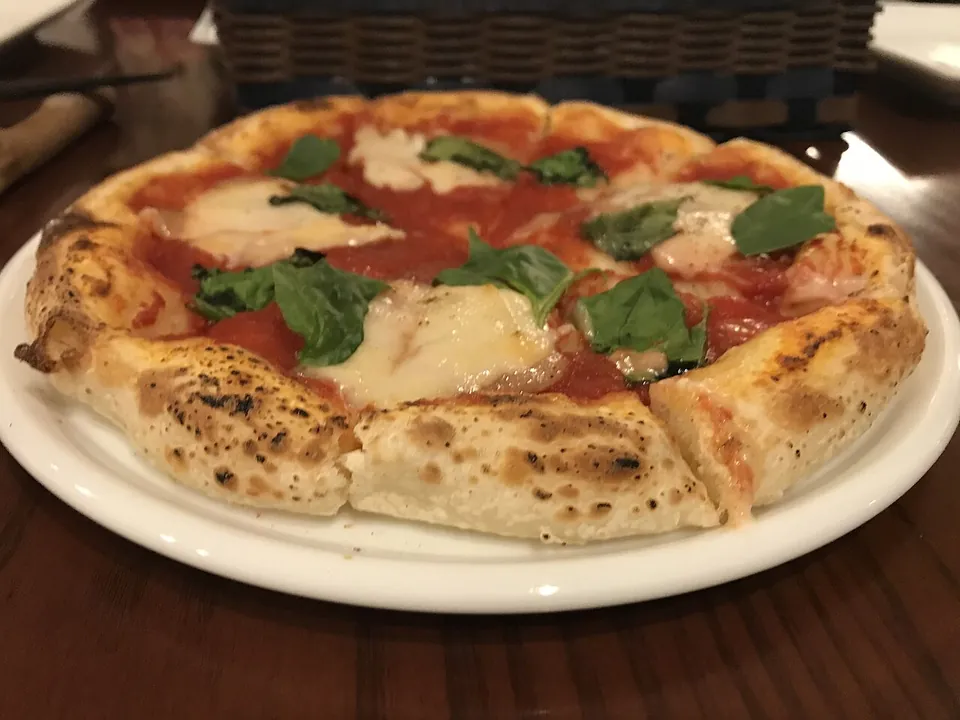
The Margherita is a Neapolitan pizza: a thin round of dough topped with tomato, mozzarella, and basil and baked in an oven, so that red, white, and green sit together on one pie. The tomato at its heart is a crop that crossed the Atlantic from the Americas.
A picture of Naples pizza shops in the mid-nineteenth century survives in the second volume of "Usi e costumi di Napoli e contorni descritti e dipinti" (Customs of Naples and Its Surroundings, Described and Painted), edited by Francesco De Bourcard. Its chapter on the pizza maker, written by Emmanuele Rocco, says that pizzas spread with grated cheese and lard were finished with a few basil leaves, and that thin slices of mozzarella were often added to them. Tomato appears in a short list of toppings used now and then, alongside sliced ham and clams. The volume's title page is dated 1858 and its cover 1866. By then, in other words, tomato, mozzarella, and basil were each already going onto pizzas in Naples.
The chapter does not, however, describe a pizza that puts all three together. When the three first met on a single pie, and when the name "Margherita" was first attached to it, has not yet been established from the sources.
Across the sea
Across the nineteenth and twentieth centuries, Neapolitan emigrants carried this pizza to America. There the dough grew thicker and the cheese more generous, and American pizza branched off as a line of its own.
How we know
The familiar version goes like this. In 1889, when Queen Margherita visited Naples, the pizzaiolo Raffaele Esposito made her a pizza in the three colors of the Italian flag — red tomato, white mozzarella, green basil — and named it in her honor.
The proof long offered for this is a thank-you letter from the royal household, dated 1889 and displayed at the Pizzeria Brandi in Naples. Nowak (2014) judged the letter a forgery. The royal household kept no record of it, its seal is fake, and it is written in a different hand. The way it is addressed is also off: it names the recipient "Esposito Brandi," with the husband carrying his wife's surname, Brandi — something Italian men in the nineteenth century did not do.
Nor does the event itself appear in the records of 1889. The official telegrams of the time reporting the queen's 1889 visit to Naples say nothing of a pizzaiolo being received by her. The story of Esposito presenting the pizza to the queen and naming it does not appear in print until the late 1930s or early 1940s.
A story pairing the queen with a pizza maker was in circulation earlier, though. On 25 July 1880, The Washington Post, reprinting an item from a Geneva paper, reported that while staying in Naples the queen sent for a pizzaiolo famous for his skill, who showed her a list of thirty-five kinds of pizza and then made eight of the one she chose in the royal kitchen. The piece gives neither the pizza maker's name nor the toppings. What it shows is that a tale of the queen and a pizza maker existed before the 1889 naming story — not that nothing happened in 1889.
So the 1889 naming story has been set aside as a tale made up in later times, since the letter it rested on has been judged a forgery. Nothing has yet taken its place. Tomato, mozzarella, and basil were each on Naples pizzas by the mid-nineteenth century, but when the three first came together on one pie, and when and how the name "Margherita" came to be given, the sources still do not tell us.
The full set of origin theories and the detailed verification log — traceable all the way to their sources — are available on the Japanese edition.
See the full origin theories and verification log (Japanese) →
Related dishes
Cross-links Sister dishes & same-name dishes (separate lineage)
Shares the key ingredient
- Pasta al pomodoroSouthern ItalyB
- ShakshukaMiddle East / North AfricaC
- Jollof riceWest AfricaC
- Butter chickenDelhi (India)C
- Khao SoiB
- GazpachoAndalusia (Spain)B
- LecsóHungaryC
- Chana masalaNorth India (Punjab)C
- RatatouilleProvence, France (Nice)C
- Thieboudienne (ceebu jën)SenegalB
- ChakalakaSouth AfricaC
- KedjenouIvory CoastB
- Caprese saladCapri (Italy)C
- SaloonaPersian Gulf (Bahrain and Kuwait)C
- Shan khauk hswè (Shan noodles)Myanmar (Shan State)C
- FrancesinhaPorto (Portugal)D
- ChakhokhbiliGeorgia (Caucasus)C
- KachumberGujarat (Western India)C
- SalmorejoAndalusia (Spain)C
- Greek salad (horiatiki)GreeceC
- Shopska saladBalkans (Bulgaria)B
- Melanzane alla parmigianaItalyC
Similar dishes Overlapping ingredient, period or region
More debunked origins
Other famous dishes whose popular origin story doesn't survive the sources.