All dishes / Eastern Europe
Khachapuri Period COrigin theory CVerified
Some fields (dish name, region and gates) are shown from the Japanese-edition data.
Khachapuri is the cheese bread of Georgia. Its name is first securely on record in a dictionary of the early eighteenth century, and the idea that it goes back to the Middle Ages remains a conjecture. The tale that Black Sea sailors shaped the boat-like Adjaruli after the sea, a ship, and the sun has likewise only been handed down; what the sources show is that the boat shape settled in the nineteenth and twentieth centuries.
Verification highlight popular claim → verdict → evidence
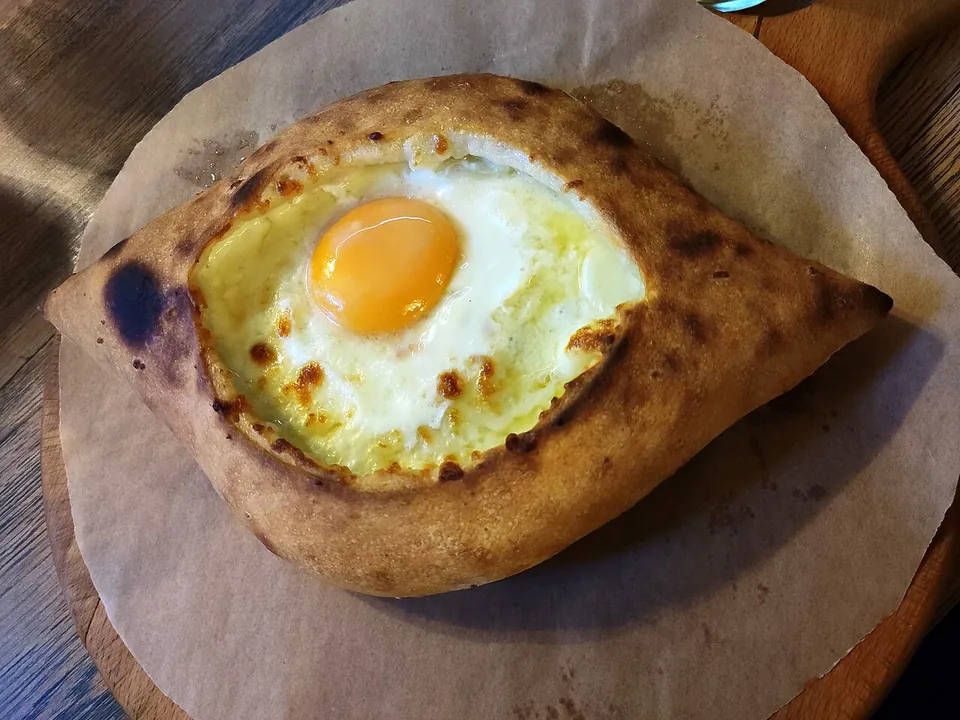
Popular story: the boat shape of Adjarian khachapuri, with an egg yolk at its center, symbolizes the sea, a boat, and the sun as imagined by Laz sailors. Verdict: refuted -- the dish's round predecessor, 'penerli' (from Turkish peynirli), arrived under Ottoman rule in the 15th-16th century, and only took its boat shape in the 19th-20th century and its current name in the 1950s; a food historian quoted in the press calls the sea/boat/sun story an explicit legend, not history. Key sources: Adjarian Khachapuri, Advantour; Adjaruli Khachapuri: The Cheesy Bread, Going.com.
The three gates
- Ingredient-supply gate
- Wheat, cheese, and eggs were all long-established in the region — the Caucasus is one of the old centres of wheat growing. Nothing among the ingredients sets an earliest possible date for the dish; it rests on staples already at hand in the land.
- Cooking-technique gate
- Wheat is milled to flour and the dough leavened, then baked in an oven or on a flat pan, while the filling calls for the separate craft of cheesemaking.
- Venue gate
- Baked at home, it was everyday food for ordinary people, and it belonged to every province of Georgia alike.
Overview
A bread of Caucasian wheat and cheese
Khachapuri is a Georgian cheese bread: leavened wheat dough wrapped around cheese and baked. It is made with the cheeses of the land, such as Sulguni and Imeretian cheese, and sometimes with egg. Wheat and cheese alike have long been rooted in the Caucasus, a region counted among the old centres of wheat growing.
Grinding the wheat, leavening the dough, baking it brown in an oven or on a flat pan, making the cheese that goes inside: with these skills, khachapuri has been baked household by household and has come to everyday tables across every part of Georgia.
It has also branched into regional styles. Imeruli seals the cheese inside the dough; Megruli lays Sulguni on top as well; Adjaruli is shaped like a boat and finished with an egg yolk and butter. These three best-known styles are variants suited to each region's cheese and terrain. Records of when Imeruli and Megruli took shape are scarce, though, and which of the three is the oldest is not clear either.
The name khachapuri is securely on record in the Georgian dictionary that Sulkhan-Saba Orbeliani compiled between 1685 and 1716. In a passage listing the many kinds of bread made with eggs, milk, butter and the like, khachapuri appears as one of them. The word is explained as khacho (curds) and puri (bread). By the early eighteenth century at the latest, khachapuri was on record as the name of a kind of bread.
How we know
Three stories are often told about the age of khachapuri: that it goes back to Georgia's medieval golden age, that its name first appeared in writing in 1725, and that the boat-shaped Adjaruli was modelled by sailors.
The medieval origin comes from the food historian Darra Goldstein's book The Georgian Feast. Goldstein is reported to have said that khachapuri probably dates back to the twelfth century, the golden age of Georgia. That date was offered as a conjecture, however, and what it rests on cannot be told from the accounts that pass it on. Specialists are divided on the chronology, and another conjecture holds that Roman soldiers brought the idea of the bread. A medieval origin remains one view among others and is still unsettled.
The year 1725 has often been cited as the moment the name khachapuri first appeared in writing. But 1725 is the year Orbeliani, the compiler of the dictionary, died. The dictionary itself was compiled between 1685 and 1716, and his death year seems to have been mistaken for the date of the dictionary. What can be relied on as the time the name was recorded is those thirty-odd years of compiling.
The most colourful story, meanwhile, was explaining a form that took shape in modern times. It holds that the boat shape of Adjaruli, with an egg yolk at its centre, was modelled by sailors of the Black Sea coast on the sea, a ship, and the sun. The tale circulates widely in cookbooks and travel pieces, but the sources tell rather the opposite. The forerunner of Adjaruli was a round bread known around Batumi as penerli. The name comes from the Turkish peynirli, "with cheese", and the bread arrived with the lineage of Turkish pide under Ottoman rule in the fifteenth and sixteenth centuries. The name penerli lingered until around the 1950s, and the present form, shaped into a boat and finished with an egg, settled only in the nineteenth and twentieth centuries. The symbolism of sea, ship, and sun was a story attached afterwards to a form standardized in modern times; the food historian Lali Papashvily calls it a poetic fable. It is a lovely explanation, but the sources do not support it.
The full set of origin theories and the detailed verification log — traceable all the way to their sources — are available on the Japanese edition.
See the full origin theories and verification log (Japanese) →
Related dishes
Shares the key ingredient
- SamosaIndian subcontinent (Delhi Sultanate)B
- PelmeniSiberia (Russia)C
- Hot dogNew York, United StatesC
- HaleemHyderabad (Deccan)C
- KobeteCrimea (Crimean Tatar)C
- BrikTunisiaC
- BoortsogMongoliaC
- Mission burritoSan Francisco, California (USA)C