All dishes / North America
Hot dog Period BOrigin theory CVerified
Some fields (dish name, region and gates) are shown from the Japanese-edition data.
The hot dog comes wrapped in origin stories: that Charles Feltman opened the first stand on Coney Island, that a man named Feuchtwanger invented the bun, that a cartoonist named Tad Dorgan coined the name. Food historians have set all three aside for lack of evidence. The most widely held view today is that German immigrants gradually spread the habit of putting a sausage in a roll through the cities of 19th-century America, and who sold the first one is not known.
Verification highlight popular claim → verdict → evidence
Popular claim: invented by a single named figure (Feltman's cart, Feuchtwanger's bun, or Dorgan's cartoon naming). Verdict: food historian Bruce Kraig debunks all three specific origin stories; the most widely held view is a gradual popularization by German immigrants putting sausage in a bun across 19th-century cities, but who sold the first one is still not known. Key sources: Bruce Kraig, Hot Dog: A Global History (2009); Cohen, Popik & Shulman, Origin of the Term Hot Dog (2004).
The three gates
- Ingredient-supply gate
- The wheat bun and pork/beef sausage are both Old World staples; food supply is not the limiting factor.
- Cooking-technique gate
- Sausage-making (casing) technique plus grilling or boiling — a German smoking/sausage-casing tradition.
- Venue gate
- Street cart and ballpark venue; common-people stratum; bought from vendors; German immigrant community into the urban public at large.
Overview
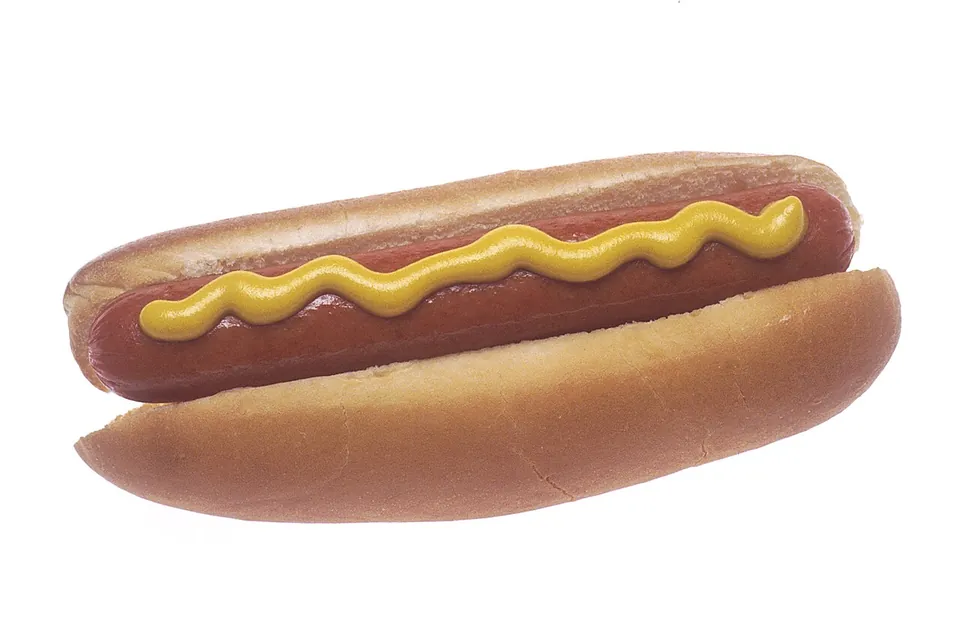
The hot dog is a sausage tucked into a long, soft bun, a snack that took shape in the United States and is most closely tied to New York. It settled into place as street food between the late 19th century and the early 20th, and its emergence is generally placed within that span.
Its parts were all old-world staples. The wheat bun belongs to a long European tradition of baked bread, and the pork or beef sausage carries on the German-speaking world's craft of the casing and the smokehouse. The sausages that lend their names to the dish, the frankfurter from Frankfurt and the wiener from Vienna, came to American cities with German immigrants in the 19th century, along with the smoking and stuffing skills that made them.
In the growing cities those sausages found their setting: the street cart, the ballpark, the amusement park, the crowds of ordinary urban life. Cheap, quick, and eaten on the move, the sausage-in-a-roll took hold in the rhythm of the city. The food historian Bruce Kraig sees the hot dog not as anyone's invention but as a snack that rose as an immigrant food culture went mainstream, carried along by the traffic of the city; this is currently the most widely held view.
How we know
The hot dog's beginnings come with several stories, each fitted out with a name and a date. Charles Feltman opened the first hot dog stand on Coney Island in 1867 or 1871. Feuchtwanger of St. Louis invented the bun. A single panel by the cartoonist Tad Dorgan gave the world the name 'hot dog.' They are specific, and being specific, they are easy to tell.
The food historian Bruce Kraig (Hot Dog: A Global History, 2009) took them apart one by one. No contemporary record backs up Feltman's stand, and the bun was already known before Feuchtwanger and cannot fairly be called his invention. Kraig found no evidence for the claim that a Dorgan cartoon gave the hot dog its name either, and set that story aside too.
The Dorgan story was finished off by a later work devoted to the phrase itself, Origin of the Term Hot Dog by Gerald Cohen, Barry Popik, and David Shulman (2004). According to Cohen, Dorgan did not come to New York City until 1903, his first hot dog cartoon appeared in December 1906, and its subject was a bicycle race, not baseball. All of this is well after 1884, the year the phrase first appears in print. Cohen offered a two-hundred-dollar reward to anyone who could produce the supposed baseball cartoon. No one came forward.
The same study also retraced how the name spread. 'Hot dog' first surfaces in September 1884, in a newspaper in Evansville, Indiana, meaning sausage meat. The finished form, the sausage in a bun, appears in December 1892 in a Paterson, New Jersey paper, served with mustard and popular with the crowd. As slang for a dandy or a showoff, it turns up in 1894 and 1895 in the humor magazines of Yale and Michigan. It was campus slang, built on a 19th-century urban legend that the sausages might contain dog meat. These dates show only that the name was in use by those years at the latest; they are not the years the dish was born.
Kraig, the historian who dismissed the three origin stories, holds that there was no single inventor, and that German immigrants were already tucking sausages into bread before Feltman. The picture of German immigrants bringing the sausage, and of it slowly taking root as a snack amid the traffic of 19th-century American cities, is for now considered the most likely. But it is the view left standing after three origin stories fell away, not one drawn from a record of the hot dog's actual beginning. Who sold the first hot dog is still unanswered.
The full set of origin theories and the detailed verification log — traceable all the way to their sources — are available on the Japanese edition.
See the full origin theories and verification log (Japanese) →
Related dishes
Shares the key ingredient
- SamosaIndian subcontinent (Delhi Sultanate)B
- KhachapuriGeorgia (Caucasus)C
- PelmeniSiberia (Russia)C
- HaleemHyderabad (Deccan)C
- KobeteCrimea (Crimean Tatar)C
- BrikTunisiaC
- BoortsogMongoliaC
- Mission burritoSan Francisco, California (USA)C