All dishes / North America
Poutine Period BOrigin theory CVerified
Some fields (dish name, region and gates) are shown from the Japanese-edition data.
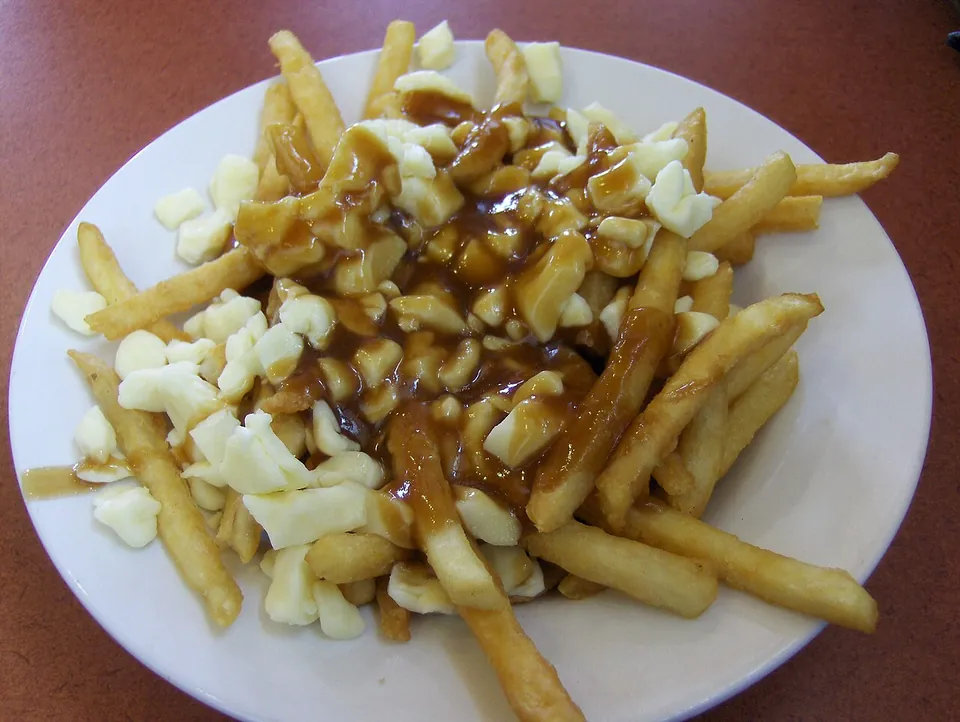
Poutine, fries topped with cheese curds and hot gravy, is claimed by two Québec towns, Warwick and Drummondville. Yet in the earliest known written account of the dish, a 1977 newspaper article, the Drummondville restaurateur himself dates his recipe to "around 1971," and who first made it, and when, is still unsettled.
Verification highlight popular claim → verdict → evidence
Two towns in Quebec's Centre-du-Québec region both claim poutine, and neither claim has won out. In Warwick, café owner Fernand Lachance is said to have exclaimed in 1957, as he added cheese curds to fries, "ça va faire une maudite poutine!" ("that'll make a damn mess!"), and his family points to a 1957 menu listing poutine at 35 cents. In Drummondville, the restaurant Le Roy Jucep says Jean-Paul Roy opened a snack bar serving fries with his own gravy in the late 1950s and that regulars later asked for curds to be mixed in. No contemporary record has yet been found for either town's dates. The earliest known written account of the dish, a 1977 article in the Sherbrooke newspaper La Tribune, describes it as a Drummondville-area specialty of the past four or five years and quotes Roy as saying he invented the recipe around 1971, when a customer asked for fries mixed with cheese, and added the sauce later. A 2016 study, drawing on an earlier book, notes that the exact origin is still disputed, with agreement only that the dish emerged in Centre-du-Québec in the late 1950s. Who first made it, and in which town, remains unsettled; what is certain is that by 1977 it was widely eaten around Drummondville. Main sources: Nicolas Fabien-Ouellet, "Poutine Dynamics" (CuiZine, 2016); David Wilton's transcription of the 1977 La Tribune article (Wordorigins); The Globe and Mail (2009).
The three gates
- Ingredient-supply gate
- Potatoes originated in the Andes of South America and reached Quebec by way of Europe. They were not yet being planted there in 1749 and spread after 1764. Cheesemaking had also spread by the late 19th century, so both were in place long before the dish appeared.
- Cooking-technique gate
- Deep-frying technique plus a steady supply of fresh cheese curds (regional dairy farms and cheese factories).
- Venue gate
- Rural roadside diners (casse-croûte), spreading to cities and then nationwide.
Overview
Poutine is a plate of hot French fries scattered with cheese curds, the fresh, unaged nuggets of cheese, and covered in hot gravy. It most likely took shape in Centre-du-Québec, in the interior of the province of Québec, sometime between the late 1950s and the early 1970s. By 1977 at the latest, a newspaper was describing it as a local specialty of the Drummondville area.
The potato is an Andean crop that reached Québec by way of Europe. In the mid-eighteenth century it was still not being planted there, and it spread into the fields only after 1764. By the time poutine appeared, the potato had been a Québec field crop for nearly two hundred years; the dish fried it and paired it with curds from the region's dairies. Centre-du-Québec is thick with cheese plants, and the curds used for poutine come from plants like these. The heat of the fries half-melts the curds just as the gravy goes on.
The dish spread from casse-croûtes, the province's snack bars, and roadside drive-ins. Quick and cheap, it caught on locally, then moved to the cities and on across Canada.
How we know
Two towns claim to be poutine's birthplace. One is Warwick. There, the story goes, in 1957 Fernand Lachance, owner of Le Café Idéal, put cheese curds into a serving of fries and exclaimed "ça va faire une maudite poutine!" ("that'll make a damn mess!"), and the name was born. Gravy is said to have joined around 1962, and Lachance's family says a 1957 menu listed poutine at 35 cents. The other is Drummondville. As the restaurant tells it, Jean-Paul Roy, who had trained as a saucier in the kitchen of a Montreal hotel, came home in the late 1950s and opened a snack bar serving fries with a gravy of his own; in time his regulars began asking for cheese curds to be mixed in, and the combination was known simply as "fromage-patate-sauce." In 1964 Roy bought a drive-in and renamed it Le Roy Jucep. One account has the name poutine joining the French word for pudding to "Ti-Pout," the nickname of the restaurant's cook, and in 1998 the restaurant registered "Inventor of Poutine" as a trademark.
Both claims come from what the restaurants and families said later. No contemporary record has yet been found for Warwick's 1957, or for Drummondville's late 1950s or 1964. The food researcher Sylvain Charlebois splits the honors, calling Warwick the birthplace and Roy the true inventor, as the first to combine the three elements and sell them. The Oxford Companion to Cheese goes further: the inventors, it says, were not chefs but the customers who added curds to their fries.
The earliest known written account of the dish is an article in the Sherbrooke newspaper La Tribune on 22 August 1977, known through a transcription by the word historian David Wilton. It presents a savory dish of cheese curds, fries and sauce as a local specialty eaten in the Drummondville area for the past four or five years, and credits its development to a Drummondville restaurateur, Jean-Paul Roy. Roy himself recalls inventing the recipe around 1971, after a customer asked for fries mixed with cheese, and only later thinking to add sauce. That date is later than the late 1950s and the 1964 the restaurant now gives, and the order is reversed from the restaurant's story, in which curds were added to fries already served with gravy. In English, according to the Oxford English Dictionary, the first recorded use comes in the Montreal Gazette in 1980.
The word poutine is much older than the dish. It is thought to be a dialect form of pouding, pudding, and since the early nineteenth century it has been used for a range of dishes. The Acadian grated-potato dumplings, poutines râpées, share the name.
In a 2016 article, the researcher Nicolas Fabien-Ouellet, drawing on Théorêt's book Maudite Poutine!, writes that the exact origin of poutine is still disputed, but that there is consensus on one point: it emerged in the late 1950s in Centre-du-Québec, where cheese plants are plentiful. More than a decade separates that late-1950s date from the "around 1971" Roy gave in 1977. What can be said with confidence is that by 1977 at the latest the dish was widely eaten in the Drummondville area; who first made it, and in which town, has not been settled.
The full set of origin theories and the detailed verification log — traceable all the way to their sources — are available on the Japanese edition.
See the full origin theories and verification log (Japanese) →
Related dishes
Shares the key ingredient
- Vada pavMumbai (India)C
- Muisca highland stew (before chicken ajiaco)Bogotá highlands (Cundinamarca)C
- Pani puriNorth IndiaC
- Aloo kachoriIndia (Rajasthan / North India)C
- VichyssoiseFrance / USA (disputed)B
- Olivier saladMoscow (Russia)C
- Bacalhau à BrásLisbon (Portugal)C
- Caldo verdeMinho (Portugal)C
- Pav bhajiMumbai (India)C
- Abgoosht (dizi)IranC
- Jansson's temptationSwedenC
- California burritoCalifornia (USA)C
- Shepherd's pieEnglandB
- StamppotNetherlandsC
- Sindhi biryaniSindh (Pakistan)C
- Patties (Sri Lankan)Sri LankaC
- OkroshkaRussiaC
- Potato chipsUnited StatesC
- DranikiBelarusC