All dishes / Western Europe
Caldo verde Period BOrigin theory CVerified
Some fields (dish name, region and gates) are shown from the Japanese-edition data.
Some call this signature green soup of Portugal 'a taste that has run since the fifteenth century,' but its smooth body could not appear until the New World potato had taken root in the north.
Verification highlight popular claim → verdict → evidence
A popular claim dates caldo verde to the mid-15th century in Minho. That cannot hold for the soup as it is made today. The potato came from the New World and became a staple in northern Portugal only in the late 18th century, as Lucas Rigaud's cookbook of 1780 and Queen Maria I's decree of 1798 encouraging its cultivation show. What may go back to the 15th century is an earlier green soup of kale with grains or bread, made without potato. The potato-thickened soup took shape in Minho after the potato had taken root there, and in the 19th century it spread to Lisbon and Porto with people moving in from the interior; Júlio Dinis's novel Uma Família Ingleza (1868), set in Porto, already uses the name caldo verde, without explanation, for the everyday food of the north. The name of whoever first made it has not come down to us.
The three gates
- Ingredient-supply gate
- Kale (couve) is an old vegetable that had long been grown in local gardens. The potato came from the New World, and its arrival in the 18th century sets the earliest possible date for the dish.
- Cooking-technique gate
- Mashing potatoes and simmering them with finely shredded kale into a soup.
- Venue gate
- Home cooking in the farming households of the north.
Overview
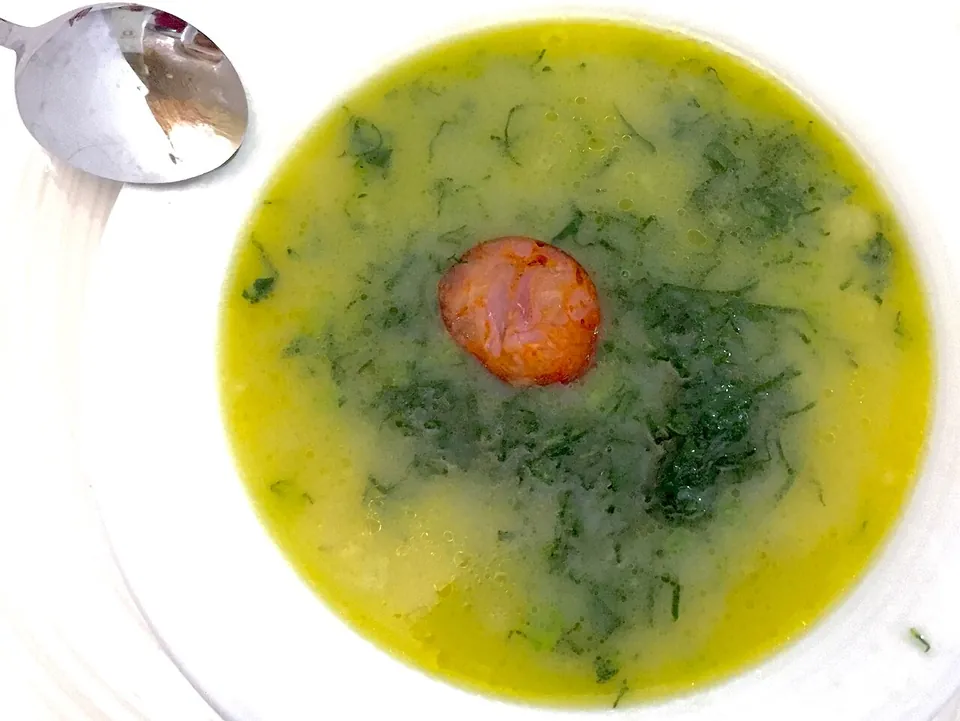
Caldo verde is a soup from the Minho region of northern Portugal: potato mashed to give it body, thin-sliced green kale (couve), and chouriço simmered together. Its present form was settled in this region from the late eighteenth century onward.
What lends the soup its body and thickness is the potato. This crop crossed from the New World to Europe, and it was in the late eighteenth century that it took root as a staple in northern Portugal, in Trás-os-Montes and elsewhere. The cookbook Cozinheiro Moderno ("The Modern Cook"), written in 1780 by the royal cook Lucas Rigaud, and a 1798 decree by Queen Maria I encouraging its cultivation both attest to how well established the potato had become. Kale was an old vegetable long rooted in the soil, present in kitchen gardens from early on. As the potato joined it in the life of the north, today's smooth caldo verde took shape.
Later, as people migrated from the interior in the nineteenth century, the soup spread to cities such as Lisbon and Porto and grew into something close to a national dish of Portugal. The name of its maker has not come down to us.
How we know
Caldo verde carries a story passed down that it was born in the Minho in the mid-fifteenth century. This tale, which boasts of the dish's age, collides with the record when applied straight to today's potato-based form.
The potato was a crop brought from the New World, and it spread as a staple in northern Portugal only in the late eighteenth century. In the fifteenth-century Minho there were as yet no potatoes. A soup thickened with mashed potato, as we know it, could not appear until that crop had settled into the land. Indeed, the royal cook Rigaud's 1780 cookbook Cozinheiro Moderno records the Portuguese table of the day, and the original survives in the National Library of Portugal in Lisbon. The food-history study that read this cookbook closely (João Pedro Gomes, 2016) likewise traces how the potato became established over the late eighteenth century.
Even so, the soup's lineage is not itself new. What can be traced back to the fifteenth century is an earlier green vegetable soup without potato—a plain bowl of kale simmered with grains or bread. The parent dish is old, yet the smooth caldo verde we know today arose in the late eighteenth century, after the potato had rooted in the north. When these two stages are laid over one another, the comforting story of "a fifteenth-century taste carried on unchanged" was born. But the dish changed its shape once the ingredient at its base had arrived.
The full set of origin theories and the detailed verification log — traceable all the way to their sources — are available on the Japanese edition.
See the full origin theories and verification log (Japanese) →
Related dishes
Lineage Family, predecessor, variants
Shares the key ingredient
- Vada pavMumbai (India)C
- PoutineQuebec (Canada)C
- Muisca highland stew (before chicken ajiaco)Bogotá highlands (Cundinamarca)C
- Pani puriNorth IndiaC
- Aloo kachoriIndia (Rajasthan / North India)C
- VichyssoiseFrance / USA (disputed)B
- Olivier saladMoscow (Russia)C
- Bacalhau à BrásLisbon (Portugal)C
- Pav bhajiMumbai (India)C
- Abgoosht (dizi)IranC
- Jansson's temptationSwedenC
- California burritoCalifornia (USA)C
- Shepherd's pieEnglandB
- StamppotNetherlandsC
- Sindhi biryaniSindh (Pakistan)C
- Patties (Sri Lankan)Sri LankaC
- OkroshkaRussiaC
- Potato chipsUnited StatesC
- DranikiBelarusC