All dishes / Western Europe
Vichyssoise Period BOrigin theory BVerified
Some fields (dish name, region and gates) are shown from the Japanese-edition data.
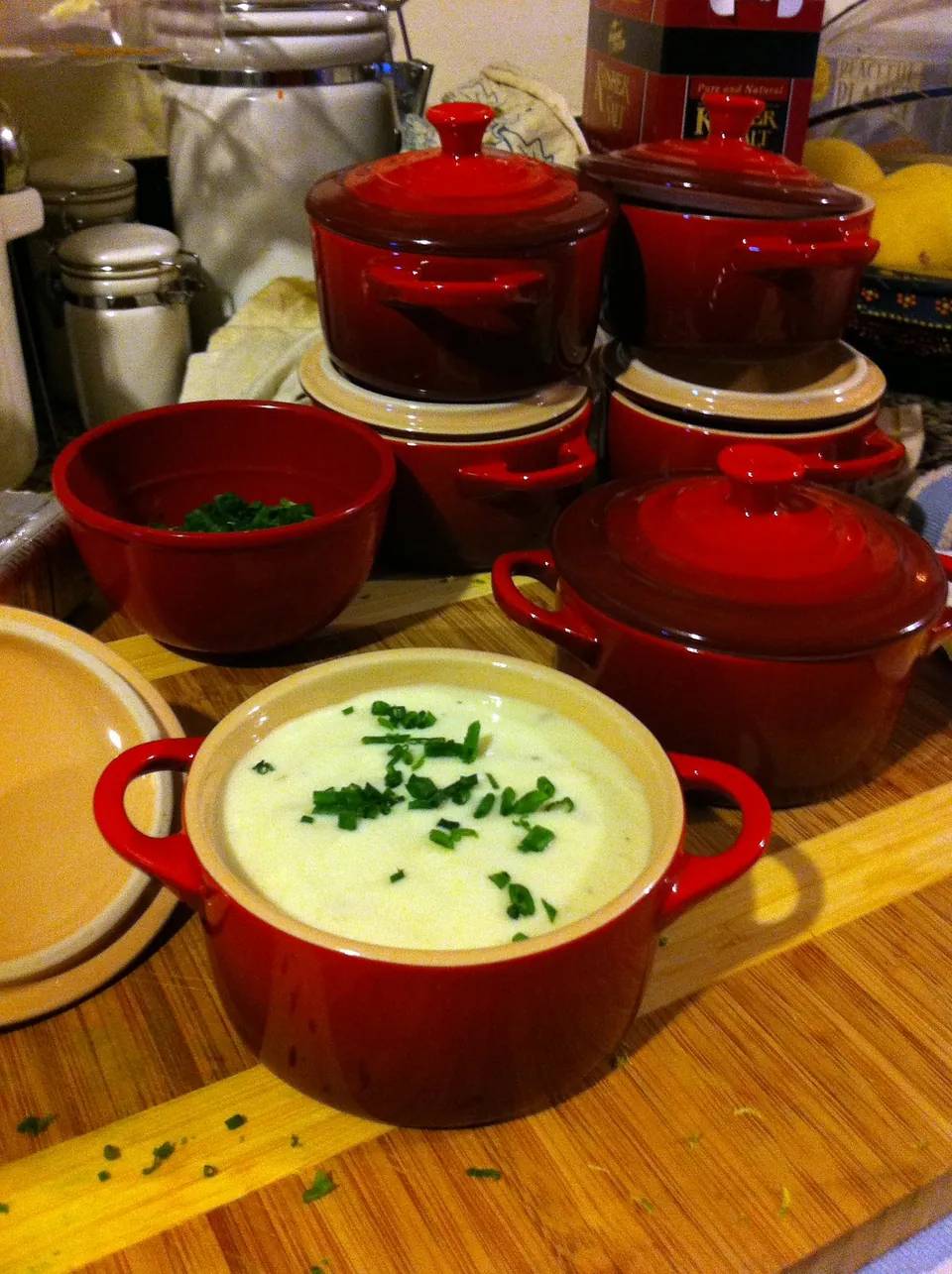
Vichyssoise, the cold soup of leeks and potatoes, carries a French name and the name of a French town. Yet this refined chilled potage was born neither in Paris nor in Vichy, but across the Atlantic, in New York.
Verification highlight popular claim → verdict → evidence
Myth: vichyssoise is purely French, sometimes traced to a legend at the court of Louis XV where a taster's delay let a soup go cold. Verdict: refuted -- the dish was created around 1917 by chef Louis Diat at the Ritz-Carlton in New York, who chilled his mother's potage bonne femme; the earliest print attestation is 1923 (La Revue culinaire), which itself classifies it as American cuisine. A separate claim that Jules Gouffe published a cold version in 1859 is also refuted (his first cookbook only dates to 1867). Key sources: Diat's own account in Gourmet magazine (1951), La Revue culinaire (1923).
The three gates
- Ingredient-supply gate
- Potato is a New World crop but had already reached Europe by the 16th century, so it is not a limiting ingredient (treated as constantly available); leek and cream are native.
- Cooking-technique gate
- A strained, cold potage -- the modern French technique of serving a soup chilled.
- Venue gate
- Fine dining and hotel restaurants (the Ritz-style urban restaurant world).
Overview
Vichyssoise is a creamy soup of potatoes and leeks: simmered, passed through a sieve, thinned with cream, and served cold. Its warm counterpart, the leek-and-potato potage bonne femme, had long been a familiar dish in French homes. Leeks and cream had always been close at hand, and the potato had long since become an everyday crop on European tables.
Serving a smoothly sieved potage chilled over ice was a refinement of modern French cooking, and by the early twentieth century the dining rooms of grand city hotels bearing the Ritz name had become the stage on which chefs showed off that skill. The name is French and nods to the spa town of Vichy, but cold vichyssoise took shape as a dish in the 1910s, on the far side of the Atlantic, in the kitchen of the Ritz-Carlton hotel in New York.
How we know
The name vichyssoise sounds thoroughly French. There is the French cadence, the place-name Vichy, and the warm leek-and-potato soup of the French home. Taken together, they gave rise to the widely told story that this cold soup, too, was born in France.
But the cold soup was the work of Louis Diat, a French-born chef who worked in New York. Diat ran the kitchen of the Ritz-Carlton there, and in 1941 he also wrote a cookbook, Cooking à la Ritz. In 1951 he looked back on his Ritz years in a piece for Gourmet magazine. Of all the Ritz specialties he had originated, he wrote, vichyssoise seemed to him the one that had most thoroughly "captured the fancy of Americans from coast to coast." The piece says nothing, however, about when or how he came to make the soup. The year is often given as 1917, but nothing settles it, and some put it at 1910. The story that he took the warm leek-and-potato soup his mother used to make, served it cold, and named it after Vichy, the spa town near his hometown, is said to appear in Diat's own cookbook, published after his death. On the French side, the culinary journal La Revue culinaire is said to have printed the soup in 1923 as an "American dish."
The belief in a purely French origin came from melting two things into one: the age of the warm soup as a genre, and the cold soup as it is served today. The ingredients and the way of making it do come from the French home. But cold vichyssoise as a dish took shape in New York. That history fits the fact that the soup is less loved in France than in the United States and Britain.
Some tellings push the French origin much further back. The idea is said to have surfaced in 2008 on an American blog: that the nineteenth-century French cook Jules Gouffé had published a recipe for a cold soup of leeks, potatoes and cream in a book in 1859. What is known of this blog, and of the case against it, comes from a note in an earlier version of the English-language Wikipedia article on vichyssoise. That note pointed out that Gouffé's first cookbook was Le Livre de cuisine, published in 1867, and that his later book of soups, Le Livre des soupes et des potages, includes no soup of leeks, potatoes and cream, cold or hot. The note has since been removed from the page. Whatever the case, 1859 sits more than half a century away from the twentieth-century New York in which cold vichyssoise appeared.
Another origin legend holds that cold soup was born at the court of Louis XV, when the royal food taster took so long over his sampling that the soup went cold. Nothing beyond court lore has been put forward to support it, and press accounts plainly call it a "legend." Its era, too, is nowhere near the twentieth-century New York where cold vichyssoise was born.
The full set of origin theories and the detailed verification log — traceable all the way to their sources — are available on the Japanese edition.
See the full origin theories and verification log (Japanese) →
Related dishes
Shares the key ingredient
- Vada pavMumbai (India)C
- PoutineQuebec (Canada)C
- Muisca highland stew (before chicken ajiaco)Bogotá highlands (Cundinamarca)C
- Pani puriNorth IndiaC
- Aloo kachoriIndia (Rajasthan / North India)C
- Olivier saladMoscow (Russia)C
- Bacalhau à BrásLisbon (Portugal)C
- Caldo verdeMinho (Portugal)C
- Pav bhajiMumbai (India)C
- Abgoosht (dizi)IranC
- Jansson's temptationSwedenC
- California burritoCalifornia (USA)C
- Shepherd's pieEnglandB
- StamppotNetherlandsC
- Sindhi biryaniSindh (Pakistan)C
- Patties (Sri Lankan)Sri LankaC
- OkroshkaRussiaC
- Potato chipsUnited StatesC
- DranikiBelarusC
More debunked origins
Other famous dishes whose popular origin story doesn't survive the sources.