All dishes / Eastern Europe
Chebureki Period BOrigin theory CVerified
Some fields (dish name, region and gates) are shown from the Japanese-edition data.
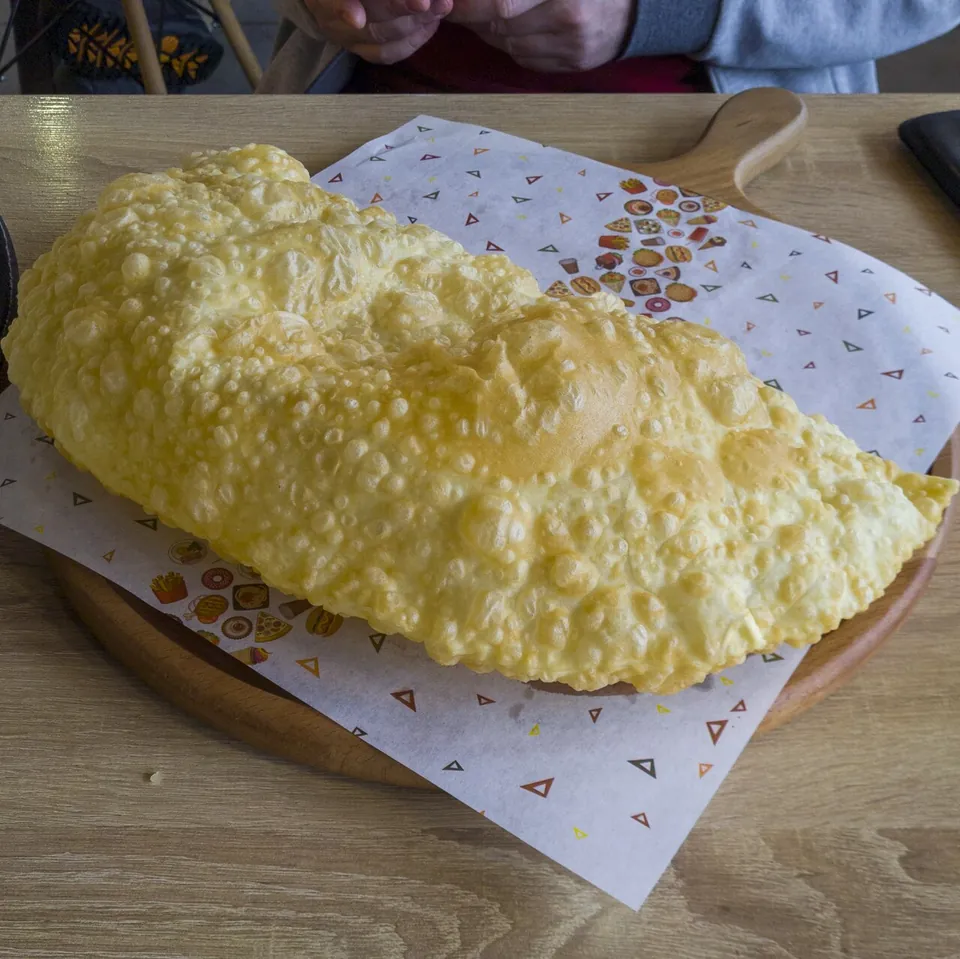
A half-moon pastry the Crimean Tatars have handed down, thin dough folded around minced lamb and deep-fried. A stirring origin tale has long circulated, that it began when Genghis Khan's soldiers grilled it on heated shields, but no old record stands behind it.
Verification highlight popular claim → verdict → evidence
A popular story, repeated in Russian-language articles, says that in the 13th century Genghis Khan's Mongol-Tatar soldiers baked meat pies on metal shields heated over campfires. No contemporary record supporting it has been found, and neither its source nor when it was first told can be traced. Chebureki are fried, not baked on a shield, and the name comes from Turkic, not Mongolian. The view that the dish grew out of Crimean Tatar culture is considered the strongest; another view places it among the many similar fried meat pies of Turkic and Mongol nomads, such as the Mongolian khuushuur, and no early record settles whether it spread from one place or arose in several. Chebureki were little known outside the Tatar community in the time of the Crimean Khanate, and became widespread across the Soviet Union in the 20th century, after the 1944 deportation of the Crimean Tatars to Central Asia and the opening of a chebureki shop in Moscow in 1957.
The three gates
- Ingredient-supply gate
- Wheat and mutton had long been part of Eurasian food and were at hand early on, so neither ingredient narrows the earliest possible date for the dish.
- Cooking-technique gate
- Minced meat is wrapped in thinly rolled dough and deep-fried in oil.
- Venue gate
- The nomadic and settled life of the Crimean Tatars; the dish later spread to Russia and Central Asia.
Overview
A travel food raised by Crimean herding and settlement
Cheburek is a fried meat pastry from the tables of the Crimean Tatars, who live on the northern shore of the Black Sea. Thin-rolled wheat dough is folded around minced lamb or beef with onion, shaped into a half-moon, and deep-fried. In Crimean Tatar culture today it is cherished as a national dish.
What supported this dish was herding, which relied on sheep and cattle, and the craft of milling and kneading wheat. Wheat and lamb are both long-established across Eurasia, on hand from early on. The method of folding meat into dough and frying it in oil turned wheat flour and meat into a filling, portable food well suited to a mobile life, and it took root as something you could carry and eat on the move.
In the days of the Crimean Khanate, the dish was little known outside the Tatar community. After Russia annexed Crimea in 1783, it spread with the movement of people into Russia and Central Asia. It became widely known only in the twentieth century: the 1944 deportation of the Crimean Tatars to Central Asia scattered them across many places, and the opening of a cheburek specialty shop, the Cheburechnaya, in Moscow in 1957 helped push the dish across the whole Soviet Union.
How we know
Cheburek is trailed by an origin tale that sounds suitably ancient. In the thirteenth century, the story goes, Mongol-Tatar soldiers under Genghis Khan grilled meat-filled pastries on metal shields heated over a fire. It has been repeated again and again in popular Russian-language articles.
But no contemporary record supports the anecdote. Neither its source nor the time it was first told can be traced, and it bears the strong color of a story added later. Cheburek is, after all, a fried dish, and it does not fit the image of grilling on a shield. Its name, too, comes from a Turkic word, not from Mongolian. It is best kept apart from the historical record, as an origin tale that borrows antiquity and the name of a famous conqueror.
The name itself holds a knot that will not quite come undone. That the second element, börek, means pastry is certain, but what the first element, çi-, means is unsettled. Views split three ways: çiy for raw, the Tatar çi for delicious, and iç for the filling inside. The modern Turkish reading çiğ börek (raw pastry) is widely known, but it is likely a later re-etymology fitted to a similar-sounding word, and no old source lets one declare it the original meaning.
Origins, too, resist a single answer. The view that cheburek is a product of Crimean Tatar culture itself is considered the strongest, while another widens the lens to the nomads of Eurasia. The construction, thin dough folded around minced meat and fried, is simple, and among Turkic and Mongolic nomads there are many similar fried meat pastries. The Mongolian khuushuur is nearly the same shape, and a shared nomadic food culture has been suggested as their common root. Whether it passed from one land to many, or arose separately amid similar ways of life, no old record survives to decide.
The full set of origin theories and the detailed verification log — traceable all the way to their sources — are available on the Japanese edition.
See the full origin theories and verification log (Japanese) →
Related dishes
Lineage Family, predecessor, variants
Cross-links Sister dishes & same-name dishes (separate lineage)
- Sister dish (shared ancestor)BelyashiVolga-Ural (Tatar / Bashkir)C
- Sister dish (shared ancestor)KhuushuurMongoliaB
Shares the key ingredient
- PierogiPolandC
- EmpanadaRío de la Plata (Argentina)C
- BliniRussiaB
- PirozhkiRussiaB
- JalebiNorthern IndiaB
- Fortune cookieCalifornia (USA)C
- StroopwafelGouda (Netherlands)C
- LamingtonQueensland (Australia)C
- ChimichangaTucson, Arizona (USA)C
- BuuzMongoliaB
- VarenykyUkraineC
- MandaziEast Africa (Swahili Coast)C
- LángosHungaryC
- Daoxiaomian (knife-cut noodles)Shanxi (China)C
- Dobos torteHungaryB
- SambusaEast Africa (Swahili Coast)B
- SarburmaCrimea (Crimean Tatars)B
- ThenthukTibet / NepalB
- ShumaiGuangzhou (China)B
- Jiaozi (gyoza)ChinaC
- Hohhot shaomaiHohhot (China)B
- OliebollenNetherlandsC
- MarquesitaYucatán (Mexico)D
- Halwa puriLahore (Pakistan)D
- Roti prataSingaporeB
- SopaipillaNew Mexico (USA)C
- CoyotaSonora (Northern Mexico)C
- RunzaMidwestern United StatesB
- BanshMongoliaC
- Kashyk-ash (къашыкъ-аш, Crimean Tatar spoon-dumpling soup)Crimea (Crimean Tatar)C
- KulebyakaRussiaB
- Spring roll (Chinese)ChinaC
- ChuchvaraUzbekistan (Samarkand / Fergana)C
- DamperAustraliaC
- SamsaCentral AsiaC
- HalushkyUkraineC
- BanitsaBalkans (Bulgaria)C
- Har gowGuangzhou (China)C