All dishes / East Asia
Har gow Period BOrigin theory CVerified
Some fields (dish name, region and gates) are shown from the Japanese-edition data.
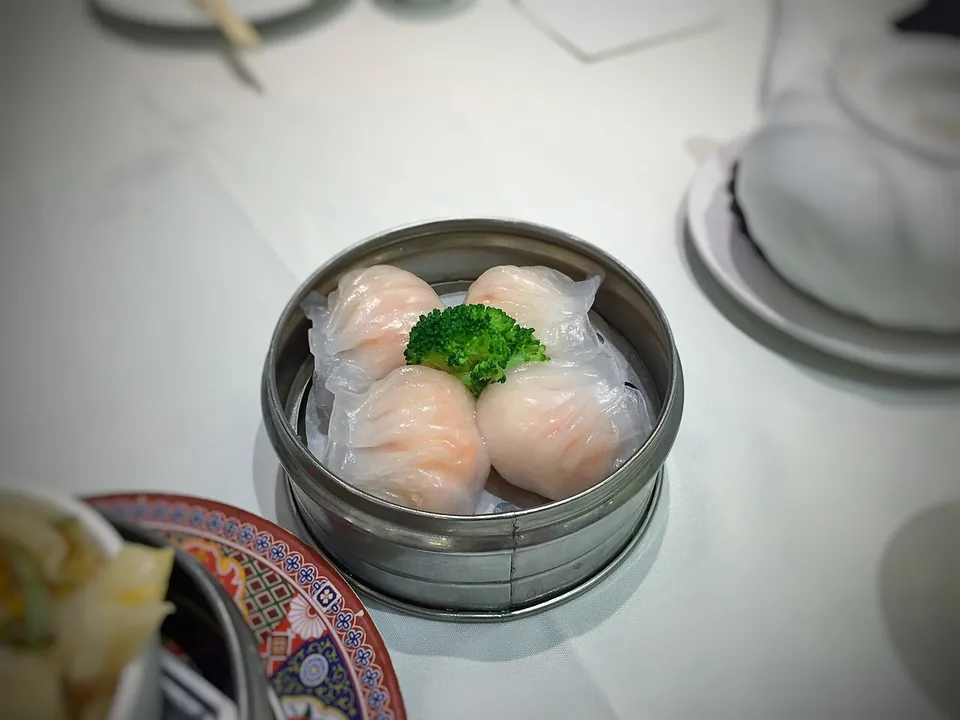
A Guangzhou dim sum whose translucent skin lets the pink of river shrimp show through, closed with more than a dozen fine pleats. The tale that it was born in a teahouse in the village of Wufeng is told everywhere — yet the earliest writing that carries it dates from the 2000s, some eighty years after the events it describes.
Verification highlight popular claim → verdict → evidence
A dim sum dumpling of shrimp wrapped in a nearly translucent skin made from wheat starch (cheng fun). It spread through Guangzhou's teahouse culture in the 1920s-30s; the popular story crediting a particular village and teahouse has not been confirmed by any contemporaneous source found so far.
The three gates
- Ingredient-supply gate
- Shrimp was a long-established local ingredient. The limiting factor for the style is the technique of refining wheat starch (cheng fun) out of wheat flour; the clear, translucent wrapper is then made by gelatinizing that starch with boiling water.
- Cooking-technique gate
- The dim sum technique of rolling the wheat-starch wrapper thin and pleating it into a dozen or so folds.
- Venue gate
- The yum cha teahouse culture around Guangzhou.
Overview
Har gow (蝦餃) is one of Guangzhou's signature dim sum: a thin, half-transparent wrapper through which the shrimp's redness glows. A plump river shrimp is folded into a crescent closed by more than a dozen finely pinched pleats.
The shrimp itself was a long-established local ingredient, caught in the Pearl River delta and on hand from early on. What gives this dumpling its distinctive look is the wrapper. Wheat starch — flour with the gluten removed, known as cheng fun — turns clear when scalded with boiling water and steamed. Early wrappers are said to have been rice-starch based, developing toward blends of wheat starch and tapioca starch. Rolling this clear skin thin and closing it with fine pleats, thirteen or so held up as the ideal, is what marks har gow today.
Such technique was honed in the teahouses and settled into a dish within the dim sum culture around Guangzhou. Still, no primary source has yet been found that fixes a norm for the number of pleats or the date the wheat-starch skin was perfected.
How we know
Har gow comes with a widely told origin story. A teahouse in the village of Wufeng near Guangzhou, the Yizhen teahouse, is said to have served it first, under the name "Wufeng fresh-shrimp dumpling." It is held to have spread through Guangzhou's teahouse culture in the 1920s, prized as a dumpling that made the most of the delta's fresh river shrimp. Other accounts place its beginnings in Shunde, or push them back much further: to the kitchen of Wu Bingjian, the Thirteen Factories merchant magnate of the mid-Qing, where a household cook is said to have devised the wheat-starch wrapper. That last account, however, comes with its own disclaimer — the text that carries it states plainly that the history of har gow is not recorded in any document and is passed down by word of mouth from old-timers.
Trace the Wufeng naming tale back and the earliest writing that carries it turns out to be a 2006 column by the Hong Kong food writer Wai Ling (唯灵) in the Hong Kong Economic Journal, along with a 2008 piece in the Yangcheng Evening News. The events they describe belong to the 1920s, so what these texts preserve is oral tradition set down some eighty years later. Among the datable materials of the Republican era held by the Guangzhou Museum — the old menus, recipe books and food advertisements in its keeping — no notice tying har gow to Wufeng has yet been found. Nor is har gow one of the twenty dim sum the museum restored for its "Vanished Dim Sum" project from a 1930s manual of dim sum methods.
None of which means the dumpling was absent from the teahouses of the day. Zhou Songfang, a historian of Republican-era Cantonese cuisine at Sun Yat-sen University, writes that in the 1920s the Cantonese restaurants of Guangzhou and Shanghai introduced the "weekly delicacies" list — a rotating roster of dim sum, credited to Guo Xing of the Luyuju teahouse in the late 1920s — and he counts har gow among its signature items. By a route quite separate from the Wufeng tale, har gow can be seen on Guangzhou's teahouse tables in the 1920s. What that shows, though, is only the period, the 1920s; it says nothing about who first made the dumpling, or where.
The clear skin and the dozen-odd pleats are likewise recounted as proud craft, yet no record from the period has been found that shows when that practice was set. Which teahouse, and when — for now there is not enough to draw a single line. The Wufeng story remains what it has always been: a tale handed down.
The full set of origin theories and the detailed verification log — traceable all the way to their sources — are available on the Japanese edition.
See the full origin theories and verification log (Japanese) →
Related dishes
Shares the key ingredient
- PierogiPolandC
- EmpanadaRío de la Plata (Argentina)C
- BliniRussiaB
- PirozhkiRussiaB
- CheburekiCrimea (Crimean Tatar)C
- BelyashiVolga-Ural (Tatar / Bashkir)C
- JalebiNorthern IndiaB
- Fortune cookieCalifornia (USA)C
- StroopwafelGouda (Netherlands)C
- LamingtonQueensland (Australia)C
- ChimichangaTucson, Arizona (USA)C
- BuuzMongoliaB
- YantykCrimea (Crimean Tatar)C
- VarenykyUkraineC
- MandaziEast Africa (Swahili Coast)C
- LángosHungaryC
- Daoxiaomian (knife-cut noodles)Shanxi (China)C
- KhuushuurMongoliaB
- Dobos torteHungaryB
- SambusaEast Africa (Swahili Coast)B
- SarburmaCrimea (Crimean Tatars)B
- ThenthukTibet / NepalB
- ShumaiGuangzhou (China)B
- Jiaozi (gyoza)ChinaC
- Hohhot shaomaiHohhot (China)B
- OliebollenNetherlandsC
- MarquesitaYucatán (Mexico)D
- Halwa puriLahore (Pakistan)D
- Roti prataSingaporeB
- SopaipillaNew Mexico (USA)C
- CoyotaSonora (Northern Mexico)C
- RunzaMidwestern United StatesB
- BanshMongoliaC
- Kashyk-ash (къашыкъ-аш, Crimean Tatar spoon-dumpling soup)Crimea (Crimean Tatar)C
- KulebyakaRussiaB
- Spring roll (Chinese)ChinaC
- ChuchvaraUzbekistan (Samarkand / Fergana)C
- DamperAustraliaC
- SamsaCentral AsiaC
- HalushkyUkraineC
- BanitsaBalkans (Bulgaria)C