All dishes / Eastern Europe
Varenyky Period COrigin theory CVerified
Some fields (dish name, region and gates) are shown from the Japanese-edition data.
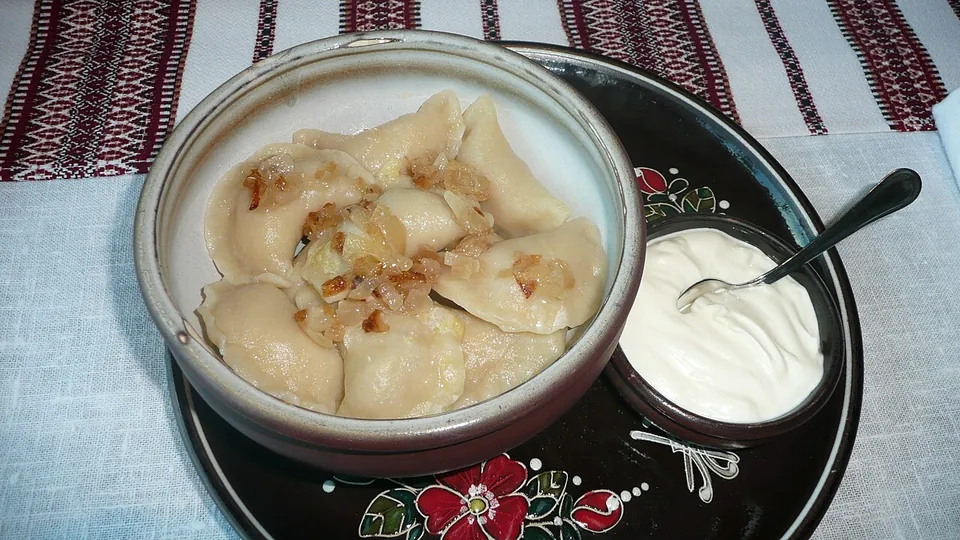
A Ukrainian home dish for festive days, made by wrapping a filling in dough and boiling it. Its very name comes from the word for "to boil," and the potato filling now thought of as standard is in fact a relatively recent addition. The story told on food blogs and elsewhere, that the name was "borrowed from a Turkic dumpling," has no scholarly support.
Verification highlight popular claim → verdict → evidence
A claim repeated on food blogs says the name was borrowed directly from a Turkic dumpling called dyush-vara, but it has no scholarly support: the name is fully explained by the native East Slavic verb varyty, 'to boil.' Where the dish itself comes from is still an open question. One view roots varenyky in a native East Slavic tradition of boiled dishes; another holds that the idea of a boiled dumpling came from the Turkic peoples of Central Asia and reached Eastern Europe by way of the Mongols and Tatars. Versions without potato are older than the potato filling: a 1682 Polish cookbook, Compendium ferculorum, already has the related pierogi, filled with veal kidney or with rose and elder preserves, and no potato.
The three gates
- Ingredient-supply gate
- The wheat-flour dough is a native staple. The signature filling, potato, is a New World crop that only spread through Ukraine in the 18th-19th centuries, so the potato-filled version could appear only after that arrival; versions without potato are older.
- Cooking-technique gate
- Wrapping a filling in wheat dough and boiling it.
- Venue gate
- A home and festival dish of the Ukrainian countryside.
Overview
Varenyky are made by wrapping a filling in thinly rolled wheat dough and boiling the parcels in water. In the Ukrainian countryside they are loved both as home cooking and as a dish that brightens the festive table. The fillings vary: cottage cheese, fruit such as sour cherries, potato and more. Sweet and savory fillings alike go by the same name, varenyky, so the dish can serve as a meal or as a dessert.
Their emergence is placed somewhere between the late Middle Ages and the early modern period, roughly the fourteenth to the seventeenth century. The wheat of the dough was a local crop, grown here as a main crop from early on. Wrapping a filling in a thin skin and dropping it into boiling water is a plain handiwork that needs no special tools. Because the ingredient was at hand so early and the craft was a plain one, it is hard to pin down the moment when varenyky came together as one dish.
The cast of fillings has changed over time. One firmly dated clue is Compendium ferculorum, published in Kraków in 1682 and the earliest known cookbook published originally in Polish. The pierogi it describes, members of the same family, come in two kinds: a savory one, in which chopped veal kidney seasoned with herbs, salt, pepper and nutmeg is wrapped and boiled, and one that wraps rose or elder preserved in sugar. Potato is not among the fillings of those pierogi. In literature set in Ukraine, varenyky with sour cream appear in "The Fair at Sorochyntsi" (1831), one of Gogol's Evenings on a Farm Near Dikanka, and "Christmas Eve" (1832) has varenyky that are not Lenten fare, dipped in sour cream before eating. Neither story says what is wrapped inside. Today's standard potato filling was added only after potatoes, brought from the New World, spread through the region from the eighteenth and nineteenth centuries onward, which makes it a relatively recent variant.
How we know
One anecdote about where varenyky came from has been told on food blogs and elsewhere. It holds that Ukrainians took the name of dushvara, a Turkic boiled dumpling, reshaped it into varenyky, and swapped the filling for local ingredients. The name itself, in other words, was borrowed from abroad.
But this "dushvara borrowing" has no scholarly support. Followed back, it leads to a different lineage. The joshpara family, from the Persian josh (to boil) and para (piece), already appears in the thirteenth-century Arabic cookbook Kitab al-Wuslah ila l-habib, and its line runs from Central Asia through the Finno-Ugric "ear bread" (pelnan) to the pelmeni of seventeenth-century Russia. No trace has been found of it passing directly into the name varenyky. That the names share the sense of "to boil" is a parallel, similar dishes arriving at the same idea in separate lands, and not evidence of borrowing.
The name has a more straightforward explanation. Varenyky is built from the Old East Slavic varyty (Proto-Slavic *variti), "to boil, to cook," plus a noun ending: the act of boiling became the name of the dish.
Even so, the story does not close as the achievement of Ukraine alone. The origin of pierogi and varenyky themselves has not been established and has often been debated, with one view holding that they were common to the Slavs from long ago and another that the idea of the dumpling was taken from the Turkic peoples of Central Asia. Varenyky belong to a wide world of boiled dumplings that stretches from the East Slavs across Eurasia, and they stand to pelmeni, which wrap minced meat, as equal sisters within that world. The small tale of a borrowed name falls apart, yet the wide kinship the dish carries stands out all the more clearly.
The full set of origin theories and the detailed verification log — traceable all the way to their sources — are available on the Japanese edition.
See the full origin theories and verification log (Japanese) →
Related dishes
Cross-links Sister dishes & same-name dishes (separate lineage)
Shares the key ingredient
- PierogiPolandC
- EmpanadaRío de la Plata (Argentina)C
- BliniRussiaB
- PirozhkiRussiaB
- CheburekiCrimea (Crimean Tatar)C
- BelyashiVolga-Ural (Tatar / Bashkir)C
- JalebiNorthern IndiaB
- Fortune cookieCalifornia (USA)C
- StroopwafelGouda (Netherlands)C
- LamingtonQueensland (Australia)C
- ChimichangaTucson, Arizona (USA)C
- BuuzMongoliaB
- YantykCrimea (Crimean Tatar)C
- MandaziEast Africa (Swahili Coast)C
- LángosHungaryC
- Daoxiaomian (knife-cut noodles)Shanxi (China)C
- KhuushuurMongoliaB
- Dobos torteHungaryB
- SambusaEast Africa (Swahili Coast)B
- SarburmaCrimea (Crimean Tatars)B
- ThenthukTibet / NepalB
- ShumaiGuangzhou (China)B
- Jiaozi (gyoza)ChinaC
- Hohhot shaomaiHohhot (China)B
- OliebollenNetherlandsC
- MarquesitaYucatán (Mexico)D
- Halwa puriLahore (Pakistan)D
- Roti prataSingaporeB
- SopaipillaNew Mexico (USA)C
- CoyotaSonora (Northern Mexico)C
- RunzaMidwestern United StatesB
- BanshMongoliaC
- Kashyk-ash (къашыкъ-аш, Crimean Tatar spoon-dumpling soup)Crimea (Crimean Tatar)C
- KulebyakaRussiaB
- Spring roll (Chinese)ChinaC
- ChuchvaraUzbekistan (Samarkand / Fergana)C
- DamperAustraliaC
- SamsaCentral AsiaC
- HalushkyUkraineC
- BanitsaBalkans (Bulgaria)C
- Har gowGuangzhou (China)C