All dishes / Eastern Europe
Pierogi Period COrigin theory CVerified
Some fields (dish name, region and gates) are shown from the Japanese-edition data.
Poland's pierogi carry a lovely legend: that in 1240, Saint Hyacinth handed them out to the starving. But the saint's own biography says not a word about pierogi.
Verification highlight popular claim → verdict → evidence
The legend that St. Hyacinth handed out pierogi to the starving during the Mongol invasion around 1240 is refuted: the 14th-century account of his life and miracles never mentions the dish, and the episode was added in later retellings. The claim that the dish and its name came from China via Marco Polo and the Silk Road is likewise refuted by the history of the word: Brückner's etymological dictionary of Polish (1927) identifies pieróg as the sole surviving Polish form of the old Slavic *pir ('feast'), not a borrowing. The Old Polish form piróg is recorded in 1472 as 'a kind of dough, either filled or kneaded with cheese,' but those medieval records do not say whether it was boiled or baked. A recipe for boiling filled dough first appears in 1682, in Compendium ferculorum, the earliest known cookbook published originally in Polish. That the name is local does not settle where the technique of wrapping and boiling dough came from, and when pierogi took their present form remains uncertain.
The three gates
- Ingredient-supply gate
- Wheat flour, native to the Old World and the limiting ingredient; the potato-filled version is a later New World-influenced variant, but potato is not the defining ingredient
- Cooking-technique gate
- Wrapping a filling in kneaded dough and boiling it. The name is native Slavic, but where this technique came from (whether it spread in from the east or grew up locally) remains an open question
- Venue gate
- From household and monastery kitchens to a festive holiday staple
Overview
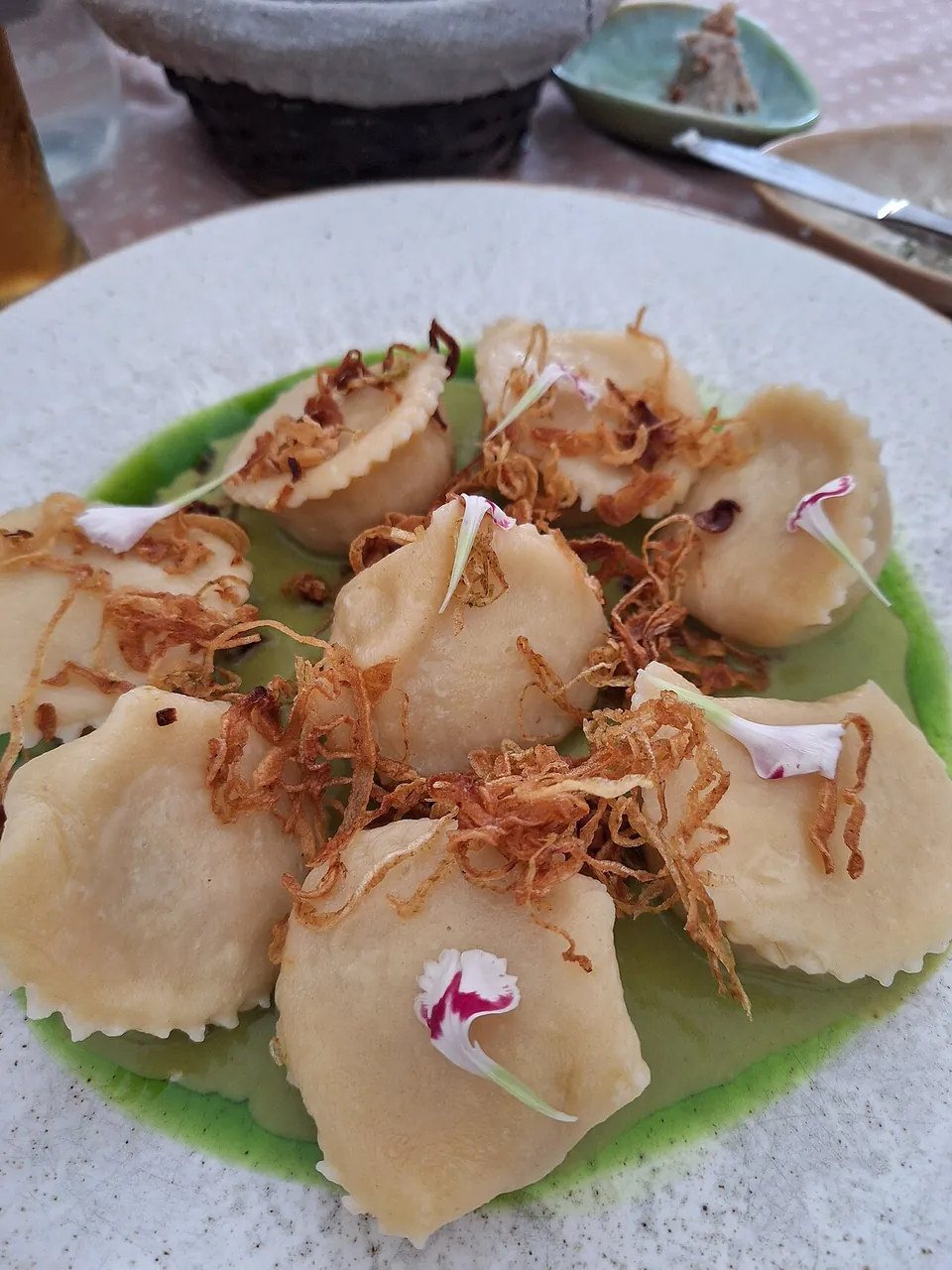
Pierogi are dumplings of thinly rolled wheat dough folded around a filling and boiled. The fillings vary, from cheese and cabbage to, later, potato, and the dish has long been loved in Poland and across central and eastern Europe. It began in home kitchens and monastery meals and grew into a staple of the festive table.
The name pierogi comes from the local Slavic language. The Polish pieróg goes back to an old Slavic word meaning "feast," and one etymological dictionary holds that it was originally the name of a pastry made for ritual occasions. In Old Polish the word piróg is recorded in 1472, meaning "a kind of dough, either filled or kneaded with cheese." The medieval records, though, do not say whether this dough was boiled or baked.
The main ingredient, wheat, is a grain long grown in this region. Potato-filled pierogi are a type born much later, after the potato crossed from the New World; widely loved as they are today, potato is not what makes a pierogi a pierogi. At the heart of the dish lies the handwork of kneading dough, folding in a filling, and boiling it.
A recipe for boiling filled dough first appears in a cookbook in 1682, in Compendium ferculorum, the earliest known cookbook published originally in Polish. The story that the dish goes back to the thirteenth century is a tradition of later times, and when pierogi were born remains uncertain. What is certain is that by 1682 at the latest, a recipe for boiled pierogi had been written down in a cookbook.
How we know
The beginnings of pierogi have long been a tangle of legend, a theory of distant importation, and a case for native roots.
Most famous is the legend of Saint Hyacinth. Around 1240, the story goes, when the Mongol invasion left people starving, this saint fed them pierogi and saved them. But open the fourteenth-century account of his life and miracles, and pierogi appear nowhere in it. This heartwarming episode was added much later, as people retold the story; the contemporary record shows no trace of it.
Next comes a theory of importation from the distant East. A wrapped dish like the dumplings of Central Asia, it was said, was carried from China to eastern Europe by Marco Polo or along the Silk Road, and the very name pierogi came from Chinese. This story comes apart at the name. Aleksander Brückner's etymological dictionary of Polish (1927), a classic of the field, identified pieróg as the sole surviving Polish form of the old Slavic *pir, "feast." The Russian pirog shares the same root. The name was rooted not in Chinese but deep in Slavic speech, and the tale of a dish carried from China, name and all, cannot stand against the history of the word. How the technique of wrapping and boiling dough itself spread across Eurasia is a separate question, and one still open.
Set the legend and the Chinese theory aside, and what remains is a name and a cookbook. The name is unmistakably local Slavic, and the word piróg appears in writing in 1472. But the piróg of that time is recorded only as a dough with a filling or with cheese, and whether it was boiled or baked cannot be told. A recipe for boiling filled dough appears in a cookbook only in 1682. That the name belongs to the local language does not settle where the technique of wrapping and boiling dough began, or how it traveled. Pierogi are often said to be of unknown and unverifiable origin, yet the name is local, and the boiled form was in a cookbook by 1682 at the latest. That much can be said with certainty.
The full set of origin theories and the detailed verification log — traceable all the way to their sources — are available on the Japanese edition.
See the full origin theories and verification log (Japanese) →
Related dishes
Cross-links Sister dishes & same-name dishes (separate lineage)
Shares the key ingredient
- EmpanadaRío de la Plata (Argentina)C
- BliniRussiaB
- PirozhkiRussiaB
- CheburekiCrimea (Crimean Tatar)C
- BelyashiVolga-Ural (Tatar / Bashkir)C
- JalebiNorthern IndiaB
- Fortune cookieCalifornia (USA)C
- StroopwafelGouda (Netherlands)C
- LamingtonQueensland (Australia)C
- ChimichangaTucson, Arizona (USA)C
- BuuzMongoliaB
- YantykCrimea (Crimean Tatar)C
- VarenykyUkraineC
- MandaziEast Africa (Swahili Coast)C
- LángosHungaryC
- Daoxiaomian (knife-cut noodles)Shanxi (China)C
- KhuushuurMongoliaB
- Dobos torteHungaryB
- SambusaEast Africa (Swahili Coast)B
- SarburmaCrimea (Crimean Tatars)B
- ThenthukTibet / NepalB
- ShumaiGuangzhou (China)B
- Jiaozi (gyoza)ChinaC
- Hohhot shaomaiHohhot (China)B
- OliebollenNetherlandsC
- MarquesitaYucatán (Mexico)D
- Halwa puriLahore (Pakistan)D
- Roti prataSingaporeB
- SopaipillaNew Mexico (USA)C
- CoyotaSonora (Northern Mexico)C
- RunzaMidwestern United StatesB
- BanshMongoliaC
- Kashyk-ash (къашыкъ-аш, Crimean Tatar spoon-dumpling soup)Crimea (Crimean Tatar)C
- KulebyakaRussiaB
- Spring roll (Chinese)ChinaC
- ChuchvaraUzbekistan (Samarkand / Fergana)C
- DamperAustraliaC
- SamsaCentral AsiaC
- HalushkyUkraineC
- BanitsaBalkans (Bulgaria)C
- Har gowGuangzhou (China)C