All dishes / Western Europe
Risotto alla milanese Period BOrigin theory BVerified
Some fields (dish name, region and gates) are shown from the Japanese-edition data.
Risotto alla Milanese, the golden saffron rice of Milan, is often traced to a wedding in 1574, when an apprentice to a stained-glass maker supposedly dyed the rice yellow as a prank. No contemporary record supports it, and the dish does not appear in cookbooks until the nineteenth century, more than two centuries later. The story is a later invention.
Verification highlight popular claim → verdict → evidence
Myth: the dish was born in 1574, when an apprentice to a stained-glass maker, nicknamed 'Saffron', jokingly colored the rice with saffron at a wedding. Verdict: rejected - no contemporary record supports the tale, which traces no further back than a twentieth-century collection of Milanese legends, with no independent early corroboration. The dish's name and method can be read in a household cookbook published in Milan in 1859 (Il cuoco milanese e la cuciniera piemontese) and in Artusi's La scienza in cucina (1891); Italian encyclopedias and food magazines cite earlier records in Il Cuoco Moderno (Milan, 1809) and in Luraschi's cookbook of 1829. Even these fall more than two centuries after 1574. Key sources: Il cuoco milanese e la cuciniera piemontese (Milan, 1859, primary source); Pellegrino Artusi (1891, primary source); Wikipedia (it.); Rice in Lomellina (Sforza's gift of rice seed in 1475).
The three gates
- Ingredient-supply gate
- Rice is not native to Italy: it reached the Mediterranean through Arab and Spanish trade in the late Middle Ages, and paddy cultivation took hold on the Po plain of northern Italy only in the fifteenth and sixteenth centuries, which sets the earliest possible date for the dish. Saffron could be had before that, carried in by Mediterranean trade, and no New World ingredient plays any part in it.
- Cooking-technique gate
- It calls for the risotto method known as mantecatura: the rice is stirred as it gradually drinks in the broth, held over a steady, sustained heat.
- Venue gate
- Cooked at home and served in eating houses, it was a dish of the city; it began at the tables of the upper classes and in time became food for the townspeople at large, and it belonged to Lombardy, and to Milan above all.
Overview
Where rice met saffron in Milan
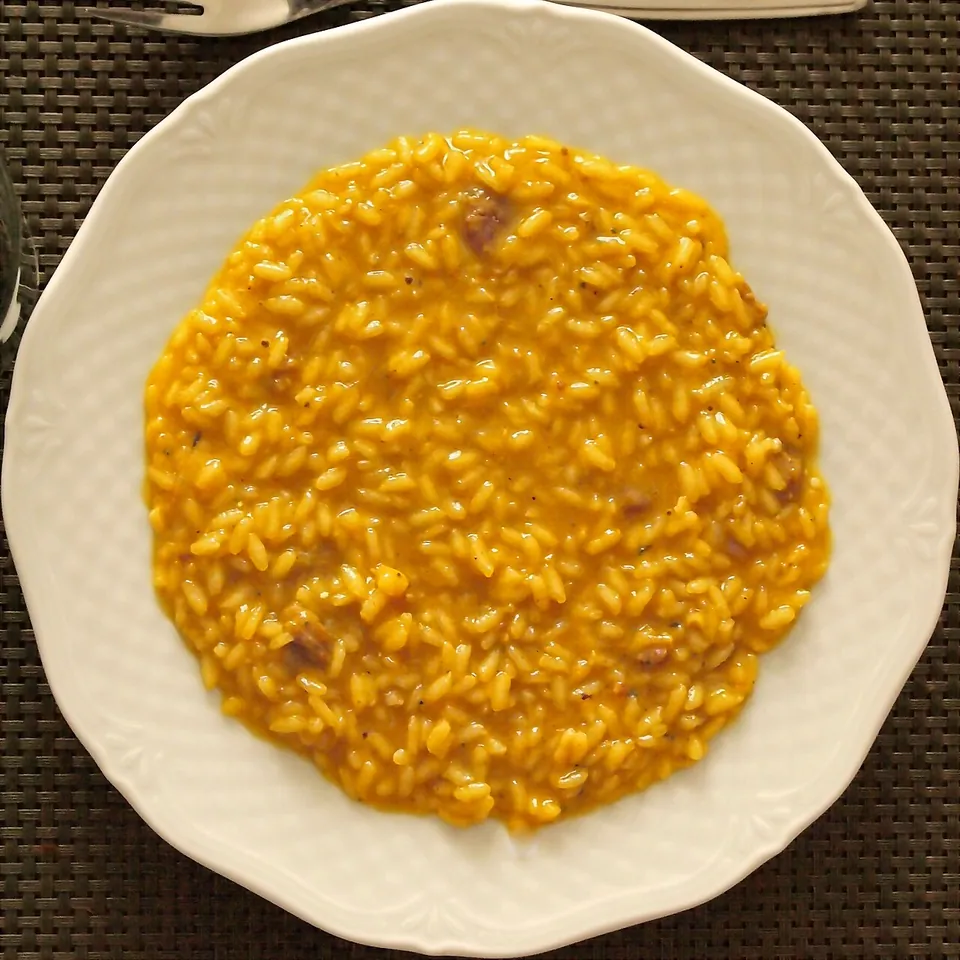
Risotto alla Milanese is a dish of Lombardy, centered on Milan: rice toasted and simmered in broth, tinted and flavored with saffron, enriched with marrow or butter, and finished with Parmesan.
Rice, the heart of the dish, was not originally an Italian crop. It reached the Mediterranean by way of the Arab and Spanish worlds in the late Middle Ages, and paddy cultivation took hold on the Po plain of northern Italy only in the fifteenth and sixteenth centuries. In 1475 the Milanese lord Sforza sent twelve sacks of rice seed to a neighboring ruler, and a notarial deed near Vercelli from 1493 lists a rice mill as an ordinary, everyday fixture. Records like these show rice farming settling in as a daily industry. Saffron came in through Mediterranean trade; no New World ingredient plays any part in this dish.
The finishing craft is what defines it: stirring the rice so it drinks in the broth little by little, held over a steady, patient heat. Because saffron was costly, the dish began at the tables of the Lombard elite, but it spread over time into a staple of Milan's townspeople.
The dish's name and method can be read plainly in cookbooks by the middle of the nineteenth century. A household cookbook published in Milan in 1859, Il cuoco milanese e la cuciniera piemontese, has an entry headed "Risotto alla milanese": fry onion in butter until golden, add saffron and let it cook, and before bringing it to the table stir in cheese from Lodi and a little butter. In 1891 a dish of the same name appeared in Pellegrino Artusi's La scienza in cucina (Science in the Kitchen): rice, butter, onion and saffron cooked in broth, served with Parmesan. Italian encyclopedias and food magazines cite earlier records still. They point to a yellow rice in Il Cuoco Moderno, a cookbook published in Milan in 1809, made by frying marrow among other ingredients and letting the rice drink up a broth tinted with saffron, and to a "risotto alla milanese giallo" (yellow Milanese risotto) in the 1829 cookbook of Felice Luraschi. There was no single inventor and no single moment of invention. This golden rice came into being from the meeting of two things: the rice that had rooted itself on the Po plain, and the saffron carried in by trade.
How we know
This dish carries a famous origin story. On 8 September 1574, at the wedding of the daughter of Maestro Valerio, a stained-glass maker at Milan's cathedral, an apprentice nicknamed "Saffron" for the lavish way he used the spice to color glass supposedly tinted the rice yellow as a joke and served it up. That, the tale goes, was the beginning of the dish. The year, the date, the people are all specific, and it all sounds convincing.
Yet no contemporary record supports the anecdote. Even the cookbooks that Italian encyclopedias and food magazines cite as the dish's early records date from the start of the nineteenth century, more than two centuries after the 1574 of the story. What is more, when you trace the tale to its source, it leads back to a twentieth-century collection of Milanese legends, Leggende e storie milanesi, set down more than three hundred years after the year it describes, with no independent early corroboration. In food history it is read as a later fabrication, a story lacking any basis for pinning down an origin. A vivid, endearing anecdote comes apart in the silence of the sources.
When, then, did the dish make it onto the page? Its name and method can be read together in the "Risotto alla milanese" entry of a household cookbook published in Milan in 1859, and in Artusi's book of 1891. Italian encyclopedias and food magazines report earlier sightings: a yellow rice in a cookbook of 1809, and a yellow risotto under this name in Luraschi's cookbook of 1829. The rice had settled onto the Po plain from the fifteenth century onward, and saffron had been available through trade before that. The dish that joined the two was written down in Milan's cookbooks over the course of the nineteenth century.
This has the same shape as the story of Margherita's royal naming. A specific, affectionate founding anecdote collapses under the silence of the record. What produced the golden risotto was not one craftsman's prank, but the rice rooted on the Po plain and the saffron that crossed the sea.
The full set of origin theories and the detailed verification log — traceable all the way to their sources — are available on the Japanese edition.
See the full origin theories and verification log (Japanese) →
Related dishes
Shares the key ingredient
- BiryaniSouth Asia (Deccan / Mughal)C
- DosaSouth India (Tamil Nadu / Karnataka)C
- PaellaValencia, SpainB
- Nasi gorengIndonesia (Java)C
- JambalayaNew Orleans (Louisiana, USA)C
- MujaddaraLevant (Syria, Lebanon, Palestine)B
- DoriaYokohama, JapanB
- IdliSouth IndiaC
- MaqlubaPalestine / LevantC
- White mixed rice (hondon-ban / goldong-ban)Korean PeninsulaC
- MandiHadhramaut (Yemen)C
- Rice and native-grain upma (sada upma, before semolina)South IndiaC
- KiribathSri LankaD
- KabsaSaudi ArabiaC
- PlovUzbekistan (Samarkand / Fergana)C
- MachboosPersian Gulf (Bahrain / Kuwait)B
- Gallo pintoCosta Rica / NicaraguaC
- Dal bhatNepalC
- KoshariEgyptC
- PilauEast Africa (Swahili Coast)C
- Rice-and-lentil koshari (before pasta and tomato)EgyptC
- Bánh cuốnVietnamB
- MahshiEgyptB
- PolowIranC
- PulaoNorth IndiaB
- PilavAnatoliaC
- Kabuli palawAfghanistanC
- Pilaf (French)FranceC
- Pilaf (Japanese-style)JapanC
- Arroz de mariscoAlgarve (Portugal)C
- CasadoCosta RicaC
- Nan gyi thokeMyanmarC
- Mont diMyanmarC
- AranciniSicily (Italy)C
- Mazbi (madhbi)Yemen (Hadhramaut)C