All dishes / Western Europe
Arancini Period BOrigin theory CVerified
Some fields (dish name, region and gates) are shown from the Japanese-edition data.
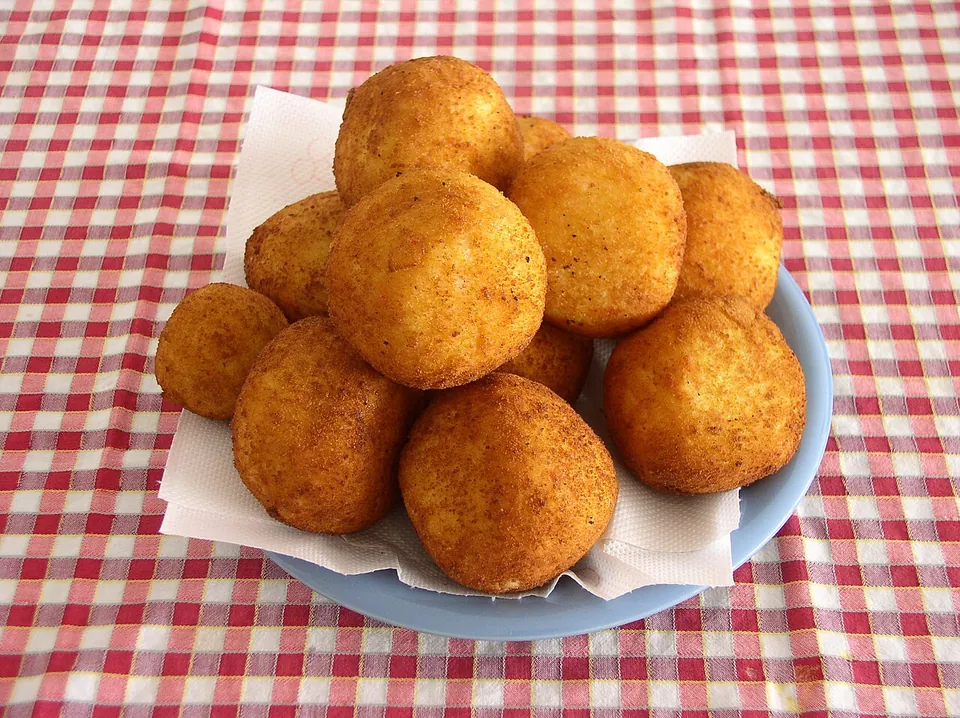
Arancini, Sicily's rice croquettes. When they took their present breaded-and-fried form is unsettled, and even the name divides across the island, masculine in the east and feminine in the west.
Verification highlight popular claim → verdict → evidence
Two competing theories remain unresolved: origin under Arab rule (10th-11th c.) versus an 18th-century southern Italian origin proposed by architectural historian Annette Condello. The Catania (arancino) versus Palermo (arancina) naming dispute is also left unadjudicated by the Accademia della Crusca, which accepts both forms as valid. Key sources: Traina's 1868 Sicilian-Italian dictionary and the Accademia della Crusca.
The three gates
- Ingredient-supply gate
- Rice was introduced to Sicily under Arab rule (9th-11th c.), which sets the limiting date; saffron arrived via the same route. Tomato-filled versions are a later variant that postdates the arrival of New World tomatoes.
- Cooking-technique gate
- Shaping rice into balls, coating, and deep-frying.
- Venue gate
- An Arab-derived court dish that later became a street-food staple sold at rosticcerie.
Overview
Arancini are a Sicilian specialty: saffron-tinted rice pressed into a ball or a cone, stuffed with mozzarella or the like, and fried in a coat of breadcrumbs. Because the shape and color recall an orange, the name comes from the diminutive of aranciu, the Sicilian word for orange.
Rice reached Sicily with Islamic agriculture and its irrigation techniques during the period of Arab rule that began in the ninth century, and saffron came by the same route. That crossing, in the ninth to eleventh centuries, gives the earliest possible date for the dish. It does not mean that the breaded and fried form of today was complete at that time.
Views differ on when the present form took shape. A common account holds that a prototype, a dish of pressed rice, arose in the period of Arab rule. The architectural historian Annette Condello, on the other hand, places today's breaded and fried form, and in particular the classic filled with a tomato-and-meat ragù, in eighteenth-century southern Italy. She sees it as a scaled-down version of the towering rice timbales made by French cooks in the Baroque aristocratic kitchens of the Bourbon era. In the written record, Giuseppe Biundi's Sicilian-Italian dictionary of 1851 lists arancinu as "a sweet dish of rice made in the shape of an orange." Antonino Traina's New Sicilian-Italian Dictionary of 1868 gives arancinu as a kind of dish and sends the reader to crucchè, small croquettes made of rice, potato or the like. Neither dictionary says the dish is coated and fried, and what they record does not settle whether the sweet rice dish of 1851 is the same thing as today's arancini.
How we know
The first thing that snags you about arancini is the name. In Catania, in eastern Sicily, it is masculine, arancino (plural arancini), and shaped into a cone. In Palermo, in the west, it is feminine, arancina (plural arancine), and rolled into a sphere. The same dish goes by different genders on the two sides of the island.
Standard Italian has a convention of setting the masculine name of a tree against the feminine name of its fruit, and from that comes a persistent view that arancina, after the orange fruit, is the correct form. But the Accademia della Crusca, the authority on the Italian language, recognizes both forms as valid. This is a matter of regional usage, it concludes, and neither form is a mistake; it awards the point to neither side.
Nor is the timing settled. The Arab-period origin and the eighteenth-century Baroque origin stand side by side, neither with decisive evidence. The written trail goes back as far as dictionaries of the mid-to-late nineteenth century that list a rice dish named arancinu; when and where today's breaded and fried form came together remains an open question. Its date unsettled, and its name correct in both the eastern and the western form, this rice croquette is loved in each place in its own way.
The full set of origin theories and the detailed verification log — traceable all the way to their sources — are available on the Japanese edition.
See the full origin theories and verification log (Japanese) →
Related dishes
Shares the key ingredient
- BiryaniSouth Asia (Deccan / Mughal)C
- DosaSouth India (Tamil Nadu / Karnataka)C
- PaellaValencia, SpainB
- Risotto alla milaneseMilan (Lombardy, Italy)B
- Nasi gorengIndonesia (Java)C
- JambalayaNew Orleans (Louisiana, USA)C
- MujaddaraLevant (Syria, Lebanon, Palestine)B
- DoriaYokohama, JapanB
- IdliSouth IndiaC
- MaqlubaPalestine / LevantC
- White mixed rice (hondon-ban / goldong-ban)Korean PeninsulaC
- MandiHadhramaut (Yemen)C
- Rice and native-grain upma (sada upma, before semolina)South IndiaC
- KiribathSri LankaD
- KabsaSaudi ArabiaC
- PlovUzbekistan (Samarkand / Fergana)C
- MachboosPersian Gulf (Bahrain / Kuwait)B
- Gallo pintoCosta Rica / NicaraguaC
- Dal bhatNepalC
- KoshariEgyptC
- PilauEast Africa (Swahili Coast)C
- Rice-and-lentil koshari (before pasta and tomato)EgyptC
- Bánh cuốnVietnamB
- MahshiEgyptB
- PolowIranC
- PulaoNorth IndiaB
- PilavAnatoliaC
- Kabuli palawAfghanistanC
- Pilaf (French)FranceC
- Pilaf (Japanese-style)JapanC
- Arroz de mariscoAlgarve (Portugal)C
- CasadoCosta RicaC
- Nan gyi thokeMyanmarC
- Mont diMyanmarC
- Mazbi (madhbi)Yemen (Hadhramaut)C