All dishes / Central Asia
Kabuli palaw Period COrigin theory CVerified
Some fields (dish name, region and gates) are shown from the Japanese-edition data.
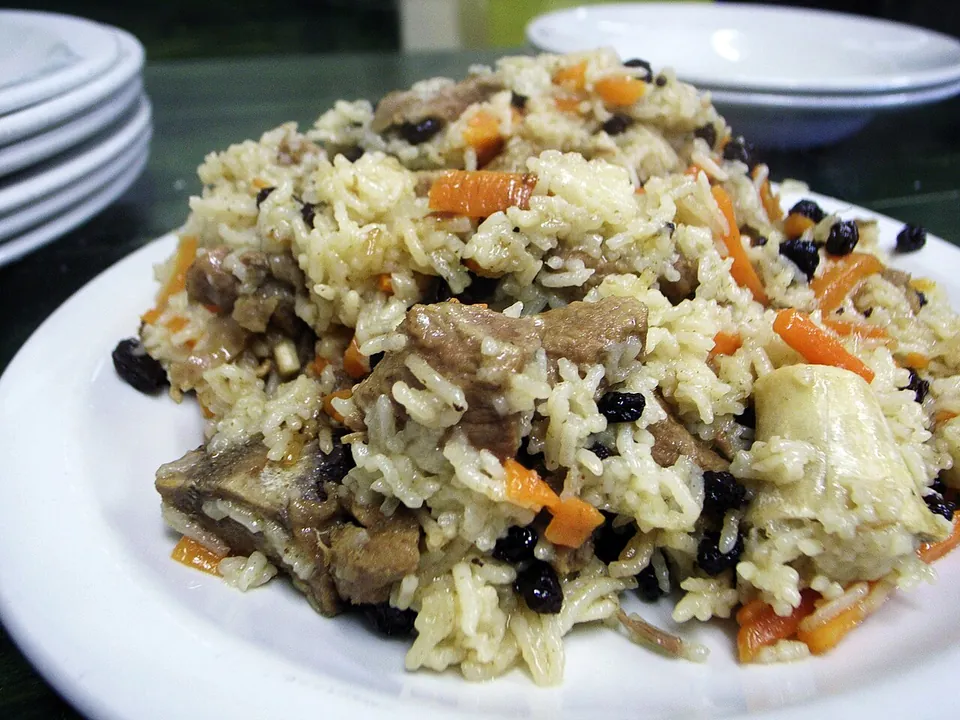
Rice heaped with sweetly fried carrots and raisins and tender lamb, Kabuli palaw is the national dish of Afghanistan. Its name means "of Kabul," yet accounts of where it was born disagree: one credits the upper-class households of Kabul, another the border with Uzbekistan in the north.
Verification highlight popular claim → verdict → evidence
The name means 'of Kabul', but accounts of the birthplace disagree: an article by Humaira Ghilzai, who writes about Afghan food, credits the upper-class families of Kabul, while the English-language Wikipedia places it on the border of northern Afghanistan and Uzbekistan. Neither cites a source, and no record has yet been found that says when the dish took its present form.
The three gates
- Ingredient-supply gate
- Rice reached Afghanistan through Old World trade and became established there; the dish depends on rice farming and the grain trade.
- Cooking-technique gate
- Rice is cooked in stock until it takes up the liquid, then layered with carrots and raisins fried until sweet and with lamb, in the Kabuli palaw manner.
- Venue gate
- Today the main dish at celebrations in Afghanistan (writers on Afghan food call it the national dish). Where it began is unsettled: one account places it in the homes of Kabul's upper classes, another on the border between northern Afghanistan and Uzbekistan, and neither cites a source.
Overview
Kabuli palaw is a rice dish: rice cooked in stock, topped with carrots and raisins fried until sweet and with lamb stewed until tender. Counted as Afghanistan's national dish, it is the main course at celebrations. It belongs to the family of palaw, or pilaf, the rice dishes of Persia and Central Asia.
Rice, the heart of the dish, came to Afghanistan through Old World trade and settled onto its tables with the help of local rice farming and the grain trade. The cooking runs across several pots. The rice simmers in stock until it has taken up all the liquid; the carrots and raisins are fried sweet in another pan; the lamb is stewed until soft. Finally everything is layered over the rice and served as one dish.
How we know
There are two accounts of where Kabuli palaw was born. One comes from an article by Humaira Ghilzai, who writes about Afghan food and culture. In her telling, the dish was created by the upper-class families of Kabul, who could afford to put caramelized carrots, plump raisins and prized nuts into their rice. As people in Afghanistan grew wealthier, the dish became more common, and its name changed from Kabuli ("of Kabul") to Qabili. The Dari word qabil, she explains, means "well accomplished."
The other account is in the English-language Wikipedia. Although the dish is called "Kabuli" in English, it says, it did not originate in Kabul and more likely arose on the border between northern Afghanistan and Uzbekistan. The two accounts disagree about the place, and neither cites a source. No record supporting either has yet been found.
Going back through older cookbooks leads to the Kār-nāma of 1521, the oldest surviving cookbook in Persian. It devotes six chapters to rice dishes, but whether the Kar-nama contains this dish's name, or rice layered with carrots and raisins, has not yet been checked in the original text. For neighboring Iran, the polow (rice) recipes in sixteenth-century Safavid cookbooks are said to differ from those cooked today, and today's methods seem to have begun in the later Qajar period. That observation concerns Iranian polow, though, and says nothing about the date of Kabuli palaw.
English cookbooks have not turned up the name either. The English-language cookbooks written for the British in India between the mid-eighteenth and early twentieth centuries carry plenty of pilaf recipes and mention Kabul's apricots and raisins, yet no pilaf bearing Kabul's name has surfaced in them so far.
When and where rice first came to be layered with carrots and raisins in today's manner is a question no source found so far has answered.
The full set of origin theories and the detailed verification log — traceable all the way to their sources — are available on the Japanese edition.
See the full origin theories and verification log (Japanese) →
Related dishes
Cross-links Sister dishes & same-name dishes (separate lineage)
Shares the key ingredient
- BiryaniSouth Asia (Deccan / Mughal)C
- DosaSouth India (Tamil Nadu / Karnataka)C
- PaellaValencia, SpainB
- Risotto alla milaneseMilan (Lombardy, Italy)B
- Nasi gorengIndonesia (Java)C
- JambalayaNew Orleans (Louisiana, USA)C
- MujaddaraLevant (Syria, Lebanon, Palestine)B
- DoriaYokohama, JapanB
- IdliSouth IndiaC
- MaqlubaPalestine / LevantC
- White mixed rice (hondon-ban / goldong-ban)Korean PeninsulaC
- MandiHadhramaut (Yemen)C
- Rice and native-grain upma (sada upma, before semolina)South IndiaC
- KiribathSri LankaD
- KabsaSaudi ArabiaC
- PlovUzbekistan (Samarkand / Fergana)C
- MachboosPersian Gulf (Bahrain / Kuwait)B
- Gallo pintoCosta Rica / NicaraguaC
- Dal bhatNepalC
- KoshariEgyptC
- PilauEast Africa (Swahili Coast)C
- Rice-and-lentil koshari (before pasta and tomato)EgyptC
- Bánh cuốnVietnamB
- MahshiEgyptB
- PulaoNorth IndiaB
- PilavAnatoliaC
- Pilaf (French)FranceC
- Pilaf (Japanese-style)JapanC
- Arroz de mariscoAlgarve (Portugal)C
- CasadoCosta RicaC
- Nan gyi thokeMyanmarC
- Mont diMyanmarC
- AranciniSicily (Italy)C
- Mazbi (madhbi)Yemen (Hadhramaut)C